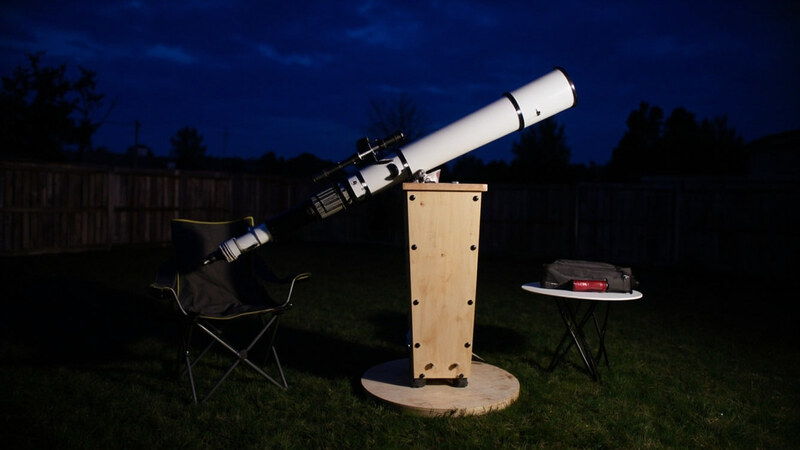
8-Inch Dobsonian Telescopes Compared
Aperture alone does not separate two 8 inch Dobsonian telescopes. Every model on this page carries 203 mm (8 in) of aperture on a 1,200 mm tube at f/5.9. Each one gathers (203 ÷ 7)² = 841 times the light of a 7 mm pupil. The ceiling is 2 × 203 = 406x on all of them, and the floor is 203 ÷ 7 = 29x.
So what you choose is the tube, the base, the finder and the weight. A solid tube against a collapsible one. A finder you aim by hand against a motor that aims for you. Forty pounds against fifty-seven to lift out of the car.
The four models are compared on their spec sheets, side by side. The optical numbers are fixed by the 203 mm mirror.
The optical columns come from one division on 203 mm and 1,200 mm. The model columns come from four maker listings, each checked 2026-11-02.
What 8 inches of aperture gives you
Our assumptions come first, because every other number here is built on them. A 203 mm mirror on a 1,200 mm tube at f/5.9. A 7 mm dark-adapted pupil for the light figure.
A Dawes limit of 116 ÷ aperture in mm. A 52° apparent field for the eyepieces below. Change the focal length and the powers move. Change nothing and the whole page holds.
Light grasp is aperture ÷ 7, squared. 203 ÷ 7 = 29, and 29² = 841. That is the light an 8-inch Dobsonian telescope gathers against a 7 mm dark-adapted pupil. The Classic 200 listing prints the same figure from the other end, a faintest stellar magnitude of 14.2.
Resolution follows 116 ÷ 203 = 0.57 arcsec. That is the Dawes limit, the point where two points of light stop being two. It belongs to the mirror, not to the sky, and raising the magnification does not move it.
Power has two ends. The floor is 203 ÷ 7 = 29x. Below that, the exit pupil grows wider than the eye can use. The ceiling is 2 × 203 = 406x. Above that, you magnify the seeing instead of the image.
The dark-sky star limit is 2.7 + 5 log10(203) = 14.2 magnitudes. A Bortle 6 yard reaches a smaller number, because the sky adds its own glow to the target. The mirror does not change between sites. The sky does.
Three eyepieces cover almost every night on this telescope. A 25 mm gives 1,200 ÷ 25 = 48x. A 10 mm gives 120x. A 6 mm gives 200x.
The exit pupil is aperture ÷ power, so those three sit at 203 ÷ 48 = 4.2 mm, 203 ÷ 120 = 1.7 mm and 203 ÷ 200 = 1.0 mm.
The true field follows the same habit. 52° ÷ power gives 1.08°, 0.43° and 0.26°. At 48x the 1.08° field swallows the 0.52° disc of the Moon with room to spare.
At 200x the field is a quarter of a degree wide, which is why the 6 mm step is for detail and not for finding.
The 4.2 mm beam at 48x is about as wide as the eye uses. The 1.0 mm beam at 200x is a thin pencil of light. It rewards steady air. The 1.7 mm step in between is where planetary detail shows up.
Two misconceptions sit behind most of the numbers on a box. The first is that magnification adds light. It does not. Power only magnifies what the 203 mm mirror already collected, and past 406x it magnifies the seeing instead.
The second is that a faster focal ratio means a brighter image. Focal ratio changes the beam, not the light. On the 1,200 mm f/5.9 tube a 25 mm eyepiece gives a 4.2 mm exit pupil, because 25 ÷ 5.9 = 4.2.
The same 25 mm on a 1,270 mm f/5 tube gives 5.0 mm, because 25 ÷ 5 = 5.0. The exit pupil is the only thing the focal ratio touches.
Now take a number off a box. Printed magnification is telescope focal length ÷ eyepiece focal length, sometimes with a Barlow multiplied in. Divide first, compare second.
On a 1,200 mm tube a box that claims 600x implies a 2.0 mm eyepiece. 1,200 ÷ 600 = 2.0. A box that claims 800x implies 1.5 mm, because 1,200 ÷ 800 = 1.5.
Both numbers fail twice over. A 2.0 mm or a 1.5 mm eyepiece sits below the 4 mm practical floor, so the beam is narrower than the pupil and the image turns grey.
And 600 ÷ 406 = 1.5, so the claim is one and a half times past the ceiling of a 203 mm mirror.
Our magnification calculator runs the same division on any focal length and prints the ceiling beside it. The number on the box is a printing job. The 406x comes out of the aperture.
| Model | 25 / 10 / 6 mm | Tube | Finding | Focuser | Weight | Box length |
|---|---|---|---|---|---|---|
| Sky-Watcher Classic 200 (S11610) | 48x · 120x · 200x 4.2 · 1.7 · 1.0 mm | Solid | 9x50 straight | 2 in Crayford | 45 lb | 49 in |
| Sky-Watcher Flextube 200 (S11700) | 48x · 120x · 200x 4.2 · 1.7 · 1.0 mm | Collapsible | 8x50 right-angle | 2 in Crayford | 40 lb | 36 in |
| Sky-Watcher S11800 GoTo Collapsible | 48x · 120x · 200x 4.2 · 1.7 · 1.0 mm | Collapsible | 9x50 + controller | 2 in Crayford | 57 lb | 49 in |
| Celestron StarSense Explorer 8" | 48x · 120x · 200x 4.2 · 1.7 · 1.0 mm | Solid | Phone dock | Not listed | 43.4 lb | 49 in |
Read that table by the columns that change. The optical set is identical on all four rows — 203 mm of aperture on a 1,200 mm tube at f/5.9, the same 48x, 120x and 200x steps — because one 203 mm mirror sets all of it.
The columns that move are tube type, finding method, focuser, weight and box length. One cell is read rather than quoted: the Celestron listing does not name the tube, so its 49 in box length does the work. It matches the two solid-tube models and not the 36 in of the collapsible one. Each box lists one item, and each Dobsonian is still two pieces: a tube and a base.
One number deserves a second look. The Flextube lists 36 in as its box length, against 49 in for the other three. That 13 in difference in the box is the whole argument for a collapsible tube.
Pick by where you observe
Two different limits decide where an 8-inch Dobsonian earns its place. Aperture sets the brightness ceiling: 841 times the light of a 7 mm pupil, 14.2 magnitudes against a dark background.
Seeing sets the resolution ceiling: when the air smears stars across 2 arcsec, a 0.57 arcsec mirror is idle.
That split explains why the same telescope can be right for a garden and wrong for a field. In the city you are buying light and stability.
At a dark site you are buying resolution and reach. The table below maps each situation to the one parameter that decides it.
| Situation | Parameter to read | Key number | Model row |
|---|---|---|---|
| Dark site, manual pointing | Light grasp and star limit | 841×, 14.2 mag | Classic 200 |
| Suburban yard or balcony | Aperture and finder method | 203 mm, 43.4 lb | StarSense Explorer 8" |
| One person carries it | Collapsed length and weight | 85 cm (33.5 in), 40 lb | Flextube 200 |
| Motorised pointing | Object database and base weight | 42,000+, 57 lb | S11800 GoTo |
| Boot or garage storage | Collapsed length | 85 cm | Flextube 200, S11800 GoTo |
Start with the dark site, because that is where the numbers stop being an argument and start being the whole case. At a Bortle 3 or 4 sky the 841 times light figure is what you are paying for.
The 14.2 magnitude limit is what it buys. Stars between 13.6 and 14.2 magnitudes, the band a 150 mm mirror stops short of, in a sky where the air is often steady enough to use the 0.57 arcsec Dawes limit.
Nothing at that site requires a motor. A chart, a bright starting point and a straight-through finder are enough to walk to a target. The Classic 200 keeps a solid tube that needs no struts folded on the way home. This is the reading to make if the trip itself is the point.
The suburban yard is a different calculation. A garden, a balcony, a driveway: the mirror is the same and the sky is not. Here the brightness limit still comes from the mirror.
The resolution limit comes from the sky. On a typical night with 2 arcsec of seeing, no aperture turns the 0.57 arcsec Dawes figure into visible detail.
What a suburban yard rewards is finding a target without spending an hour on it. That is an argument for a phone-guided base and a manual alt-azimuth mount, not for a heavier motorised one.
The phone does the pointing, the base stays light, and 43.4 lb is still a two-piece carry.
There is a second reason the yard favours a guided scope. A suburban sky changes hour by hour, and the faint stuff that a 203 mm mirror can reach is exactly the stuff you will not recognise by eye.
Pointing at it first and looking second keeps the glass on the target.
The weight column separates the four models fastest. The listings run from 40 lb for the collapsible manual tube to 57 lb for the motorised one.
A 17 lb spread is 42.5 percent of the lightest kit, and it arrives in the two pieces you carry to the car.
One row of the table is worth reading twice. The garage row asks for the collapsed length. That is the number that decides whether the tube fits down the side of the house or in the boot of a hatchback. The packed box length in the listing is a different measurement, and it decides whether the box fits.
Now the transport question, which is where a lot of 8-inch decisions are actually made. A solid tube is 49 in as the listing measures the packed box, and about 120 cm in use on the maker drawing.
It needs a car with the back seats down and a second pair of hands at the far end.
A collapsible tube folds its struts and drops to about 85 cm stored on the maker drawing, which is 33.5 in. The listing measures the packed box at 36 in, a different number. The Flextube 200 is that tube: 40 lb assembled, 24 lb of it in the tube and 26 lb in the base. The saving is 13 in of packed length and 5 lb against the solid tube. The cost is a procedure. Every time the struts go back in, the mirrors need checking again.
Set the scope up once at home, then check it again at the site. The second check buys back the 13 in of packed length.
The last situation is the one the motor is built for: pointing without a chart, a phone or a finder. A GoTo base stores coordinates and drives the tube to them.
That is a different job from the optical one. It is paid for in pounds, cables and a battery that has to be charged before you leave.
Read the numbers in the GoTo section below before deciding. The step from a manual base is the largest single jump on this page: 12 lb of kit, and none of it in the optics.
Collapsible tubes and what they cost you
The figure below shows the geometry that decides this. A solid tube stands about 120 cm tall in use on the maker drawing, because 1,200 mm of focal length plus the focuser travel has to fit somewhere.
The collapsible version folds its struts and stores at about 85 cm on the same drawing. The mirror is 203 mm in both cases. Only the tube around it changes.
Two numbers carry the trade. Length: 120 cm in use against 85 cm stored on the maker drawing, a difference of 35 cm, or 13.8 in. The listing reports 13 in, and that is a different measurement: the gap between two packed boxes, 49 in against 36 in.
Weight: 40 lb for the collapsible kit against 45 lb for the solid one, a 5 lb difference.
Split the listing weights and the picture sharpens, though the numbers do not reconcile. The Flextube lists 24 lb of tube and 26 lb of base on a 40 lb kit, and those two parts add to 50 lb. The Classic 200 does add up: 20 lb of tube and 25 lb of base on 45 lb.
So the collapsible tube is the heavier of the two tubes and the lighter of the two kits. Plan with the kit figure, 40 lb against 45 lb, and read the split as a question for the maker's page.
What you give up is the second half of the word collapsible: it is a procedure, not a box. The Sky-Watcher listing for the Flextube puts it plainly.
The strut design lets the optical tube collapse for portability while keeping collimation. Keeping it collimated means checking the mirrors again after each collapse.
A temperature swing does the same thing to a tube that never collapsed. So the rule is simple, and it is not about the model.
Check the collimation when you assemble the scope, check it again after a collapse, and check it again when the tube has sat in a cold car. Three checks is the price of the 35 cm.
How often you collapse it decides how often you check it. A scope that lives in a car boot and goes out once a month is checked once a month.
A scope that is carried to a field every clear evening is checked every evening, and at that rate the checking becomes the hobby. The length saving is worth less than it looks if you pay for it with a nightly ritual.
GoTo, app-guided, and manual mounts
Three ways of finding a target sit on this page, and all three use the same mirror. Manual pointing is a chart, a finder and your own hands.
App guidance is a docked phone that recognises the sky above you and draws arrows, while the mount stays by hand. GoTo is a hand controller, a database of coordinates and two motors that move the tube for you.
The optical numbers do not change between the three. What changes is the base: its weight, its height, and how much of the night goes into pointing instead of looking.
| Finding method | Power needed | Assembled weight | Tube | Eyepieces included | Finder | Suits |
|---|---|---|---|---|---|---|
| Manual, chart and finder | None | 45 lb | Solid | 25 mm, 10 mm | 9x50 straight-through | Dark sites, planned targets |
| App-guided, manual base | Phone battery | 43.4 lb | Solid | Not listed | Phone dock | Suburban yards, unplanned nights |
| Manual, collapsible tube | None | 40 lb | Collapsible | 25 mm, 10 mm | 8x50 right-angle | One-person transport |
| GoTo, hand controller | Battery, cable | 57 lb | Collapsible | 25 mm, 10 mm | 9x50 plus controller | Large object lists, faint targets |
The weight column is where the decision hides. The manual solid tube is 45 lb. The app-guided one is 43.4 lb, lighter than the manual solid tube because the drive is a phone and the base stays by hand. The S11800 GoTo is 57 lb: 24 lb of tube and 33 lb of base, against 20 lb and 25 lb on the manual solid tube. The extra 8 lb of base is the motor, the gears and the battery, and the 4 lb of extra tube is the collapsible strut design.
You pay for the pointing in three currencies. Pounds, at 57 against 45. Battery, which has to be charged before the drive out.
And collimation, because a motorised base still needs its mirrors checked, and the wiring is one more thing to carry and one more thing to set up.
A database does not remove the sky from the job. It removes the coordinate reading, the chart flipping and the searching.
The target still has to be faint enough to be worth the drive, and it still has to be above the horizon when you get there. A motor points well at an object you already chose.
The finder decides how much of the night goes into pointing. A red dot shows no magnification at all, so it works only if you already know where the target is. A straight-through finder magnifies 9 times, which is a narrow field and a steady aim.
It is what the Classic 200 and the GoTo both ship with. The 8x50 right-angle on the Flextube turns the image through 90°, so you look down into it. Its field is about 6° of sky.
The phone dock is a third kind of finder again. It shows the whole sky on a screen and matches the pattern above you. That is why the app-guided model makes sense in a yard where you do not know the sky yet.
What to check on the spec sheet
Start with the label, because that is where the numbers go wrong. Divide 1,200 mm by the printed power and you get the eyepiece the maker is claiming.
1,200 ÷ 600 gives 2.0 mm, which is under the 4 mm floor. And 600 is already 1.5 times the 406x ceiling. If the division lands in the wrong place, the number is decoration.
The eyepieces in the box come next. Three of the four models ship with a 25 mm and a 10 mm, which on 1,200 mm are 48x and 120x. That is a sensible low pair, and it leaves the 200x step open. A 6 mm is the one worth adding later. Our eyepiece guide works out which focal lengths close the gaps, and the eyepiece kit comparison covers the sets.
Then the focuser, because it decides what will ever fit in the tube. The three Sky-Watcher models list a 2 in Crayford-style focuser with a 1.25 in adapter.
An adapter only runs one way. A 1.25 in eyepiece drops into a 2 in focuser, and a 2 in eyepiece does not go into a 1.25 in one.
Weight comes next, and it comes in pieces rather than as one lump. The listings split tube from base: 20 lb and 25 lb on the Classic 200, 24 lb and 26 lb on the Flextube, 24 lb and 33 lb on the GoTo. The Flextube listing is the one that does not add up, as the collapsible section shows.
Two pieces means two carries, and the base is the one that keeps its shape in your hands.
The finder form comes after that, because it decides how long pointing takes. A 9x50 straight-through finder magnifies 9 times and gives a narrow, upright field.
The 8x50 right-angle on the Flextube turns the image through 90°, and its field is about 6° of sky. A phone dock shows the whole sky on a screen and matches the pattern above you.
Last, the tube. A solid tube gives a fixed, square structure with no struts to fold. A collapsible tube folds to about 85 cm stored on the maker drawing, and its packed box is 36 in. It needs its collimation checked again after every collapse, which is the trade the length saving is paid with.
One job is shared by every owner, so it is worth one sentence. After you assemble the scope, or after it has stood through a temperature change, check that the mirrors still line up.
Skipping that check is what turns a good night into a poor one.
8-inch or 10-inch
The step up is arithmetic, not opinion. A 254 mm (10 in) mirror gathers (254 ÷ 7)² = 1,317 times the light of a 7 mm pupil, against 841 for the 8-inch.
Its Dawes limit is 116 ÷ 254 = 0.46 arcsec against 0.57. Its ceiling is 2 × 254 = 508x against 406x.
So the 10-inch buys 1.57 times the light, 0.11 arcsec of resolution and 102x more headroom at the top.
The weight is the other side of the ledger. The StarSense Explorer 10 lists 54.8 lb assembled, against 40 lb to 57 lb for the four 8-inch models here.
The field barely moves. That 10-inch runs 1,200 mm at f/4.7, so a 25 mm eyepiece gives 48x and the same 1.08° field as the 8-inch. The difference is in the beam: 5.3 mm against 4.2 mm.
Same field, same power, a 1.1 mm wider pencil of light. And 54.8 lb is lighter than the motorised 8-inch kit on this page, so the step up buys glass rather than a heavier carry.
If the weight in the car is the question rather than the sky, the 6-inch is the other end of the same line. A 150 mm mirror at f/8 gathers 459 times the light, resolves 0.77 arcsec and tops out at 300x. Our 10-inch page and our 6-inch page run the same formulas at 254 mm and 150 mm.
Common Questions
Can an 8-inch Dobsonian show Saturn's rings?
Yes. The rings span about 43 arcsec across, so at 48x the shape is obvious well before the detail is. The Cassini Division is 0.74 arcsec wide. That sits close to the 0.57 arcsec Dawes limit of a 203 mm mirror, so it needs 150x to 200x and steady air. Our 8-inch page works through the rest of the target list.
Can one person carry an 8-inch Dobsonian?
Yes, in two pieces, and the split is on the spec sheet. The lightest kit here is the 40 lb collapsible manual tube.
The heaviest is 57 lb, a 24 lb tube and a 33 lb base. Neither is a single-lift job. The base is the awkward one, because a tube is easy to tip and a base is not.
How long does an 8-inch Dobsonian take to set up?
Two pieces means two lifts, plus the collimation check. A solid tube goes together as it came out of the box, so the time goes on the check rather than on assembly.
A collapsible tube adds the strut fold and the second check afterwards. That is where the extra work lives.
What does a GoTo add to a manual Dobsonian?
A database and two motors. The SynScan controller on the GoTo model holds more than 42,000 objects and drives the tube to them.
You are not reading coordinates off a chart. The cost is 8 lb on the base, a battery to charge and a cable to carry. The mirror and the optics are identical.
Can a Dobsonian telescope take photos?
Not long exposures from the stock base. The alt-azimuth mount does not track, so the field drifts across the sensor while the exposure runs.
A target that fits in one frame, or a stack of short exposures, is the way it is used. Longer work needs a mount that tracks, and that is a different instrument.
What does 800x on the box actually mean?
Divide 1,200 mm by 800 and you get the eyepiece the maker is claiming: 1.5 mm. That is under the 4 mm practical floor, so the beam never fills the pupil and the view turns grey.
It is also 2 times past the 406x ceiling of a 203 mm mirror. The printed power is a division you can undo.
Read next
- What you can seeWhat an 8-inch telescope shows
- EyepiecesHow to choose telescope eyepieces
- ToolsTelescope magnification calculator
- TelescopesDobsonian, refractor, Maksutov and smart
- What you can seeWhat a 10-inch telescope shows
- What you can seeWhat a 6-inch telescope shows
- EyepiecesTelescope eyepiece kits compared
- Aperture guideWhat size telescope do you need?
- MethodHow we research and calculate
Sources
- Formulas used on this page. Power = focal length ÷ eyepiece. Exit pupil = aperture ÷ power. Light grasp = (aperture ÷ 7 mm)². Dawes limit = 116 ÷ aperture in mm. Maximum useful power = 2 × aperture in mm. Minimum useful power = aperture ÷ 7. True field = apparent field ÷ power. Limiting magnitude = 2.7 + 5 log10(aperture in mm). Our method page lists each one with its source.
- Sky-Watcher Classic 200 (S11610) listing, checked 2026-11-02. It lists 1,200 mm max focal length, 94% reflective mirrors, a faintest Steller magnitude of 14.2, a 2 in Crayford-style focuser with a 1.25 in adapter, 25 mm and 10 mm eyepieces, a 9x50 straight-through finder, 45 lb assembled (20 lb tube, 25 lb base), 49 × 18 × 27 in, 1 piece, white. The maker does not state a material.
- Sky-Watcher Flextube 200 (S11700) listing, checked 2026-11-02. It lists a collapsible strut design, 94% reflective mirrors, a 2 in Crayford-style focuser with a 1.25 in adapter, 25 mm and 10 mm eyepieces, an 8x50 right-angle finder, 40 lb assembled (24 lb tube, 26 lb base), 36 × 26 × 19 in, a listed weight of 27 lb, 1 piece, white and black. The maker does not state a material. The tube and base weights on this listing do not add up to the 40 lb kit figure, and the page quotes both as printed.
- Sky-Watcher S11800 GoTo Collapsible listing, checked 2026-11-02. It lists built-in WiFi, a SynScan hand controller with a 42,000+ object database, DC servo motors with all-metal gearing, a 2 in Crayford-style focuser with a 1.25 in adapter, 25 mm and 10 mm eyepieces, a 9x50 finder, 57 lb assembled (24 lb tube, 33 lb base), 49 × 27 × 14 in, a listed weight of 55 lb, 1 piece, white. The maker does not state a material.
- Celestron StarSense Explorer 8" listing, checked 2026-11-02. It lists a 203 mm Newtonian with XLT coatings, a phone dock with the StarSense app, a manual alt-azimuth base, 43.4 lb, 49 × 18.5 × 19 in, 1 piece, silver, a 2-year warranty. The maker does not state a material and does not state a focuser. Its 1,200 mm focal length at f/5.9 is recorded from the Celestron spec sheet on our telescope types page, checked 2026-10-17. The solid tube in the table is read from its 49 in packed length, which matches the two solid-tube models and not the 36 in of the collapsible one.
- Celestron StarSense Explorer 10" listing, checked 2026-11-02. It lists 54.8 lb assembled, 51 × 21 × 21 in, 1 piece. The 10-inch optical figures come from our 10-inch page, checked 2026-10-17: 254 mm, 1,317 times the light of a 7 mm pupil, a 0.46 arcsec Dawes limit, a 508x ceiling, on a 1,200 mm tube at f/4.7.
- Optical figures for the 203 mm class come from our 8-inch page, checked 2026-10-17. They are 841 times the light of a 7 mm pupil, a 0.57 arcsec Dawes limit, a 406x ceiling, a 29x floor, and a 14.2 magnitude dark-sky limit. The same page carries the 0.52° disc of the Moon, the 43 arcsec span of the Saturn rings and the 0.74 arcsec Cassini Division used in the questions below.
- Finder fields are read off our finder chart: a red dot with no magnification, an 8x50 right-angle at about 6°, and a phone dock that shows the whole sky on screen.
- The 150 mm figures come from our 6-inch page, checked 2026-10-17: 459 times the light of a 7 mm pupil, a 0.77 arcsec Dawes limit, a 300x ceiling and a 13.6 magnitude dark-sky limit.