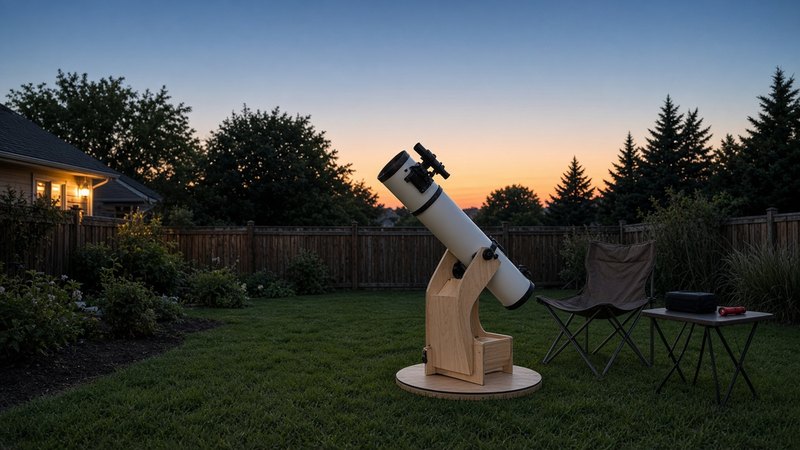
What Can You See With an 8-Inch Telescope?
A 203 mm (8 in) mirror gathers 841 times the light of a 7 mm pupil, with a Dawes limit of 0.57 arcsec.
With an 8 inch telescope you can see Saturn's rings and, on steady nights, the Cassini Division at the ring tips, Jupiter's belts, and M13 broken into stars at its edge.
A dark site reaches all 110 Messier objects. Under a Bortle 6 to 7 sky the faint galaxies drop away, and the planets and the Moon remain.
Use 2 arcsec of seeing for your town sky. Use 1 arcsec when you drive to a dark site.
- Aperture
- 203 mm (8.0 in)
- Light grasp vs 7 mm pupil
- 841 times
- Dawes limit
- 0.57 arcsec
- Rayleigh limit at 550 nm
- 0.69 arcsec
- Limiting magnitude, dark sky, stars
- 14.2
- Max useful power
- 406x
- Min useful power
- 29x
- Typical focal length
- 1,200 mm (f/5.9 Dob)
Light grasp is (203 / 7) squared. Dawes is 116 / 203. The power cap is 2 times 203. Magnitude is 2.7 + 5 log10(203).
A 6 in mirror is 152 mm. (203 / 152) squared is 1.78. You get that much more light than a 6 in, and a 10 in beats this one by 1.57.
Planets and the Moon
The mean Moon is 0.52 degrees across.
A 25 mm eyepiece at 1,200 mm gives you 48x. A 52 degree apparent field then covers 52 / 48 = 1.08 degrees. That is about 2 Moon widths.
Swap to 10 mm and you are at 120x. The true field drops to 0.43 degrees. One Moon no longer fits. A 6 mm eyepiece is 200x and 0.26 degrees.
Your exit pupil tracks the same steps. 203 / 48 = 4.2 mm. 203 / 120 = 1.7 mm. 203 / 200 = 1.0 mm. Under 0.5 mm the image goes dim and empty.
0.57 arcsec at 384,400 km is 1.1 km. A 2 arcsec night is coarser: about 3.7 km.
A 93 km crater such as Copernicus spans about 50 arcsec. That is roughly 90 times the Dawes limit. At 80x the walls and the floor are separate shapes.
At 120x that 50 arcsec crater subtends 1.7 degrees at your pupil. The whole Moon, unaided, is 0.52 degrees. The crater looks about 3 times wider than that.
Rilles are the harder lunar target. A 1 km rille matches the 0.57 arcsec optics and loses to 2 arcsec seeing. You want the terminator and air under 1 arcsec.
Full phase is the glare problem. Surface brightness scales with exit pupil squared. From 4.2 mm at 48x to 1.7 mm at 120x is a factor of 6.1.
2.5 log10(6.1) is about 2.0 magnitudes. So 120x dims the lunar surface about as much as a filter that passes about 16 percent. The field shrinks with that power.
A neutral-density filter is rated by the percent it passes. The magnitude drop is 2.5 log10(100 / T). At 13 percent the drop is 2.2 magnitudes.
At 25 percent the drop is 1.5 magnitudes. The filter leaves the 0.57 arcsec limit where it is and cuts glare. Most eyepieces for these scopes take 1.25 in filters.
Many focusers also take 2 in eyepieces. A 1.25 in filter still fits the smaller barrel. The moon filter page sorts transmission by aperture.
Jupiter's disk runs about 30 to 50 arcsec. At 48x you see a bright oval and four moons as points. You will want 100x to 180x on the belts.
The Great Red Spot is an oval a few arcsec long. On a steady night, 150x to 250x shows that oval.
Seeing writes the real cap. A 2 arcsec blur at 150x covers 300 arcsec at the pupil, which is 5 arcmin. Past about 250x on a 2 arcsec night, the image gets bigger and softer.
The four large moons show at 40x. They are near 1 arcsec across, so disks are only a hint near 200x.
Can you see Saturn with an 8 inch Dobsonian? Yes. The rings show at about 50x. The Cassini Division is a contrast target at the ring tips.
What size telescope to see Saturn's rings? A 60 mm lens at about 50x already shows the ring shape. Two times 60 mm is 120x, so 50x sits under the cap.
An 8 in is 203 / 60 = 3.4 times the diameter. Squared, that is about 11 times the light. The rings show in the 60 mm lens. The 8 in spends that light on the gap and on Titan.
Take a disk of 19 arcsec, close to the 19.7 arcsec disk at the 2026-10-04 opposition. NASA lists the equatorial diameter as 120,500 km. One arcsec is then 120,500 / 19 = 6,342 km.
The Cassini Division is 4,700 km wide, so 4,700 / 6,342 = 0.74 arcsec. It is a dark lane between bright rings. Contrast and seeing set it. At this tilt the lane is hard.
0.74 / 0.57 = 1.3 times the Dawes limit of this 203 mm mirror. 0.74 / 0.76 = 0.97 times the 6 in limit. The 8 in adds light and that margin.
To stretch 0.74 arcsec to 2 arcmin at the pupil, use 120 / 0.74 = 162x, so 150x to 200x is the working power.
Ring span is larger than the disk. The A-ring outer radius is 2.27 times the equatorial radius. A 19 arcsec disk means a 43 arcsec ring span.
43 arcsec at 50x is 2,150 arcsec, or 36 arcmin. The Moon is about 31 arcmin. At 50x the rings look a bit larger than the Moon does with no telescope.
At the 2026-10-04 opposition the rings were tilted 7.45 degrees, and by early December the tilt is about 6.1 degrees.
The short axis is 43 arcsec times sin 7.45 degrees, about 5.6 arcsec.
The Cassini Division is hard at the ansae at this tilt. By mid-2027 the tilt is near 13 degrees and the rings open further.
The Encke Gap is only a few hundred km across, well under 0.1 arcsec, far below the 0.57 arcsec Dawes limit.
Titan sits near magnitude 8.4, bright enough that you can pick it up at 50x beside the planet. Fainter moons want a chart and a darker sky. They stay points.
In October 2026 Mars is only about 6 arcsec across, an orange disk at 100x to 150x. The next opposition is 2027-02-19, an aphelion opposition, and the disk peaks near 13.8 arcsec. The north polar cap shows then at 150x to 200x in steady air.
Venus shows phase only. The disk runs about 10 to 60 arcsec, so 40x to 100x is enough.
Uranus is magnitude 5.7 and 3.7 arcsec. Neptune is magnitude 7.8 and 2.3 arcsec. You still need a chart for both. At 150x Uranus is a tiny disk.
The box says 675x. That's 900 mm times 3 (a 3x Barlow) divided by 4 mm.
On a 60 mm (2.4 in) lens the ceiling is about 120x, so 675x is not usable. This 203 mm mirror tops out near 406x.
A 2x Barlow on a 10 mm eyepiece acts like a 5 mm eyepiece. Power goes from 120x to 240x. Exit pupil goes from 1.7 mm to 0.85 mm. The aperture stays 203 mm.
| Object | Size | Bortle 6 to 7 | Bortle 3 to 4 | Power |
|---|---|---|---|---|
| Moon, 93 km crater | about 50 arcsec | Walls at 80x | Same, air is the limit | 80 to 150x |
| Jupiter belts | 30 to 50 arcsec disk | Yes | Yes | 100 to 180x |
| Great Red Spot | a few arcsec | Steady air only | Same | 150 to 250x |
| Saturn rings | 43 arcsec span | Yes at 50x | Yes at 50x | 50 to 150x |
| Cassini Division | 0.74 arcsec | Hard in 2026; steady nights only | Hard in 2026; steady nights only | 150 to 200x |
| Titan | mag about 8.4 | Yes | Yes | 50 to 150x |
| Mars, October 2026 | about 6 arcsec | Orange disk | Orange disk | 100 to 150x |
| Mars, February 2027 | peaks near 13.8 arcsec | North cap at 150x to 200x | Same, air is the limit | 150 to 200x |
| Venus phase | 10 to 60 arcsec | Yes | Yes | 40 to 100x |
| Uranus | 3.7 arcsec, mag 5.7 | Tiny disk at 150x | Easier to confirm | 120 to 200x |
| Neptune | 2.3 arcsec, mag 7.8 | Needs a chart | Needs a chart | 150 to 200x |
Suburban glow barely touches this table. Planets are bright. Your deep-sky column is the one that changes.
Deep-sky objects
Nebulae and galaxies look gray at the eyepiece. M42 can show a green-gray tint. Photo colors come from long exposures; the eye at the eyepiece sees gray.
From a dark site the 203 mm mirror reaches all 110 Messier objects and hundreds of NGC targets. The magnitude 14.2 figure is the dark-sky limit for stars, points of light. A galaxy spreads that light over arcminutes.
M31 is magnitude 3.4 and its core shows from a driveway. M101 is about magnitude 7.9 with low surface brightness, so the same driveway often misses it. Total magnitude hides that spread.
Bortle 6 has an unaided limit near magnitude 5.1 to 5.5. Bortle 7 is near 4.6 to 5.0. Bortle 3 to 4 sits near 6.1 to 7.0. John Bortle set those bins in 2001.
Your driveway is probably Bortle 6 or 7. A dark site two hours away is often Bortle 3 or 4. Plan the list for the sky you will actually stand under.
M45, the Pleiades, is magnitude 1.6 and about 110 arcmin across. That is 1.83 degrees. Both skies show the stars. The cluster is wider than most 1.25 in fields.
A 32 mm, 52 degree eyepiece gives 1,200 / 32 = 37.5x. Its 1.25 in barrel caps the field stop near 27 mm, so the true field is 27 / 1,200 times 57.3 = 1.29 degrees. The Pleiades still spill.
A 68 degree field at 37.5x reaches 1.81 degrees in a 2 in barrel. The cluster is 1.83 degrees, so it does not fit. The outer stars are cut off.
A 2 in eyepiece with a 46 mm field stop reaches 46 / 1,200 times 57.3 = 2.2 degrees, and the whole cluster fits.
Run other apparent fields through the eyepiece calculator. Change only the apparent field. Focal length stays 1,200 mm.
M42 is magnitude 4.0 and about a degree across. Both skies show the glow, green-gray at the eyepiece. Bortle 3 to 4 adds the faint outer fan.
The four bright Trapezium stars span about 20 arcsec and split at 80x in either sky. 20 arcsec is 35 times the 0.57 arcsec limit, a wide split beside a Dawes pair.
M31 is magnitude 3.4 and about 3 degrees long. At 48x your field is 1.08 degrees, so you frame the core, not the galaxy. The dust lane wants Bortle 3 to 4 and about 80x.
M13 is magnitude 5.8 and about 20 arcmin. At 120x a 52 degree eyepiece shows 0.43 degrees, or 26 arcmin. The cluster fits.
In Bortle 6, M13 is a grainy ball at 120x. In Bortle 3 to 4 the edge breaks into stars. The nebula and galaxy rows flip the same way with sky class.
Bright NGC planetaries and galaxies join that list. NGC 7009 and NGC 6543 are about magnitude 8 and only tens of arcsec across, so 150x shows them from a suburb.
NGC 253, about magnitude 7.1 and 25 by 7 arcmin, shows a core in town and its length at a dark site. NGC 4565, about magnitude 9.6 and 16 by 3 arcmin, is a dark-site needle.
| Object | Mag | Size | Bortle 6 to 7 | Bortle 3 to 4 | Power |
|---|---|---|---|---|---|
| M45 Pleiades | 1.6 | 110 arcmin | Stars, field spills | Same | 30 to 40x |
| M42 Orion | 4.0 | about 1 degree | Glow plus Trapezium | Fainter outer fan | 40 to 80x |
| M31 Andromeda | 3.4 | about 3 degrees | Core only | Dust lane near 80x | 40 to 80x |
| M13 Hercules | 5.8 | 20 arcmin | Grainy ball | Edge stars | 100 to 150x |
| M27 Dumbbell | 7.4 | 8 by 6 arcmin | Small glow | Two lobes | 80 to 120x |
| M57 Ring | 8.8 | 1.4 by 1.0 arcmin | Small ring at 100x | Ring, central hole clear | 80 to 150x |
| M51 Whirlpool | 8.4 | 11 by 7 arcmin | One core, often | Both cores | 80 to 150x |
| M81 and M82 | 6.9 and 8.4 | one low-power field | Both at Bortle 6 | M82 shape shows | 40 to 80x |
| M8 Lagoon | 6.0 | about 90 by 40 arcmin | Faint, low in the sky | Lagoon shape | 40 to 80x |
| NGC 7009 | 8.0 | about 0.5 arcmin | Small disk at 150x | Same | 120 to 200x |
| NGC 6543 | 8.1 | about 20 arcsec | Small disk at 150x | Same | 120 to 200x |
| NGC 253 | 7.1 | about 25 by 7 arcmin | Core | Full length | 40 to 80x |
| NGC 4565 | 9.6 | about 16 by 3 arcmin | Easy to miss | Needle shape | 80 to 150x |
Double stars test resolution. Albireo is about 35 arcsec apart. At 40x the gold and blue split is easy in either sky.
Epsilon Lyrae is two pairs, about 2.3 and 2.6 arcsec. Each pair is about 4 times the 0.57 arcsec limit. 100x splits them on a steady night. At 40x you still see two stars.
A 0.6 arcsec pair is the real Dawes test, near 300x, and only when your air is excellent. Most nights the air you get is coarser than that 0.6 arcsec.
Our assumptions
Aperture is 203 mm, from 8 times 25.4 rounded. Pupil for light grasp and minimum power is 7 mm, the planning value for a dark-adapted pupil.
Focal length is 1,200 mm. Focal ratio is 1,200 / 203 = 5.91. Apparent field, unless noted, is 52 degrees. The Moon in field sketches is 0.52 degrees.
Suburban seeing in the planet notes is 2 arcsec. Dark-site seeing is 1 arcsec. Those are planning values, not a forecast for your town.
Magnification is focal length divided by eyepiece focal length. 1,200 / 25 = 48. A Barlow multiplies that result. A 2x Barlow on 10 mm gives 240x.
Exit pupil is aperture divided by power. It is also eyepiece focal length divided by focal ratio. 25 / 5.91 = 4.23 mm. 203 / 48 = 4.23 mm. Same answer.
True field is apparent field divided by power. 52 / 48 = 1.08 degrees. 52 / 120 = 0.43 degrees. Other apparent fields go through the eyepiece calculator.
Minimum power is aperture in mm divided by 7. 203 / 7 = 29x. That power has a 7 mm exit pupil. A longer eyepiece wastes aperture.
Check the edge. 7 mm times 5.91 is 41 mm. A 40 mm eyepiece gives 30x and a 6.8 mm pupil. A 50 mm eyepiece would waste light at this focal ratio.
Maximum power is 50 times the aperture in inches, or 2 times the aperture in mm. 2 times 203 is 406x, the figure the calculator shows. 50 times 8 gives the same rule in inches.
Dawes limit is 116 divided by aperture in mm, or 4.56 divided by aperture in inches. 116 / 203 = 0.57. 4.56 / 8 = 0.57. The two forms agree.
Rayleigh at visual wavelengths is about 5.5 divided by aperture in inches. 5.5 / 8 = 0.69 arcsec. It is the looser of the two tests. We quote Dawes on the card.
Light grasp versus a 7 mm pupil is (203 / 7) squared. 203 / 7 = 29. 29 squared is 841. A 6 in at 152 mm gives 472. A 10 in at 254 mm gives 1,317.
Limiting magnitude, dark sky, stars, is 2.7 + 5 log10(D), with D in mm. log10(203) is 2.307. Times 5 is 11.54. Plus 2.7 is 14.2.
The same formula gives 13.6 at 152 mm and 14.7 at 254 mm. The 8-to-10 step is 0.48 magnitude. 2.5 log10(1.57) is also 0.48. Area and magnitude agree.
Magnitude 14.2 is the dark-sky star limit. Extended objects follow the deep-sky table. In a bright sky the stellar limit sits brighter than 14.2.
Lunar size is arcsec times 384,400 km, divided by 206,265. That gives 1.1 km at 0.57 arcsec. A 1.52 m flag at that distance is 0.00082 arcsec, about 700 times finer.
These powers use 1,200 mm at f/6. A 25 mm eyepiece is 48x. A 10 mm eyepiece is 120x. A 6 mm eyepiece is 200x. The 203 mm resolution stays. Change the focal length and the powers move.
Compared with the next size
How big is an 8 inch telescope? Start with the mirror, not the tube. The mirror is 203 mm, or 8.0 inches. A 6 in mirror is 152 mm. A 10 in mirror is 254 mm.
The 8 in mirror is 51 mm wider than the 6 in and 51 mm narrower than the 10 in. Those 51 mm are the whole step. Tube length is a different number.
Tube length follows focal length. At 1,200 mm and f/6 a straight tube is a bit over 47 inches, about 4 feet.
Weight is not fixed by aperture. A solid tube, a truss, and a GoTo base do not weigh the same. Model weight sits on the 8-inch Dobsonian comparison, beside finder type.
The 6-to-8 step is 0.19 arcsec and 1.78 times the light. The 8-to-10 step is 0.11 arcsec and 1.57 times the light. You buy a bigger jump from 6 to 8.
Star limit moves from 13.6 to 14.2 to 14.7. Half a magnitude sounds small. It is the same 1.57 area ratio you already computed, written in magnitudes.
On the Cassini Division the 8 in adds light and margin. The lane is 1.3 times the 8 in Dawes limit and 0.97 times the 6 in limit. Steady air still decides the ansae.
On a 2 arcsec night, 6 in, 8 in, and 10 in are all seeing-limited. Extra aperture waits for 1 arcsec air.
On galaxies, the light step is what you use. M51's second core comes easier at 203 mm than at 152 mm.
The 6-inch page and the 10-inch page rerun these formulas at 152 mm and 254 mm. The aperture guide puts the sizes in one table.
| Figure | 152 mm (6 in) | 203 mm (8 in) | 254 mm (10 in) |
|---|---|---|---|
| Light vs 7 mm pupil | 472 times | 841 times | 1,317 times |
| Light vs the 8 in | 0.56 times | 1.00 (baseline) | 1.57 times |
| Dawes limit | 0.76 arcsec | 0.57 arcsec | 0.46 arcsec |
| Star magnitude, dark sky | 13.6 | 14.2 | 14.7 |
| Max useful power | 304x | 406x | 508x |
| Min useful power | 22x | 29x | 36x |
The first pick below is a 203 mm Schmidt-Cassegrain on a GoTo arm, at 2,032 mm and f/10, so powers run higher than the 1,200 mm examples above. The second is a 150 mm f/5 tabletop Dob with app guidance, a lighter step down.
Pick 203 mm when the 0.19 arcsec step and the 1.78 light step both matter, and a 4 ft tube still fits the car.
Pick 254 mm when dark-sky galaxies are the point and you can carry the extra mirror.
Pick 152 mm when the car, the stairs, or the setup time is the limit. Rings still show. The gap has less margin. Globular edges resolve less often.
A GoTo or StarSense mount points from a catalog. A plain optical finder leaves the hop to you. Weight and tube style sit on the spec sheet.
On 2 arcsec air, stop near 200x. On 1 arcsec air, 250x to 300x can still add contrast. 406x is the optics cap for the night that can use it.
Common Questions
Can you see Saturn with an 8-inch Dobsonian?
Yes. On a 19 arcsec disk the rings span about 43 arcsec. At 50x that span is 36 arcmin at the pupil, close to the Moon's 31 arcmin.
At the 2026-10-04 opposition the tilt was 7.45 degrees, so the short axis is about 5.6 arcsec. The Cassini Division, 0.74 arcsec wide, can show at the ansae at 150x to 200x on steady nights; at this tilt it is a hard target.
What size telescope do you need to see Saturn's rings?
A 60 mm scope at about 50x shows the ring shape. Its power cap is 120x, so 50x is inside the range. The ring system is about 43 arcsec across when the disk is 19 arcsec.
An 8 in gathers about 11 times the light of 60 mm. The rings already show at 60 mm. The extra light goes to the 0.74 arcsec gap at the ansae and to Titan near magnitude 8.4.
How big is an 8-inch telescope?
The mirror is 203 mm across, which is 8.0 inches. That is the aperture. Tube length follows focal length, not the inch label.
At f/6 these examples use 1,200 mm, or 47 inches, so a straight tube is just under 4 feet. 1,200 divided by 203 is 5.9, so the tube is an f/6 class. Weight depends on the model.
Can an 8-inch telescope show the flag on the Moon?
The Apollo 11 flag is 5 feet wide, 1.52 m. At 384,400 km that width is 0.00082 arcsec, about 700 times finer than the 0.57 arcsec Dawes limit.
That limit is 1.1 km on the lunar surface. A 2 arcsec night blurs about 3.7 km. Power past 406x enlarges the blur. The flag stays a 1.5 m object inside a 1.1 km resolution cell.
Read next
Sources
- Sky & Telescope, Dawes limit 4.56/D inches and 116/D mm, checked 2026-10-17: skyandtelescope.org.
- Sky & Telescope, max power about 50x per inch or 2x per mm, checked 2026-10-17: skyandtelescope.org.
- Rayleigh about 5.5/D inches, checked 2026-10-17: nexstarsite.com.
- Limiting magnitude for stars under a dark sky is 2.7 + 5 log10(D mm), the visual estimate shared with the calculators, checked 2026-10-23.
- Saturn ring tilt 7.45 degrees at the 2026-10-04 opposition, from JPL Horizons, checked 2026-10-23: ssd.jpl.nasa.gov.
- NASA Science, Saturn equator 120,500 km, Cassini Division 4,700 km, checked 2026-10-17: science.nasa.gov.
- NASA GSFC ring sheet, equator radius 60,268 km, A-ring outer radius 136,780 km, checked 2026-10-17: nssdc.gsfc.nasa.gov.
- NASA History, Apollo 11 flag is 3 by 5 feet, checked 2026-10-17: nasa.gov.
- NASA Science, Moon average distance 384,400 km, checked 2026-10-17: science.nasa.gov.
- John E. Bortle, dark-sky scale, Sky & Telescope, February 2001. Bins used here are Bortle 3 to 4 and 6 to 7.
- Messier magnitudes and sizes, M8 through M82 as cited: SEDS Messier catalog, messier.seds.org.
- Copernicus crater about 93 km: USGS Gazetteer of Planetary Nomenclature.
- Saturn at the 2026-10-04 opposition, disk about 19.7 arcsec, checked 2026-10-17: earthsky.org.
- Mars at the 2027-02-19 opposition, disk 13.8 arcsec, north polar cap tilted earthward, checked 2026-10-17: alpo-astronomy.org.
- Sky-Watcher Flextube 200P (S11700), 203 mm aperture and 1,200 mm focal length at f/5.9, checked 2026-10-17: telescopescanada.ca.
- Sky-Watcher Flextube 200P SynScan (S11800), 203 mm aperture and 1,200 mm focal length at f/5.9, checked 2026-10-18: skywatcherusa.com.
- Celestron NexStar 8SE, 203.2 mm aperture and 2,032 mm focal length at f/10, checked 2026-10-23: celestron.com.
- Celestron StarSense Explorer 150 mm tabletop Dobsonian, 150 mm aperture and 750 mm focal length at f/5, 25 lb kit, checked 2026-10-23: celestron.com.
- NGC 7009, NGC 6543, NGC 253 (magnitude 7.1, 25 by 7 arcmin), and NGC 4565, checked 2026-10-17: SEDS n7009, n6543, n0253, n4565.
- M101, magnitude 7.9, checked 2026-10-17: SEDS m101.
How we check numbers: How we research.