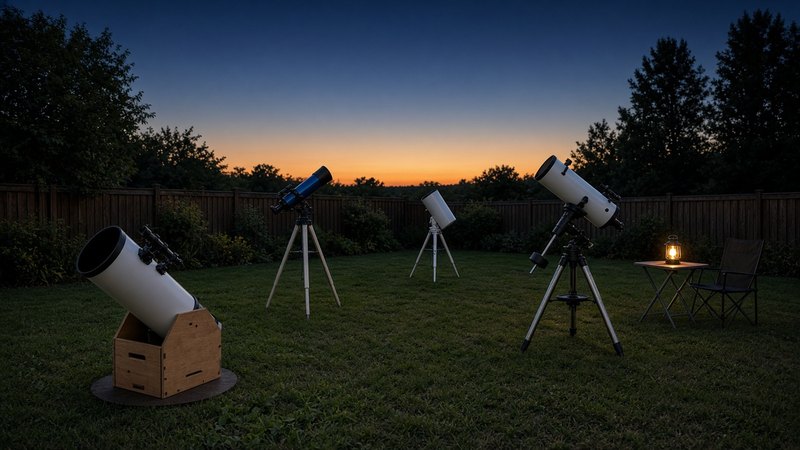
Seestar vs Dwarf: Smart Telescope Specs Compared
Pick the DWARF mini if weight comes first: 840 g. Pick the Seestar S30 Pro for the widest field: 4.6° on the diagonal. Pick the DWARF 3 for the longest battery and a mosaic mode: 10,000 mAh and 2 × 2 panels.
We compared the current Seestar and DWARF units by maker spec. All numbers below come from the maker pages, checked on 2026-10-23.
Two formulas explain most of the differences. Field in degrees is sensor width ÷ focal length × 57.3. Image scale in arcseconds per pixel is pixel size in µm ÷ focal length in mm × 206.
The specs side by side
| Spec | DWARF mini | DWARF 3 | Seestar S30 Pro | Seestar S50 |
|---|---|---|---|---|
| Aperture | 30 mm | 35 mm | 30 mm | 50 mm |
| Focal length | 150 mm, f/5 | 150 mm | 160 mm, f/5.3 | 250 mm, f/5 |
| Sensor | IMX662, 1920 × 1080 | IMX678, 3840 × 2160 | IMX585, 3840 × 2160 | IMX462, 1920 × 1080 |
| Pixel size | 2.9 µm | 2 µm | 2.9 µm | 2.9 µm |
| Field | 2.45° diagonal | 3.38° diagonal | 4.6° diagonal | 1.29° × 0.73° |
| Wide camera | not listed | 6.7 mm, 50.6° | 6 mm, 63° | none |
| Weight | 840 g | 1.35 kg | 1.65 kg | 2.5 kg |
| Battery | 7,000 mAh, up to 4 h | 10,000 mAh, up to 5.5 h | 6,000 mAh, about 6 h | 6,000 mAh, about 6 h |
| Storage | 64 GB | 128 GB | 128 GB | 64 GB |
| Mount modes | AZ, EQ | AZ, EQ | alt-az, EQ mode | alt-az, EQ mode |
| Built-in filters | dark, astro, dual-band | VIS, astro, dual-band | UV/IR cut, dual-band, dark | dual-band |
All four units are small refractors with a color camera, a tracking mount and a phone app. They differ in sensor size, focal length, weight and battery.
The DWARF mini and Seestar S30 Pro share a 30 mm aperture. The DWARF 3 has 35 mm. The Seestar S50 has 50 mm, the largest here, but a narrower field.
Read the field row next. The S30 Pro covers the most sky. The S50 covers the least. The DWARF units sit between them.
Then weight. The DWARF mini is half the weight of the S30 Pro. The S50 is three times the weight of the mini. All four fit in a backpack with a small tripod.
If you want the lightest unit
The DWARF mini weighs 840 g, or 1.85 lb. It measures 184 × 100 × 61 mm. That is about the size of a large paperback book.
Its 30 mm, 150 mm lens at f/5 feeds a 1920 × 1080 IMX662 sensor with 2.9 µm pixels. The sensor is 5.6 mm wide. Divide by 150 and multiply by 57.3: 2.13° wide by 1.20° tall.
The maker lists 2.45° on the diagonal. Scale is 3.99″ per pixel. The battery is 7,000 mAh for up to 4 h, with 64 GB of storage.
The tripod is not included. The base takes a standard 1/4 in thread, so a camera tripod works. A light tripod keeps the full kit near 1.5 kg.
EQ mode allows exposures up to 90 s. Built-in filters are dark, astro and dual-band. The dual-band filter helps on emission nebulae from a city.
The trade is battery and scale. The mini runs up to 4 h, the shortest here. Its 1080p sensor gives the smallest saved image of the four.
If you want the widest field
The Seestar S30 Pro pairs a 30 mm, 160 mm lens at f/5.3 with an 8.3 MP IMX585 sensor. The sensor is 11.1 mm wide. At 160 mm that gives 4.0° by 2.2°, or 4.6° on the diagonal.
That field fits large nebulae and long star fields in one frame. The Andromeda Galaxy at about 3° long fits with room around it. The North America Nebula fits at about 2°.
The lens is a 4 element apochromat with ED glass. A second camera at 6 mm with a 63° field helps the unit find its place in the sky.
The maker lists 1.65 kg, a 6,000 mAh battery for about 6 h and 128 GB of storage. Built-in filters are UV/IR cut, dual-band and dark. Power in is USB-C at 5 V and 3 A.
At 3.74″ per pixel, the S30 Pro favors large targets. Small galaxies span only a few dozen pixels. Planets show as bright disks.
The trade is scale. The wide field spreads each pixel over more sky. For small targets, the DWARF 3 or S50 shows more detail.
If you want battery and a mosaic mode
The DWARF 3 pairs a 35 mm, 150 mm telephoto with an 8.3 MP IMX678 sensor. Its pixels are 2 µm, smaller than the others here. Scale is 2.75″ per pixel.
The sensor is 7.7 mm wide. At 150 mm that gives 2.9° by 1.65°, or 3.38° on the diagonal. A wide camera at 6.7 mm with a 50.6° field handles finding.
The battery is 10,000 mAh, the largest here, for up to 5.5 h. Storage is 128 GB. The maker lists 1.35 kg, or 2.97 lb, and 222 × 142 × 65 mm.
The 2 × 2 mosaic mode shoots 4 overlapping panels. That roughly doubles the field in each direction, near 5.5° by 3.1° less overlap. Each panel needs its own stack.
Filters are VIS, astro and dual-band. AZ and EQ modes are both listed. In EQ mode, frames can run longer without field rotation.
The Seestar S50
The Seestar S50 is the larger Seestar. It pairs a 50 mm, 250 mm lens at f/5 with a 1920 × 1080 IMX462 sensor. Its field is 1.29° by 0.73°.
The 50 mm aperture gathers about 2.8 times the light of 30 mm. Scale is 2.39″ per pixel, the finest of the four. So the S50 suits smaller targets better than the S30 Pro.
The maker lists 2.5 kg plus a 0.65 kg tripod, a 6,000 mAh battery for about 6 h and 64 GB. It has a built-in dual-band filter and an EQ mode.
The trade is field and weight. At 1.29°, large targets need a mosaic. At 2.5 kg, it is three times the DWARF mini.
The DWARF II
The DWARF II is the earlier DWARF telephoto. It has a 24 mm, 100 mm lens with an IMX415 sensor and a field near 3°. It weighs about 1.2 kg and runs about 3 h on a replaceable 5,600 mAh battery.
The DWARF 3 replaced it with 35 mm, 150 mm, a larger battery and more storage. Light grasp went up by about 2.1 times.
Image scale: what a pixel covers
Image scale sets how much detail a small target shows. Jupiter spans about 45″. At 2.39″ per pixel it covers about 19 pixels. At 3.99″ per pixel it covers about 11.
A galaxy like M51 spans about 11′ by 7′. At 2.75″ per pixel that is about 240 by 150 pixels. At 3.74″ per pixel it is about 180 by 110.
The air sets a floor at 2″ to 3″ on most nights. All four units sit at or above it. So all of them are limited more by pixels than by the air.
Weight and size
Weight decides how often a unit leaves home. The DWARF mini at 840 g fits a jacket pocket. The S30 Pro at 1.65 kg and DWARF 3 at 1.35 kg fit a small backpack. The S50 at 2.5 kg plus tripod needs a larger bag.
The DWARF mini is 184 × 100 × 61 mm. The DWARF 3 is 222 × 142 × 65 mm. The S30 Pro is 210 × 140 × 80 mm.
On a windy night, light units shake more. A heavier tripod helps. Most apps drop blurred frames from the stack, so wind costs time more than image quality.
Battery and power
Battery hours run from up to 4 h on the DWARF mini to about 6 h on the Seestar units. The DWARF 3 lists up to 5.5 h from the largest cell, 10,000 mAh.
Cold cuts all of these. Below about 0 °C, plan for less than the maker figure. Keep the unit in a bag until setup on a cold night.
A general-purpose USB-C power bank extends a session in the field. It is the same kind of bank you would use for a phone or laptop, not an astronomy accessory. You plug it into the USB-C port of a Seestar or DWARF. The S30 Pro lists 5 V at 3 A, or 15 W. A bank with 30 W USB-C output covers that with margin.
A 20,000 mAh bank holds about 74 Wh at 3.7 V. After conversion losses, that is several hours at a 15 W input. Check the input spec of your own unit before you buy one.
Battery capacity and hours do not line up exactly. The DWARF 3 has the largest cell but lists fewer hours than the Seestar units. Hours depend on the load: motors, heaters, Wi-Fi and the camera all draw power.
A dew heater on a cold night can cut hours noticeably. Plan for a power bank on any session longer than the maker figure.
Filters and city skies
All four units list a built-in dual-band filter. It passes two narrow bands that emission nebulae give off and blocks most streetlight glow.
Dual-band filters help most on emission nebulae such as the Orion Nebula and the Lagoon Nebula. They do little for galaxies and star clusters, which shine across the spectrum.
For galaxies, a darker site helps more than any filter. Even a short drive out of town can cut sky glow enough to show faint outer detail.
The filters sit inside the units and switch from the app. You do not screw anything onto the front. That keeps setup short and avoids dust on loose filters.
The dark filter on the DWARF and Seestar units blocks light for calibration frames. The app uses those frames to remove sensor noise patterns from the stack.
Mount modes
All four units track in alt-az. In that mode the field rotates slowly during a long stack. Apps crop the rotated edges.
All four also list an EQ mode. You tilt the base toward the celestial pole, and the field holds still. The DWARF mini lists frames up to 90 s in EQ mode.
EQ mode takes a few extra minutes to set up. It pays off on long sessions with faint targets. For a quick look, alt-az is fine.
In alt-az, frames of 10 s to 30 s are common. Shorter frames mean more of them for the same total time. That costs storage and a little read noise, but it also makes the stack forgiving of wind and tracking error.
A tripod with a tilting head makes EQ mode easier. Some makers sell a wedge for this. Check the maker page for the mount accessory that fits your unit.
Apps
Seestar units run the Seestar app. DWARF units run the DWARFLAB app. Both handle target choice, stacking and saving.
Check that the app runs on your phone before you buy. Look for raw file export, mosaic modes and how often the maker updates it.
Both makers update apps often. Features can change after you buy. That is usually in your favor, since new modes arrive by update.
The wide camera
The S30 Pro and DWARF 3 have a second, wide camera beside the telephoto. The S30 Pro wide camera is 6 mm with a 63° field. The DWARF 3 wide camera is 6.7 mm with a 50.6° field.
The wide camera helps the unit find its place and frame a target. It also shoots wide views of the sky and landscape on its own.
The S50 has no wide camera. The DWARF mini spec page we checked did not list one. Both still plate solve with the main camera.
DWARF mini vs Seestar S30 Pro
These two share a 30 mm aperture, so they gather the same light. The differences are sensor, field, weight and battery.
The S30 Pro has the larger sensor, 11.1 mm wide against 5.6 mm. At similar focal lengths, that gives it nearly twice the field in each direction: 4.0° against 2.13°.
The DWARF mini weighs 840 g against 1.65 kg. It is the one to pick when every gram counts. The S30 Pro runs about 6 h against up to 4 h, and stores 128 GB against 64 GB.
Scale is close: 3.74″ per pixel on the S30 Pro and 3.99″ on the mini. So small targets look about the same size on both. The S30 Pro saves a larger file because its sensor has 4 times the pixels.
DWARF 3 vs Seestar S30 Pro
These two are the closest match in weight: 1.35 kg against 1.65 kg. Both have two cameras, 128 GB and an EQ mode.
The DWARF 3 has 35 mm against 30 mm, so it gathers about 1.4 times the light. Its 2 µm pixels give 2.75″ per pixel against 3.74″. Small targets show more detail on the DWARF 3.
The S30 Pro has the wider field: 4.6° against 3.38° on the diagonal. Large targets fit in one frame more often. The DWARF 3 answers with a 2 × 2 mosaic mode at the cost of time.
Battery is close in hours. The DWARF 3 lists up to 5.5 h from 10,000 mAh. The S30 Pro lists about 6 h from 6,000 mAh. Both charge over USB-C.
Seestar S50 vs Seestar S30 Pro
These are the two Seestar units. The S50 has 50 mm and 250 mm. The S30 Pro has 30 mm and 160 mm. The S50 gathers about 2.8 times the light.
The S30 Pro covers about 3 times the field width: 4.0° against 1.29°. Its 8.3 MP sensor saves a 4K image. The S50 saves a 1080p image at finer scale.
The S30 Pro weighs 1.65 kg against 2.5 kg plus tripod. It adds a wide camera for finding. The S50 has none.
So the S50 suits smaller targets and the S30 Pro suits large ones.
Targets that suit each unit
Large nebulae and star fields suit the S30 Pro. The North America Nebula at about 2° and the Andromeda Galaxy at about 3° fit in one frame. The Pleiades at about 2° fit with room around them.
Medium targets suit the DWARF 3 and DWARF mini. The Orion Nebula at about 1° and the Lagoon Nebula at about 1.5° fill a good part of the frame.
Small targets suit the S50. The Ring Nebula at about 1.4′ and the Whirlpool Galaxy at about 11′ show more detail at 2.39″ per pixel. They still look small on every unit here.
Setup and a first night
All four units follow the same steps. Level the tripod, power on, connect the phone and let the unit find its place. That takes a few minutes.
Start with a bright target. A cluster or a bright nebula shows results in 5 to 10 minutes. Faint galaxies need 30 minutes or more.
Keep the phone charged. The app streams images over Wi-Fi, which drains a phone fast. A second power bank for the phone helps on long nights.
Dew is a common stop on humid nights. The front lens fogs and stars fade. A dew shield or a USB heater strip keeps the lens clear.
Storage and files
Each unit saves stacked images and, on request, raw frames. Raw frames let you process data again on a computer.
Raw files fill storage fast. An 8.3 MP frame can be several MB. A 2 hour session of 10 s frames makes hundreds of frames. With 64 GB, plan to clear the unit every few sessions.
The 128 GB units hold about twice as much. That matters most on trips without a laptop.
Who each unit suits
The DWARF mini suits an owner who wants the lightest unit and already has a camera tripod. It suits hikes, flights and quick sessions from a balcony.
The Seestar S30 Pro suits an owner who wants large nebulae and star fields in one frame, with a wide camera and a long battery. It suits a first smart telescope.
The DWARF 3 suits an owner who wants finer scale in a small body, the largest battery cell and a mosaic mode. It suits long sessions on medium targets.
The Seestar S50 suits an owner who wants the most aperture of the four and shoots smaller targets. It has no Amazon listing we could link at the check date.
Care and weather
Keep each unit in its case between sessions. Dust on the front lens shows as soft halos around bright stars.
Bring a cold unit inside and leave it in the closed case for an hour. That lets it warm slowly and keeps moisture off the lens and electronics.
Wind shakes light units. A heavier tripod helps. Most apps drop blurred frames from the stack, so a windy night costs time.
Model lines
| Line | Earlier unit | Later unit | What changed |
|---|---|---|---|
| DWARF telephoto | DWARF II: 24 mm, 100 mm, IMX415 | DWARF 3: 35 mm, 150 mm, IMX678 | More aperture, longer focal length, larger battery |
| DWARF compact | DWARF 3: 1.35 kg | DWARF mini: 840 g | Lighter body, smaller sensor, no tripod in the box |
| Seestar | Seestar S50: 50 mm, 250 mm | Seestar S30 Pro: 30 mm, 160 mm | Wider field, less weight, second wide camera |
Each maker has moved in a different direction. DWARF went larger with the DWARF 3, then smaller with the mini. Seestar went from 50 mm to a lighter 30 mm unit with a wider field.
So the newest units are not simply better. Each trades aperture, field and weight in its own way.
If you own a DWARF II, the DWARF 3 is the direct step up in aperture and battery. If you own a Seestar S50, the S30 Pro adds field and drops weight but gives up aperture. An S50 owner who wants both can keep it for small targets and add a wider unit for large ones.
Which to pick
| If you want | Pick | Deciding spec |
|---|---|---|
| The lightest unit | DWARF mini | 840 g, 184 × 100 × 61 mm |
| The widest field | Seestar S30 Pro | 4.6° diagonal |
| The longest battery | DWARF 3 | 10,000 mAh, up to 5.5 h |
| The finest scale of the small units | DWARF 3 | 2.75″ per pixel |
| The most aperture | Seestar S50 | 50 mm, 250 mm |
| A mosaic mode | DWARF 3 | 2 × 2 mosaic |
For travel and hikes, the DWARF mini is the lightest. For large nebulae and star fields, the S30 Pro has the widest field. For long sessions and mosaics, the DWARF 3 has the most battery.
For smaller targets, the S50 has the finest scale and most aperture of the four. It has no Amazon listing we could link at the check date, so it is in the table only.
What to check on the spec sheet
- Aperture in mm: light grasp scales with its square.
- Focal length and sensor width: field = width ÷ focal length × 57.3.
- Pixel size: scale = pixel ÷ focal length × 206.
- Weight and size: under 1 kg fits a pocket; under 2 kg fits a small bag.
- Battery in mAh and hours, and USB-C input spec.
- Built-in filters and EQ mode.
Also check what is in the box. The DWARF mini ships without a tripod. The S50 includes one at 0.65 kg.
How we compared
We read the maker spec pages for every unit. We computed field and scale with the formulas above and used the maker figures where listed.
We did not score image quality and did not compare prices. Prices and stock change, so check the retailer page for current details. Specs here are as of 2026-10-23.
Common Questions
Is the Seestar S30 Pro or DWARF 3 better for deep sky?
It depends on target size. The S30 Pro covers 4.6° on the diagonal, so large nebulae fit in one frame. The DWARF 3 covers 3.38° at a finer 2.75″ per pixel, so smaller targets show more detail.
Which is lighter, Seestar or DWARF?
The DWARF mini at 840 g is the lightest. The DWARF 3 weighs 1.35 kg, the Seestar S30 Pro 1.65 kg and the Seestar S50 2.5 kg plus a 0.65 kg tripod.
Which has the longest battery?
By capacity, the DWARF 3 at 10,000 mAh. By maker hours, the Seestar units list about 6 h and the DWARF 3 up to 5.5 h. The DWARF mini lists up to 4 h.
Can Seestar and DWARF units show planets?
Yes, as small disks. Jupiter at about 45″ spans about 19 pixels on the S50 and about 11 on the DWARF mini. Bands may show on steady nights. For planet detail, a longer focal length helps more.
Read next
- TelescopesSmart telescopes compared by spec
- TelescopesWhat is a smart telescope? Specs that matter
- TelescopesTelescope types explained
- ToolsEyepiece field of view calculator
Sources
- Seestar S30 Pro: 30 mm, 160 mm, f/5.3, 4 element ED apochromat, IMX585 3840 × 2160, 4.6° field, wide camera 6 mm at 63°, 1.65 kg, 6,000 mAh about 6 h, 128 GB, UV/IR, dual-band and dark filters, USB-C 5 V 3 A, 210 × 140 × 80 mm. seestar.com, checked 2026-10-23.
- Seestar S50: 50 mm, 250 mm, f/5, IMX462 1920 × 1080, 1.29° × 0.73°, 2.5 kg plus 0.65 kg tripod, 6,000 mAh, 64 GB, dual-band filter. seestar.com, checked 2026-10-23.
- DWARF mini: 30 mm, 150 mm, f/5, IMX662 2.9 µm 1920 × 1080, 2.45° diagonal, 840 g, 7,000 mAh up to 4 h, 64 GB, EQ up to 90 s, 184 × 100 × 61 mm, tripod not included. dwarflab.com, checked 2026-10-23.
- DWARF 3: 35 mm, 150 mm, IMX678 2 µm 8.3 MP, 3.38° field, wide camera 6.7 mm at 50.6°, 10,000 mAh up to 5.5 h, 128 GB, 1.35 kg, 222 × 142 × 65 mm, 2 × 2 mosaic. dwarflab.com, checked 2026-10-23.
- DWARF II: 24 mm, 100 mm, IMX415, about 3° field, 5,600 mAh replaceable battery. Maker and press materials, checked 2026-10-23.
How we check numbers: How we research.