What You Can See9 min read
What Size Telescope Do You Need?
Rings at 25x. The Cassini Division near 80 to 100 mm and 150x, on a steady night. Deep-sky targets follow the sky class.
Saturn's rings show at 25x. Aperture then sorts Jupiter, Mars, Uranus, and Neptune.
What size telescope to see planets depends on the planet. A 60 mm (2.4 in) lens shows you the rings and Jupiter's four moons.
The Cassini Division wants about 80 to 100 mm, near 150x, and steady air. A 150 mm (6 in) mirror is the class Sky & Telescope names for Jupiter's Great Red Spot.
Uranus shows a tiny disk at 120x in a 70 mm telescope. Exit pupil there is 0.58 mm. Neptune's disk shows at 200x in a 150 mm telescope on a steady night, and the exit pupil is 0.75 mm.
- Deep-sky limits start from Bortle's 32 cm notes. The shift is 5 times log10 of D divided by 320. D is the aperture in mm, and the shift is negative.
- Power is telescope focal length divided by eyepiece focal length. Every power named below uses that division.
- The ceiling is 2 times the aperture in mm. Sky & Telescope states that rule, and the 50x-per-inch form beside it.
- Exit pupil is aperture divided by power. Over 7 mm the pupil spills light. Under 0.5 mm the image goes dim.
- Light grasp is aperture over 7, squared. Dawes' limit is 116 divided by mm. It scores equal double stars, not a dark gap in a bright ring.
The Moon is 1,896 arcsec across. A mean opposition puts Saturn's globe at 18.8 arcsec and the rings at 44.2 arcsec tip to tip.
Telescope aperture chart
You read one row across. Planets sit in one column. Deep sky splits into Bortle 6 to 7 and Bortle 3 to 4.
Use those deep-sky cells with the sky table further down. The table quotes the 2001 class notes. The chart turns the 32 cm magnitudes into a limit for each aperture.
Dawes gets smaller as the mirror grows. A smaller Dawes number means more nights when you can see a fine gap. It is not a line that flips at 150 mm.
| Aperture | Light grasp | Dawes limit | Power ceiling | Planets | Deep sky, Bortle 6 to 7 | Deep sky, Bortle 3 to 4 |
|---|---|---|---|---|---|---|
| 60 mm (2.4 in) | 73 times a 7 mm pupil | 1.93 arcsec | 120x | Rings at 25x. Four moons at low power. Uranus disk at 120x in a 70 mm lens. | Class 6 limit 10.4 to 10.9. M42 is evident in any telescope. | Class 3 limit 11.9 to 12.9. That nebula can span more than the Moon. |
| 102 mm (4 in) | 212 times a 7 mm pupil | 1.14 arcsec | 204x | Rings detached near 50x. Ansae gap near 150x in steady air. Uranus disk at 100x to 120x. | Class 6 limit 11.5 to 12.0. A 4 in shows the dark bay in M42. | Class 3 limit 13.0 to 14.0. NGC 253 looks grainy in a good 4 in. |
| 150 mm (6 in) | 459 times a 7 mm pupil | 0.77 arcsec | 300x | Great Red Spot on a steady night. Gap easier past the tips. Neptune's disk at 200x in steady air. | Class 6 limit 12.4 to 12.9. M13 starts to resolve at 100x to 150x. | Class 3 limit 13.9 to 14.9. Spiral traces can show in a 6 in. |
| 203 mm (8 in) | 841 times a 7 mm pupil | 0.57 arcsec | 406x | More steady nights for the ansae gap. | Class 6 limit 13.0 to 13.5. M13 resolves in a 6 or 8 in at 100x to 150x. | Class 3 limit 14.5 to 15.5. M51's spiral shows in an 8 in under a dark sky. |
| 254 mm (10 in) | 1,317 times a 7 mm pupil | 0.46 arcsec | 508x | Brighter disks at the same 150x. Exit pupil 1.69 mm. | Class 6 limit 13.5 to 14.0. Faint galaxies look bolder than in a 70 mm. | Class 3 limit 15.0 to 16.0. Spiral arms that start near 8 in are brighter. |
The disks above are the four main rows, drawn to the same scale. You compare area, not the carton power.
An 80 mm refractor is the light setup. Dawes' limit is 1.45 arcsec. The ceiling is 160x. Light grasp is 131 times a 7 mm pupil.
Celestron lists the StarSense Explorer LT 80AZ kit at 9.2 lb (4.2 kg) on an alt-az tripod. You carry that refractor in one trip.
One page for each aperture
Each size has its own page. Use those pages when you want the object list. This hub keeps the comparison.
102 mm, the 4 in class
The long-focus example here is 1,300 mm, f/12.7. A 25 mm eyepiece gives 52x. That is 1,300 divided by 25.
At 52x a 66.1 arcsec disk subtends 0.95 degrees. The 9.7 arcsec end is 0.14 degrees.
Planet power near 150x wants an 8.8 mm eyepiece. Exit pupil is 0.68 mm, which is 102 divided by 150.
The ceiling on 102 mm is 204x. So 150x is under it. On a poor night the air quits first.
Sky & Telescope says a good 3 in scope at 50x shows the rings detached from the globe. The 52x from that 25 mm eyepiece sits on that step.
Open the 4 in page when you want the object list for this class.
150 mm, the 6 in class
A 1,200 mm tube at f/8 gives 120x with a 10 mm eyepiece. An 8 mm eyepiece gives 150x. Exit pupil then is 1.0 mm.
Sky & Telescope says the Great Red Spot may need at least a 6 in scope and a steady night. It also has to face you.
On those same nights a 6 in can follow the Cassini Division past the ansae. A 3 in usually keeps the mark at the tips.
Sky & Telescope puts 100x to 200x on that gap, easiest at the ansae. 150x on this 1,200 mm tube is the middle of the band.
203 mm, the 8 in class
In a 1,200 mm tube, 25 mm gives 48x. A 10 mm eyepiece gives 120x. A 6 mm eyepiece gives 200x.
To spread a 1 arcsec lunar feature to 2 arcmin, you need 120x. A sharp eye resolves about 1 arcmin. Sky & Telescope gives that figure, and 2 arcmin is the easier size to read.
That spread is the 10 mm eyepiece, not the top of the ceiling.
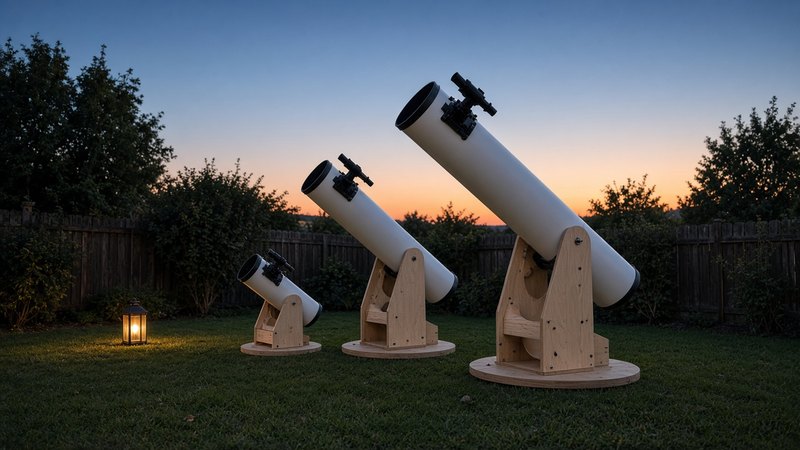
The matching Dobsonian tube collapses to 33 in for storage. The base stays a rocker, so the move is two pieces, not a camera tripod.
What an 8-inch telescope shows
8-inch Dobsonian specifications
254 mm, the 10 in class
The 10 in page holds the object list. The tube under that row is 254 mm at 1,200 mm, f/4.7.
On that 1,200 mm tube, 10 mm gives 120x. An 8 mm eyepiece gives 150x. A 6 mm eyepiece gives 200x.
Exit pupil at 150x is 1.69 mm. Celestron lists the tube at 29.2 lb, the base at 25.6 lb, and the kit at 54.8 lb. You carry the tube and the base in two trips. The base has no wheels.
A 2 arcsec night matches a Dawes limit of 58 mm, because 116 divided by 2 is 58. Extra aperture does not sharpen past the air you have.
What size telescope to see planets
Jupiter's four moons, Io, Europa, Ganymede, and Callisto, show in the smallest telescope at low power. Sky & Telescope says they change places every night.
Switch Jupiter to fairly high power. A small scope will reveal that the disk is not quite round. The parallel cloud belts are the next mark, and they do not leap out.
The Great Red Spot is harder. It sits in the South Equatorial Belt, and it faces you only half the time.
Jupiter at a mean opposition is 46.9 arcsec. The published range is 30.5 to 50.1 arcsec. At 120x the mean disk subtends 1.6 degrees.
Venus runs from 9.7 to 66.1 arcsec on the NASA sheet. A small telescope shows the phase, from a gibbous shape down toward a crescent. Markings on the cloud deck are a poor bet.
Mars at a mean opposition is 17.8 arcsec. Far from opposition it shrinks to 3.5 arcsec, and the polar cap is not the target then.
The next opposition is 19 February 2027. ALPO calls that apparition aphelic and lists a 13.8 arcsec disk, under the 17.8 arcsec mean. The north cap is tilted toward Earth, on that smaller disk.
A 3.5 arcsec Mars at 150x is only 0.15 degrees across.
Uranus at a mean opposition is 3.8 arcsec, inside a 3.3 to 4.1 arcsec range. Neptune is 2.3 arcsec, inside 2.2 to 2.4.
At 200x those disks subtend 0.21 and 0.13 degrees. You are looking for a tiny round disk, not a star point, and not a ring.
Your pair of eyepieces may differ. Run focal length and eyepiece focal length through the magnification calculator.
A telescope to see Saturn
Saturn's rings need 25x.
You can stop near 50x when a detached ring is the whole goal. The 3 in example in the S&T note is that step.
Divide 1,896 by 44.2 and you get 43x. That is a size match. It is not the power where the rings first appear.
At the October 2026 opposition the rings tilt about 7.5 degrees, south side toward us. EarthSky lists 19.7 arcsec for the globe that night.
With the rings this narrow, the Cassini Division is hard to make out. The tips are the place to look, on the steadiest minutes, near 150x.
The tilt widens each year after 2026.
Sky & Telescope's May 2015 note puts this gap at about 0.75 arcsec, under the double-star limit of a 3 in lens. The rings were tipped nearly wide open that year, so the gap was plain on a calm night.
That plain view belongs to a wide-open year. It does not describe the October 2026 opposition.
A high-contrast dark line in a bright ring is not two equal stars. Dawes compares which mirror is finer on a steady night. It does not tell you the gap is visible or not.
The drawing uses one Saturn and four apertures. The globe and the 7.5 degree tilt stay fixed. Only how far the gap mark can be followed from the tips changes.
Suburban sky and a dark sky
Planets punch through a bright sky. Galaxies follow the Bortle class and the aperture.
Bortle's class 6 note for a 32 cm mirror is magnitude 14.0 to 14.5. The shift for another aperture is 5 times log10 of D divided by 320.
For 60 mm, log10 of 60 over 320 is about −0.73. Five times that is −3.6. The class 6 limit is about 10.4 to 10.9.
For 254 mm the same shift is about −0.5. The class 6 limit is about 13.5 to 14.0. The rows between those two sit in the chart.
Class 3 is magnitude 16 on that 32 cm mirror, 1.5 to 2 magnitudes deeper than class 6. Add that range to each row. Class 4 is magnitude 15.5, half a magnitude brighter than class 3.
| Class | Unaided limit | 32 cm telescope | What the class notes name |
|---|---|---|---|
| 3 Rural | 6.6 to 7.0 | Magnitude 16 | M33 by averted vision. M4, M5, M15, M22 distinct. |
| 4 Rural to suburban | 6.1 to 6.5 | Magnitude 15.5 | M33 is hard, and only when it is high. |
| 6 Bright suburban | about 5.5 | Magnitude 14.0 to 14.5 | M31 modest. M33 needs binoculars. |
| 7 Suburban edge | 5.0 | Barely magnitude 14 | Bright Messier objects look pale. |
M42 is evident in any telescope, so it is the 60 mm target under either sky. A 4 in from a suburban yard shows the dark bay in that nebula. A 6 or 8 in at 100x to 150x begins to resolve M13.
Under a dark sky, NGC 253 looks grainy in a good 4 in. Spiral traces can show in a 6 in. M51's spiral shows in an 8 in. A 10 in makes faint galaxies bolder than a 70 mm lens, about 13 times the light.
If your sky is class 6 or 7, pick focal length for Saturn and aperture for galaxies. The planet rows barely move.
If your sky is class 3 or 4, the 8 in and 10 in rows pull ahead on faint targets. Tube type is still a separate choice.
A smart scope is the other weeknight setup, judged by mass in kg and by aperture in mm. The spec pages carry those two numbers.
When the box prints 675x
A carton may print 675x on a 70 mm lens. Twice 70 mm is 140x. That is the ceiling.
675 divided by 140 is 4.8. The printed power is about five times the useful power.
Say the tube is 700 mm and the shortest eyepiece is 4 mm. Real power is 175x. Exit pupil is 0.40 mm.
175x is still over 140x. You are past the ceiling, and the exit pupil is under 0.5 mm.
Do the division before you trust a carton. You then compare the result with 2 times the aperture in mm.
A 2x Barlow on a 10 mm eyepiece in the 203 mm, 1,200 mm tube goes from 120x to 240x. Exit pupil falls from 1.7 mm to 0.85 mm.
That 240x result is still under the ceiling of the 8 in class. You stop when the disk stops gaining detail.
Bring the aperture you are weighing back to the chart. Rings at 25x. The gap near 150x, from about 80 to 100 mm, when the air holds still.
Sources
- Sky & Telescope, Viewing Saturn: The Planet, Rings and Moons. Rings in the smallest telescope at 25x. A good 3 in scope at 50x shows them detached. The Cassini Division in a small scope during good seeing. Checked 2026-10-17. skyandtelescope.org
- Sky & Telescope, Splashy Saturn, May 2015. The rings were tipped nearly wide open. Cassini Division about 0.75 arcsec, below the double-star limit of a 3 in lens, and still plain on a calm night because the contrast is high. Checked 2026-10-17. skyandtelescope.org
- Sky & Telescope, Hello, Saturn! We're Glad You're Back. Cassini Division easiest at the ansae. Magnification 100x to 200x. A 6 in or larger can follow it farther in steady seeing. Checked 2026-10-17. skyandtelescope.org
- EarthSky, Saturn at opposition, 4 October 2026. Globe 19.7 arcsec. Ring tilt −7.5 degrees. Checked 2026-10-17. earthsky.org
- Astronomy.com, October 2026 sky. Opposition disk about 20 arcsec. Ring tilt 7.4 degrees. 150x to 200x named as the working band. Checked 2026-10-17. astronomy.com
- Astronomy.com, Sky guide 2026. Saturn opposition 4 October with rings tilted 7.5 degrees. Checked 2026-10-17. astronomy.com
- Sky & Telescope, Getting Started with Your New Telescope. Fairly high power shows Jupiter is not quite round, then the cloud belts. The Great Red Spot may need 6 in. Venus shows a phase. M42 is evident in any telescope. Checked 2026-10-17. skyandtelescope.org
- NASA NSSDCA Saturn Fact Sheet. Mean opposition distance 1,277.13 million km. Globe 18.8 arcsec. Checked 2026-10-17. nssdc.gsfc.nasa.gov
- NASA NSSDCA Saturnian Rings Fact Sheet. A-ring outer radius 136,780 km. B outer 117,507 km. A inner 122,340 km. Checked 2026-10-17. nssdc.gsfc.nasa.gov
- NASA Science, The Familiar Division, PIA08901. Cassini Division width 4,800 km. Checked 2026-10-17. science.nasa.gov
- NASA Science, Saturn Facts. Cassini Division given as 4,700 km. Checked 2026-10-17. science.nasa.gov
- NASA NSSDCA Moon Fact Sheet. Apparent diameter 1,896 arcsec. Checked 2026-10-17. nssdc.gsfc.nasa.gov
- NASA NSSDCA Jupiter Fact Sheet. Range 30.5 to 50.1 arcsec. Mean opposition 46.9 arcsec. Checked 2026-10-17. nssdc.gsfc.nasa.gov
- NASA NSSDCA Mars Fact Sheet. Range 3.5 to 25.6 arcsec. Mean opposition 17.8 arcsec. Checked 2026-10-17. nssdc.gsfc.nasa.gov
- NASA NSSDCA Venus Fact Sheet. Apparent diameter 9.7 to 66.1 arcsec. Checked 2026-10-17. nssdc.gsfc.nasa.gov
- NASA NSSDCA Uranus Fact Sheet. Range 3.3 to 4.1 arcsec. Mean opposition 3.8 arcsec. Checked 2026-10-17. nssdc.gsfc.nasa.gov
- NASA NSSDCA Neptune Fact Sheet. Range 2.2 to 2.4 arcsec. Mean opposition 2.3 arcsec. Checked 2026-10-17. nssdc.gsfc.nasa.gov
- Sky & Telescope, Astronomy Terms. Maximum power is 50 times inches, or twice the mm. Checked 2026-10-17. skyandtelescope.org
- Sky & Telescope, Telescope Calculator. Power is focal length over eyepiece focal length. A 7 mm pupil is the wide cutoff. Dawes output is the closest double star. Checked 2026-10-17. skyandtelescope.org
- Sky & Telescope, Bortle Dark-Sky Scale, February 2001. Class 3, 4, 6, and 7 limits, plus the 32 cm notes. Checked 2026-10-17. skyandtelescope.org
- Celestron, StarSense Explorer LT 80AZ. 80 mm refractor, kit 9.2 lb (4.17 kg). Checked 2026-10-17. celestron.com
- Sky-Watcher, Skymax 102. 102 mm, 1,300 mm, f/12.7, 25 mm eyepiece at 52x. Checked 2026-10-23. skywatcherusa.com
- Celestron, StarSense Explorer 10 in Dobsonian. 254 mm, 1,200 mm, f/4.7. Optical tube 29.2 lb. Base 25.6 lb. Kit 54.8 lb. Checked 2026-10-17. celestron.com
- Sky & Telescope, Ice Giants: Neptune and Uranus. Uranus shows a tiny disk at 120x in a 70 mm telescope. Neptune's disk is visible at 200x through a 6 in telescope on a night of steady seeing. Checked 2026-10-17. skyandtelescope.org
- Sky & Telescope, How to Choose Your Telescope Magnification. Naked-eye resolution about 1 arcmin for the sharpest eyesight. Checked 2026-10-17. skyandtelescope.org
- Sky & Telescope, Fuzzies in Your Future. M13 resolves in a 6 or 8 in at 100x to 150x. NGC 253 looks grainy in a good 4 in. M51's spiral shows in an 8 in under a dark sky. Checked 2026-10-17. skyandtelescope.org
- Sky & Telescope, Observing the Great Orion Nebula. At least 3 in at 40x to 50x splits the Trapezium. A 4 in from a suburban yard shows the dark bay in M42. The nebula can span more than the full Moon. Checked 2026-10-17. skyandtelescope.org
- Sky & Telescope, See Spring's Finest Spiral Galaxies. Traces of spiral structure can show in a telescope as small as 6 in. Larger aperture shows the arms better. Checked 2026-10-17. skyandtelescope.org
- Sky & Telescope, How to Choose a Telescope. A 10 in gathers nearly 13 times the light of a 70 mm lens, and faint galaxies look bolder. Checked 2026-10-17. skyandtelescope.org
- ALPO, The 2026-2027 Aphelic Apparition of Mars, Jeffrey D. Beish. Opposition 19 February 2027. Disk 13.8 arcsec. North polar cap tilted toward Earth. Checked 2026-10-17. alpo-astronomy.org
How the formulas are checked: How we research.