Calculator7 min read
Telescope Magnification Calculator
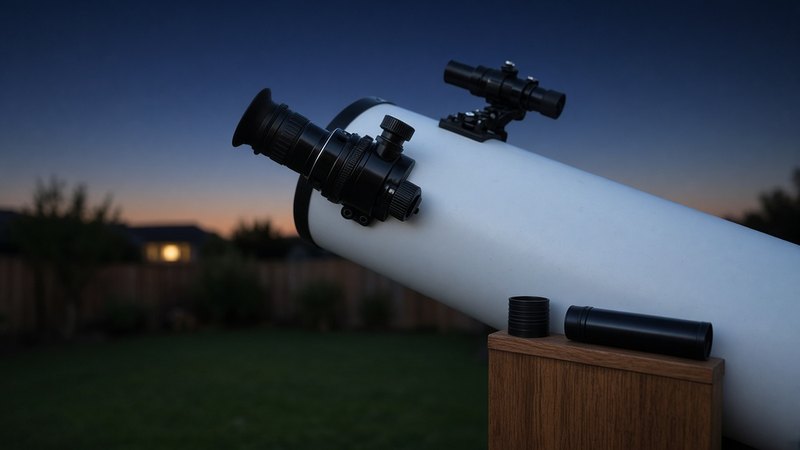
Magnification is telescope focal length divided by eyepiece focal length. The default is an 8 in f/6 tube, 1200 mm, with a 25 mm eyepiece.
48.0×
Magnification
Inside the useful range.
- Max useful
- 406x
- Min useful
- 29x
- Exit pupil
- 4.2 mm
- True field
- 1.08°
Reading your result
A 25 mm eyepiece in a 1200 mm telescope gives 48x and a 4.2 mm exit pupil; on the same 203 mm (8 in) mirror, useful power runs from 29x to 406x; the 406x cap is Sky & Telescope's 2 × aperture in mm.
That 48x result is a low power. Use it to frame a wide patch, then step up.
How the numbers work
Aperture and focal length are printed on the tube or in the manual. A typical line reads D=203mm F=1200mm.
If the label gives only the focal ratio, multiply the aperture by that number. 203 times 5.9 is about 1200 mm.
Magnification is one division: telescope focal length over eyepiece focal length. Multiply by the Barlow after that. No Barlow means times 1.
Swap to 10 mm and you get 120x, with a 1.7 mm exit pupil.
A 6 mm eyepiece gives 200x and a 1.0 mm pupil. A 15 mm eyepiece gives 80x and a 2.5 mm pupil.
To check the maximum magnification a box prints, double the aperture in millimeters. Focal length stays out of that cap.
Sky & Telescope states 50 times the inches, or 2 times the millimeters. Twice 203 mm is 406x.
The inch rule gives 400x for 8 in. The millimeter rule gives 406x. Treat both as the same ceiling.
On 1200 mm, a 6 mm eyepiece plus a 2x Barlow lands at 400x, next to that ceiling.
A dark-adapted eye opens to about 7 mm (Sky & Telescope), and Tele Vue tells reflector owners to stay under a 7 mm exit pupil.
Your pupil cannot take a wider beam than that. Divide 203 by 7 and you get 29x.
That floor wants about a 41 mm eyepiece. In a 1.25 in barrel the 27 mm stop squeezes it to about 38° apparent field, so that focal length is usually bought in 2 in.
A 32 mm 1.25 in eyepiece gives you 37.5x (about 38x) and a 5.4 mm pupil.
A 5 mm pupil, the adult example in the pupil primer, lifts your floor to 40.6x.
With that 5 mm pupil, the 32 mm (37.5x, 5.4 mm exit pupil) wastes part of the aperture. You are using about 188 mm, which is 37.5 times 5.
Exit pupil equals aperture divided by power. It also equals eyepiece focal length divided by the focal ratio.
On a reflector, stay between 0.5 mm and 7 mm. Tele Vue sets both edges. Under 0.5 mm you only enlarge blur.
At 406x the pupil is 0.50 mm. Save that power for the steadiest nights.
True field equals apparent field divided by power. With no field stop on the sheet, we use 52°.
At 48x, 52 divided by 48 is 1.08°. The Moon averages about 0.52° across (NASA's fact sheet gives 1,896 arcsec).
Tele Vue's stricter formula is field stop over focal length, times 57.3. Use it when the stop is printed.
A 1.25 in barrel caps the field stop at 27 mm. Tele Vue's 32 mm Plössl uses that stop, so you will not get a wider 1.25 in field.
On 1200 mm, 27 divided by 1200, times 57.3, is 1.29°. The 52° shortcut said 1.39°. Use the stop.
| Eyepiece | Barlow | Power | Exit pupil | True field | Flag |
|---|---|---|---|---|---|
| 32 mm | 1x | 37.5x | 5.4 mm | 1.29° | Field-stop limit |
| 25 mm | 1x | 48x | 4.2 mm | 1.08° | Inside |
| 15 mm | 1x | 80x | 2.5 mm | 0.65° | Inside |
| 10 mm | 1x | 120x | 1.7 mm | 0.43° | Inside |
| 6 mm | 1x | 200x | 1.0 mm | 0.26° | Inside |
| 4 mm | 1x | 300x | 0.7 mm | 0.17° | Inside |
| 25 mm | 2x | 96x | 2.1 mm | 0.54° | Inside |
| 6 mm | 2x | 400x | 0.5 mm | 0.13° | At the 0.5 mm edge |
| 6 mm | 3x | 600x | 0.3 mm | 0.09° | Over the 406x cap |
Our assumptions
- Aperture 203 mm, from 8 times 25.4, rounded.
- Focal length 1200 mm at f/5.9, called 8 in f/6.
- Barlow starts at 1x. You can set 2x or 3x.
- Use 52° only when the field stop is missing.
- Max is 2 times aperture in mm. Min is aperture over 7.
- The Moon comparison uses 0.52°, the same value as our calculators.
- Seeing is not an input. See the 30x-per-inch note below.
- The 675x example uses a 60 mm, 900 mm tube, f/15.
- Formula pages were checked on 2026-10-17.
When 300x fits
Whether 300x works depends on the eyepiece and the aperture. On 1200 mm, a 4 mm eyepiece gives 300x.
The pupil is 0.7 mm, and 300 sits under the 406x cap. You are inside the rule on 203 mm.
Tele Vue notes the air usually caps planetary power near 300x, whatever the aperture. On a soft night, stop closer to 240x.
On a 70 mm, 700 mm refractor the cap is 140x. You are 2.1 times past that cap at 300x.
The pupil there is 0.23 mm, under the 0.5 mm edge. The image is dim and soft; you are enlarging diffraction blur.
The box says 675x. That's 900 mm × 3 (a 3x Barlow) ÷ 4 mm. On a 60 mm (2.4 in) lens the ceiling is about 120x. At 675x the exit pupil is 0.09 mm. 675x is not usable on that lens: it is more than five times the 120x ceiling.
Four tubes, five eyepieces
The same 25 mm eyepiece is 48x on 1200 mm and 60x on 1500 mm. Focal length does that.
A 6 in mirror is 152 mm here, from 6 times 25.4 rounded, and 1200 mm makes it f/7.9.
The 102 mm refractor is 663 mm, f/6.5. The 127 mm Mak is 1500 mm, f/11.8.
| Tube | Aperture | Focal length | 32 mm | 25 mm | 15 mm | 10 mm | 6 mm | Max |
|---|---|---|---|---|---|---|---|---|
| 8 in f/6 | 203 mm | 1200 mm | 37.5x, 5.4 mm | 48x, 4.2 mm | 80x, 2.5 mm | 120x, 1.7 mm | 200x, 1.0 mm | 406x |
| 6 in f/7.9 | 152 mm | 1200 mm | 37.5x, 4.1 mm | 48x, 3.2 mm | 80x, 1.9 mm | 120x, 1.3 mm | 200x, 0.8 mm | 304x |
| 102 mm f/6.5 | 102 mm | 663 mm | 20.7x, 4.9 mm | 26.5x, 3.8 mm | 44.2x, 2.3 mm | 66.3x, 1.5 mm | 110.5x, 0.9 mm | 204x |
| 127 mm Mak | 127 mm | 1500 mm | 46.9x, 2.7 mm | 60x, 2.1 mm | 100x, 1.3 mm | 150x, 0.8 mm | 250x, 0.5 mm | 254x |
The 6 in row shares the 8 in powers, because both focal lengths are 1200 mm. Its pupil at 48x is 3.2 mm, and its cap is 304x.
The 102 mm tube stays under a 204x cap at 6 mm (110.5x). The Mak at 6 mm is 250x, against a 254x cap. Add 2x and you jump to 500x.
A bright suburb and a dark site
The formulas do not change with the sky. The row you should use does change.
Bortle class 6 is a bright suburban sky, and class 7 is suburban-urban. Class 3 is rural. Class 4 is the rural-suburban transition.
John Bortle set those classes in Sky & Telescope. We use 6 to 7 for a bright yard and 3 to 4 for a dark site.
On a class 6 night, a 5.4 mm pupil shows a bright background. Step to 15 mm. You get 80x and a 2.5 mm pupil on 1200 mm.
The smaller pupil dims the background. We treat 80x to 120x as the working range from a class 6 yard, well under the 406x math cap.
Ordinary air is stricter. A Sky & Telescope formulas note uses about 30 times per inch as a practical cap. On 8 in that is 240x.
On 1200 mm, 240x is a 5 mm eyepiece and a 0.8 mm pupil.
At a class 3 or 4 site, use the 32 mm if your pupil can take the 5.4 mm beam. You get 37.5x (about 38x) and 1.29° from the 27 mm stop.
Planets follow the air, not the Bortle class. Find and center the planet at about 50x, a 24 mm eyepiece on 1200 mm, then step up.
Tele Vue's eyepiece guide puts planetary and double-star work in at least the 150x range. On 1200 mm that is an 8 mm eyepiece and a 1.4 mm pupil.
An 8 to 24 mm zoom covers that span. At 24 mm you get 50x and a 4.1 mm pupil.
At 8 mm on this 1200 mm tube you get 150x and a 1.4 mm pupil.
Three slips that wreck the number
Slip one is the printed power. Divide before you trust it. The 675x label on 60 mm failed above.
Slip two is one eyepiece for every target. On 1200 mm, keep 25 mm at 48x, 10 mm at 120x, and 6 mm at 200x when the air holds.
Slip three is the barrel. A 2 in barrel allows a field stop up to 46 mm. A 1.25 in barrel caps the field stop at 27 mm. Tele Vue lists both limits.
A 2x on the 25 mm lands at 96x, the same power as a 12.5 mm eyepiece, so those two steps repeat. A 3x on the 6 mm is 600x. Stop there.
The Barlow lens page runs 2x and 3x on these focal lengths. Focal-length sets sit on how to choose telescope eyepieces. Zoom eyepieces and full kits are compared on telescope eyepiece kits compared.
For true field with your own eyepiece's apparent field, use the eyepiece calculator.
Past 406x you only magnify diffraction blur, even in perfect air. You do not see more detail. Sky & Telescope explains that limit in the pupil primer.
Common Questions
How do you calculate the magnification of a telescope?
Divide telescope focal length by eyepiece focal length. A 1200 mm tube and a 25 mm eyepiece give 48x. 1200 divided by 25 is 48. Multiply by the Barlow next. A 2x Barlow makes that 96x.
Keep both focal lengths in millimeters. The aperture is not in this step. It sets the cap later. On 203 mm that cap is 406x, from 2 times 203.
What magnification is useful on an 8 in telescope?
On 203 mm, the math floor is 29x and the math cap is 406x. A 7 mm pupil sets the floor. A 0.5 mm pupil sets the cap. Your 25 mm eyepiece at 48x, pupil 4.2 mm, sits in the easy middle.
On an ordinary night, about 30 times per inch is the practical cap. That is 240x on 8 in. The 406x figure wants steady air and about a 3 mm eyepiece.
Is 300x too much magnification?
On a 1200 mm, 203 mm telescope, 300x is a 4 mm eyepiece. The pupil is 0.7 mm, and 300 sits under the 406x cap. It is allowed. It still wants steady air. Average air is happier near 240x.
On a 70 mm, 700 mm refractor the cap is 140x. The same 300x is 2.1 times past that cap, and the pupil is 0.23 mm. Too much there.
What does a Barlow do to eyepiece magnification?
A Barlow multiplies power by its factor and divides the exit pupil by that same factor. A 25 mm eyepiece on 1200 mm is 48x and a 4.2 mm pupil. Add 2x and you get 96x and a 2.1 mm pupil.
A 6 mm eyepiece plus 2x is 400x and a 0.5 mm pupil, on the 406x line. Plus 3x it is 600x and a 0.3 mm pupil, past the cap.
What power shows the Moon and planets?
The Moon averages about 0.52° across. On 1200 mm, a 32 mm eyepiece gives 37.5x and, with a 27 mm stop, 1.29° of sky. A 25 mm eyepiece at 48x gives 1.08° at 52°.
Tele Vue puts planetary detail in at least the 150x range. On 1200 mm that is an 8 mm eyepiece and a 1.4 mm pupil. Center the planet at about 50x (24 mm) first.
Read next
- CalculatorField of view and exit pupil
- EyepiecesPick focal lengths for a tube
- Eyepieces2x and 3x Barlow math
- SkyWhat size telescope you need
Sources
- Sky & Telescope, Astronomy Terms: skyandtelescope.org/astronomy-terms (maximum useful magnification is 50 times aperture in inches, or 2 times aperture in millimeters). Checked 2026-10-17.
- Sky & Telescope, Telescope Calculator: skyandtelescope.org/observing/telescope-calculator (power equals telescope focal length divided by eyepiece focal length; the same cap; 52° is one apparent-field step). Checked 2026-10-17.
- Sky & Telescope, Simple Formulas for the Telescope Owner: skyandtelescope.org simple formulas (power and exit-pupil formulas; a dark-adapted pupil of about 7 mm; about 50 times per inch in excellent air, and about 30 times per inch as that author's practical cap). Checked 2026-10-17.
- Sky & Telescope, A Pupil Primer: skyandtelescope.org/a-pupil-primer (lowest power is aperture divided by pupil size; a 5 mm pupil is the worked adult example; under 0.5 mm you enlarge diffraction). Checked 2026-10-17.
- Tele Vue Optics, Telescope Formulas: televue.com formulas (power, exit pupil, field size from the field stop). Checked 2026-10-17.
- Tele Vue Optics, Choosing Eyepieces: televue.com choosing eyepieces (1.25 in field stop limit 27 mm; the 32 mm Plössl uses that 27 mm stop; 2 in limit 46 mm; reflector pupils kept between 0.5 mm and 7 mm; planetary and double-star work wants at least the 150x range; the air usually limits planetary power near 300x). Checked 2026-10-17.
- NASA National Space Science Data Center, Moon Fact Sheet: nasa.gov Moon fact sheet (apparent diameter 1896 arcsec at the distance given on the sheet). Checked 2026-10-17.
- John E. Bortle, Sky & Telescope, Gauging Light Pollution: The Bortle Dark-Sky Scale (February 2001; page updated later): skyandtelescope.org Bortle scale (class 3 rural, class 4 rural-suburban, class 6 bright suburban, class 7 suburban-urban). Checked 2026-10-17.
How we check numbers: How we research.