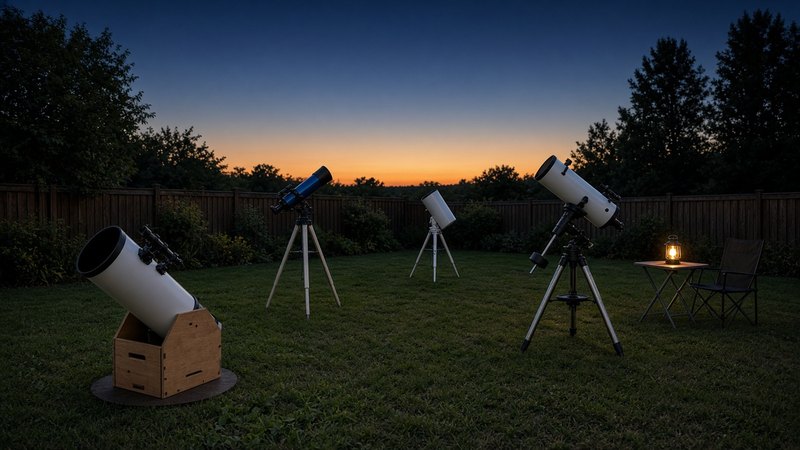
Telescope Types: Dobsonian vs Refractor vs Reflector vs Smart
A 25 mm eyepiece in a 1,200 mm Dobsonian gives 48x. In a 660 mm refractor it gives 26.4x. In a 1,540 mm Maksutov it gives 61.6x.
You divide focal length by the eyepiece. That quotient is the power.
Pick the Dobsonian for faint objects. Pick the refractor for one trip and no collimation. Pick the Mak for planets from a short balcony.
The Classic 200P is 45 lb in two pieces. A 102 mm kit is 14.2 lb. A guided 80 mm kit is 9.2 lb. A 70 mm kit is 3.3 lb.
Five designs cover a first telescope: a lens, a Newtonian on a rocker, a Maksutov, a Schmidt-Cassegrain, and a camera behind a small mirror.
Ignore the huge number on a carton. A 70 mm lens tops out near 140x, because 2 times 70 is 140. A carton that prints 525x on a 400 mm tube wants a 0.76 mm eyepiece.
Do that division. 400 divided by 525 is 0.76. You will not enjoy that eyepiece. Celestron's Travel Scope 70 sheet, also 400 mm, lists a 20 mm eyepiece at 20x.
Light grasp uses a 7 mm pupil. Divide aperture by 7, then square it. A 203 mm mirror is 841 times that pupil. A 102 mm lens is 212 times. An 85 mm mirror is 147 times.
- Lightest guided kit
- 80 mm refractor, kit 9.2 lb (4.2 kg).
- Lightest kit
- 70 mm refractor, kit 3.3 lb (1.5 kg).
- Smart mirror
- Odyssey, 85 mm, 320 mm, f/3.9 on the sheet, 8.8 lb plus a 5.5 lb tripod.
- Balcony Mak
- Skymax 102, 1,300 mm, f/12.7. A 10 mm eyepiece is 130x.
- Balcony refractor
- 102 mm, 660 mm, f/6.5, kit 14.2 lb (6.44 kg).
- Deep-sky mirror
- 203 mm Dobsonian, 1,200 mm, f/5.9, 45 lb in two pieces.
Weights and focal lengths: Sky-Watcher Classic sheet, Skymax 102 and 127, Celestron DX 102AZ, LT 80AZ, Travel Scope 70, and NexStar 6SE, Unistellar Odyssey. Read 2026-10-17.
Five designs, three numbers each
A refractor bends light with a lens at the front. A reflector bounces it off a mirror at the back. Both form an image. The tube around them does not.
A refractor has no mirror in the light path. Nothing blocks the middle of the lens. The 127 mm Mak's 39 mm secondary blocks 9 percent of the area. The 6SE's 56 mm secondary blocks 14 percent.
A Newtonian uses two mirrors. The big one is the primary. A small flat one sends the cone out the side. That flat mirror is the obstruction.
A Dobsonian is not a third optic. It is a Newtonian on a plywood rocker. John Dobson spread that rocker in the 1970s. The Classic 200P still splits into tube and base.
The 200P primary is 203 mm, listed as 8 in. Focal length is 1,200 mm. Divide 1,200 by 203 and you get f/5.9. The sheet prints f/5.9.
A Maksutov folds a long focal length into a short tube. The Skymax 102 is 1,300 mm at f/12.7.
The Skymax 127 is 1,540 mm at f/12.1, and that tube is 15 in long. The 200P tube is 43 in, or 1,092 mm, for only 1,200 mm of focus.
A Schmidt-Cassegrain folds the cone too, but the front glass is a thin Schmidt plate, not a thick meniscus.
The NexStar 6SE is 150 mm, 1,500 mm, f/10. The tube is 406 mm, which is 16 in. The kit is 28 lb, or 12.7 kg. A 10 mm eyepiece is 150x, and the exit pupil is 1.0 mm. The sheet's 25 mm eyepiece is 60x.
The thin plate lets an SCT cool faster than a Mak. Both closed tubes still trail an open Newtonian.
A Dobsonian rocker moves up-down and left-right. An equatorial mount tilts one of its two axes to point at the celestial pole, so turning that one axis follows the sky. The mount page is the alt-az versus equatorial guide.
You read each row for three numbers. Aperture sets light. Focal length sets power with one eyepiece. Weight sets whether you take a second trip.
| Type | Aperture | Focal length | f/ratio | Weight | Cool-down | Collimation | Strong use |
|---|---|---|---|---|---|---|---|
| Dobsonian | 203 mm (8 in) | 1,200 mm | f/5.9 | 45 lb, tube 20 lb plus base 25 lb | Open tube, mirror lags the night air | You align primary and secondary | Faint clusters, nebulae, galaxies |
| Refractor, 102 mm | 102 mm (4.01 in) | 660 mm | f/6.5 | Kit 14.2 lb (6.44 kg) | Fast: about an hour | No routine alignment | Moon, planets, wide fields |
| Refractor, 70 mm | 70 mm (2.8 in) | 400 mm | f/5.7 | Kit 3.3 lb (1.5 kg) | Fast: about an hour | No routine alignment | Grab-and-go, low power |
| Maksutov | 102 mm and 127 mm | 1,300 mm and 1,540 mm | f/12.7 and f/12.1 | 127 mm tube 9.7 lb, mount extra | Slow: closed tube and a thick corrector | Holds alignment; focus moves the mirror | Moon and planets from a short tube |
| Schmidt-Cassegrain | 150 mm (5.91 in) | 1,500 mm | f/10 | 6SE kit 28 lb (12.7 kg) | Closed tube, faster than a thick Mak | Secondary screws; check after a car trip | Moon, planets, compact tube |
| Smart | 85 mm | 320 mm | f/3.9 on the sheet | 8.8 lb plus a 5.5 lb tripod | Closed mirror tube | No user alignment | Fixed camera field, 0.56° by 0.75° |
| Type | Moon and planets | Bright deep sky | Faint galaxies | Milky Way, wide field |
|---|---|---|---|---|
| Dobsonian, 203 mm | 120x to 150x | 48x, field 1.08° | 841 times a 7 mm pupil | 1.08° at 48x |
| Refractor, 102 mm | 66x, pupil 1.55 mm | 26x | 212 times a 7 mm pupil | About 2° at 26x |
| Refractor, 80 mm | 90x on the 10 mm, pupil 0.89 mm | 36x on the 25 mm, field 1.44° with 52° | 131 times a 7 mm pupil | 1.44° at 36x |
| Maksutov, 102 mm | 130x, pupil 0.78 mm | 52x on a 25 mm, field 1.0° | 212 times a 7 mm pupil | 1.0° at 52x |
| SCT, 150 mm | 150x on 10 mm, pupil 1.0 mm | 60x on the 25 mm | 459 times a 7 mm pupil | 0.87° at 60x with 52° |
| Smart, 85 mm | Field 0.56° by 0.75° | 147 times a 7 mm pupil | Stacked frames; same 147 | 0.75° at the long side |
The same 10 mm eyepiece does not mean the same power. On the 200P, 1,200 divided by 10 is 120x, and the exit pupil is 1.69 mm. On the 102 mm, 660 divided by 10 is 66x, and the pupil is 1.55 mm.
On the Skymax 102, 1,300 divided by 10 is 130x. Exit pupil is 102 divided by 130, or 0.78 mm. The 127 mm tube is the comparison: 1,540 divided by 10 is 154x, and the pupil is 0.82 mm.
On the 70 mm, 400 divided by 10 is 40x, and the pupil is 1.75 mm. Under 0.5 mm the view goes dim and empty.
An open Newtonian mirror lags the night air, so the image boils until the glass matches. Sky and Telescope says a Schmidt-Cassegrain and a Maksutov take a lot longer to cool than a Newtonian.
BBC Sky at Night plans about an hour for a Newtonian or a refractor, and a couple of hours for a Mak or an SCT. The Mak is the slow one. A closed tube plus a thick meniscus holds the heat.
You collimate the Dobsonian. You do not collimate these refractors.
The 200P page says 816 times an unaided pupil. We do not use 816. With a 7 mm pupil, 203 divided by 7, squared, is 841.
The 203 mm, 1,200 mm Dobsonian is the worked example for that deep-sky row. Model-by-model notes sit on the 8-inch Dobsonian comparison.
Sort by the sky you have
Three places cover most first telescopes. A balcony in town. A car to a darker field. A site you can walk to with one hand free.
We use the Bortle scale from Sky and Telescope, February 2001. Class 6 and 7 are bright suburban skies. Class 3 and 4 are rural skies. The class is a condition, not a prize.
On class 6–7 the Milky Way is weak or gone. Planets and the Moon do not care much. Faint galaxies do. On class 3–4 the faint outer parts come back.
Our assumptions. The pupil is 7 mm. Maximum power is 2 times aperture in millimeters. Minimum power is that aperture divided by 7.
True field, when we need one, is 52° divided by power. The 52° is an assumed eyepiece, not the one packed in a box.
The Moon is the ruler. We use about 0.52° on average. If your true field is wider than 0.52°, the whole Moon fits. If it is narrower, you are touring craters.
On the 200P, a 25 mm eyepiece gives 48x. A 52° eyepiece at 48x shows 1.08°. That is 2.1 Moon diameters. The whole disk fits, with sky around it.
Swap to the included 10 mm and you are at 120x. The 52° field shrinks to 0.43°. The Moon is now 1.2 times wider than the field. You see a region, not the full face.
You plan Saturn at about 50x. That power shows the rings.
In late 2026 the rings tilt only about 7.45° at the 2026-10-04 opposition and about 6.1° in early December, so the Cassini Division shows only near the ring ends, if at all. More power does not open a gap the tilt has closed.
On the 200P, 150x is an 8 mm eyepiece. 1,200 divided by 150 is 8.0. Exit pupil is 203 divided by 150, or 1.35 mm. That pupil is still above the 0.5 mm floor. It is not a plan for the Cassini Division this season.
The 70 mm kit at 20x, with the sheet's 50° eyepiece, shows 2.5°. That is 4.8 Moon diameters. M42's core shows from a class 6 yard in that field.
Class 3–4 returns the faint outer cloud. M13 grains near 120x in the 203 mm, and stays a fuzz at 70 mm.
| Target | Bortle 6–7 | Bortle 3–4 | Power to plan |
|---|---|---|---|
| Moon | All five types; the disk is bright | Same disk, often steadier air | 48x fits it on the 200P; 120x crops it |
| Saturn | Rings at about 50x | Late 2026 tilt about 7.45° to 6.1°; Cassini only at the ends | About 50x; not a 150x Cassini target |
| M42 | Core in 70 mm; more in 203 mm | Faint outer cloud comes back | 20x to 48x |
| M13 | Fuzz at 70 mm; grain at 203 mm | Fainter stars easier to separate | 100x to 150x |
| Milky Way glow | Weak or absent overhead | Wide field pays off | Under 40x; 20x on the 70 mm is 2.5° |
Match the place to the row. A balcony Skymax 102 is 1,300 mm. A 10 mm eyepiece is 130x there, and the exit pupil is 0.78 mm. The 127 mm tube at 1,540 mm reaches 154x with that eyepiece. Neither tube is 43 in long.
A dark field wants the 203 mm mirror. 841 times a 7 mm pupil is the point of carrying 45 lb. The Flextube 200P has the same 203 mm and 1,200 mm optics in a tube that collapses from 44 in to 33 in.
The lightest guided kit here is the LT 80AZ: 80 mm, 900 mm, and 9.2 lb (4.2 kg) with the tripod. The Travel Scope 70 kit is 3.3 lb and has no phone dock. The 45 lb Dobsonian is two pieces.
A refractor from 80 mm to 102 mm
The band here is 80 mm to 102 mm. At 80 mm, the LT 80AZ's aperture, the ceiling is 160x. Dawes is 1.45 arcseconds. Light grasp is 131 times a 7 mm pupil.
The worked model is the StarSense Explorer DX 102AZ. Celestron lists 102 mm, 660 mm, and f/6.5. Tube length is 812.8 mm, which is 32 in. We read that sheet on 2026-10-17.
The included 25 mm eyepiece is printed as 26x. 660 divided by 25 is 26.4. The sheet rounds. The 10 mm is printed as 66x, and 660 divided by 10 is 66 exactly.
Exit pupil at 26.4x is 3.86 mm. At 66x it is 1.55 mm. Both sit between 0.5 mm and 7 mm. Dawes on the sheet is 1.14 arcseconds, and 116 divided by 102 rounds to 1.14.
Light grasp on the sheet is 212 times a 7 mm pupil. 102 divided by 7, squared, is 212.3. They print 212. The sheet's top power is 240x. Our ceiling is 204x, because 2 times 102 is 204.
Tele Vue notes that power past about 50x per inch shows no extra detail. You can still look at 240x. Mark 204x as the detail line, and 240x as the sheet's own cap. Lowest power on the sheet is 15x. 102 divided by 7 is 14.6x.
Weight splits cleanly. The tube is 5 lb, or 2.27 kg. The tripod is 9.2 lb, or 4.17 kg. Add them and you get 14.2 lb, the kit weight Celestron prints. 5 plus 9.2 is 14.2.
A fast achromat at f/6.5 shows a colored rim on the Moon and on bright planets. That is the doublet, not a dirty lens. An ED triplet is built to cut that rim. This 102 mm tube is not that triplet.
The focuser takes 1.25 in eyepieces. A 2 in eyepiece will not seat. The 200P is the opposite: a 2 in focuser with a 1.25 in adapter. Check the barrel before you buy the eyepiece.
The Travel Scope 70 is the light kit: 70 mm, 400 mm, f/5.7, 3.3 lb (1.5 kg). The sheet caps it at 168x. Our ceiling is 140x. Dawes matches at 1.66 arcseconds, and light grasp matches at 100.
The guided kit in this band is the LT 80AZ. Celestron lists 80 mm, 900 mm, and a kit weight of 9.2 lb (4.2 kg). A 10 mm eyepiece is 90x there. 900 divided by 10 is 90.
What a 4 in class refractor reaches, target by target, is on the 4-inch page. The 102 mm sheet is the arithmetic behind that page.
Dobsonian telescope vs refractor
Put the 203 mm Dobsonian next to the 102 mm refractor. Light comes first. 203 divided by 102 is 1.99. Square that and you get 3.96. The mirror gathers about 4 times the light.
Resolution is next. Dawes for 203 mm is 0.57 arcseconds. For 102 mm it is 1.14. The mirror can split a pair the lens blends. Dawes used equal pairs near 6th magnitude.
You hold power at 150x. The Dobsonian wants an 8 mm eyepiece. The refractor wants 4.4 mm, because 660 divided by 150 is 4.4. Both sit under their ceilings, 406x and 204x.
Exit pupils at that shared 150x are not equal. 203 divided by 150 is 1.35 mm. 102 divided by 150 is 0.68 mm. The mirror's image is brighter at the same power. That is the 4 times, seen as pupil area.
Carry is the other half of the choice. The 200P tube is 20 lb and the base is 25 lb. You take two trips. The 102 mm kit is one 14.2 lb load. Tube length is 1,092 mm against 813 mm.
Collimation is the Dobsonian's chore. Two mirrors drift, and f/5.9 is less forgiving than f/8. The refractor skips that chore. You trade it for a colored rim at f/6.5.
The same sheet's Classic 150P is 150 mm, still 1,200 mm, f/8, 40 lb. The 25 mm is still 48x.
Light changes. 203 divided by 150, squared, is 1.83. Dawes at 150 mm is 0.77 arcseconds. The ceiling is 300x. Light grasp is 459 times a 7 mm pupil.
The 200P focuser is a 2 in Crayford with a 1.25 in adapter. A 2 in eyepiece fits that Dobsonian. It does not fit the 102 mm.
In a class 6–7 yard the planets look close at the same power. The extra light shows on M42 and M13. Class 3–4 widens that gap.
At f/5.9, coma stretches stars at the edge of a low-power field. The f/6.5 refractor trades that coma for color.
Our ceiling on the 200P is 406x. The inch form, 50 times 8, is 400x. A 6 mm eyepiece is only 200x, with a 1.02 mm pupil. The top of the formula is not a target you should chase.
What the 8 in aperture reaches, object by object, is on the 8-inch page. Aperture choice across sizes is on what size telescope you need.
| Aperture | Floor | Ceiling | Dawes | Light vs 7 mm pupil |
|---|---|---|---|---|
| 85 mm | 12.1x | 170x | 1.36" | 147 |
| 70 mm | 10.0x | 140x | 1.66" | 100 |
| 80 mm | 11.4x | 160x | 1.45" | 131 |
| 102 mm | 14.6x | 204x | 1.14" | 212 |
| 127 mm | 18.1x | 254x | 0.91" | 329 |
| 150 mm | 21.4x | 300x | 0.77" | 459 |
| 203 mm | 29.0x | 406x | 0.57" | 841 |
The 85 mm row is the smart mirror on this page. 85 divided by 7, squared, is 147. You do not swap eyepieces on it. The sensor takes the whole 320 mm, so the frame stays 0.56° by 0.75°.
Maksutov vs Dobsonian
The Skymax 127 tube is 15 in long and focuses at 1,540 mm. The 200P tube is 43 in long and focuses at 1,200 mm. The short tube has the longer focus.
The included 28 mm eyepiece is printed at 55x. 1,540 divided by 28 is 55.0. Exit pupil is 2.31 mm. A 52° assumption gives a 0.95° true field, or 1.8 Moon diameters.
A 10 mm eyepiece jumps to 154x. Exit pupil falls to 0.82 mm. True field falls to 0.34°. The Moon no longer fits. This is the balcony planet setup: high power, short tube, no 43 in swing into a railing.
A 6 mm eyepiece would be 257x. 1,540 divided by 6 is 256.7. Our ceiling is 254x. Exit pupil is 0.49 mm, under the 0.5 mm line. Stop at 10 mm. The extra step buys an empty zoom.
Light still favors the Dobsonian. 203 divided by 127, squared, is 2.55. Dawes is 0.57 arcseconds against 0.91. The sheet lists Dawes 0.91 arcseconds and powers from 18x to 250x, within a step of our 18.1x and 254x.
The fold costs a 39 mm secondary. That is 31 percent of 127 mm by diameter, and 9 percent by area. A refractor's obstruction is zero.
The Mak tube, with accessories, is 9.7 lb (4.4 kg). A mount is extra. You should not treat 9.7 lb as a whole stand next to the Dobsonian's 45 lb.
On a balcony you get 154x from a 10 mm eyepiece in a 15 in tube. The Dobsonian needs about 8 mm for 150x, and that tube is 43 in.
At a dark site the 2.55 times light, and the 1.08° field at 48x, swing back to the rocker.
The meniscus corrector cancels the spherical aberration of the spherical primary. It is not there to cancel color.
The f/6.5 achromat has no mirror, so it has no spherical primary to fix. It does show a colored rim. The Newtonian primary is a paraboloid, so it skips that meniscus.
What a smart telescope changes
The smart telescope on this page is the Unistellar Odyssey. The mirror is 85 mm. Focal length is 320 mm. Unistellar prints f/3.9. 320 divided by 85 is 3.76. You watch a screen. There is no eyepiece to swap.
The frame is 33.6 by 45 arcminutes. That is 0.56° by 0.75°. The long side holds 1.44 Moon diameters. The short side holds 1.08. A Seestar S50, at 50 mm and 250 mm, is the smaller comparison, not the worked example.
The telescope is 4 kg, or 8.8 lb. The tripod is 2.5 kg, or 5.5 lb. The body is 435 mm long. Light grasp is 147 times a 7 mm pupil. Dawes is 1.36 arcseconds. 116 divided by 85 is 1.36.
A planet stays a small spot in that 0.75° frame. The crop is the sensor.
841 divided by 147 is 5.7. The 203 mm mirror gathers 5.7 times this 85 mm mirror. Stacking frames is not a larger mirror.
Unistellar states about 5 hours from the internal battery. At class 6–7 that 85 mm mirror still frames the Moon in 0.75°. Faint galaxies want the 203 mm mirror, at 841 times a 7 mm pupil.
Field and sensor, defined, are on the smart-telescope page. Several models in one table are on the smart-telescope comparison. Seestar and Dwarf, on aperture and weight, are on the Seestar vs Dwarf page.
On any listing, read aperture, focal length, and weight before the slogan. If focal length is missing, you cannot know the power. If the field is missing, you cannot know whether the Moon fits.
Common Questions
Is a Dobsonian or a refractor the simpler start?
Start with the load. The Classic 200P is 45 lb, a 20 lb tube plus a 25 lb base. The 102 mm kit is 14.2 lb. The 70 mm kit is 3.3 lb. You will carry that load more than once.
Then check power with a 25 mm eyepiece. That is 48x on the 1,200 mm Dobsonian and 26.4x on the 660 mm refractor. Pick the load you can repeat, then the power you actually want.
How is a refractor different from a reflector?
A refractor uses a lens and has nothing in the middle of the light path. A Newtonian reflector uses two mirrors, so a small flat blocks part of the beam. A Dobsonian is that Newtonian on a rocker box.
On these sheets the 102 mm lens is 660 mm long in focus and 14.2 lb as a kit. The 203 mm mirror is 1,200 mm and 45 lb. Same 10 mm eyepiece: 66x versus 120x.
How does a Maksutov compare with a Dobsonian for planets?
The Skymax 127 packs 1,540 mm into a 15 in tube. A 10 mm eyepiece gives 154x and a 0.82 mm exit pupil. The 200P needs about 8 mm to reach 150x, and the tube is 43 in.
The Dobsonian still gathers 2.55 times the light, because 203 divided by 127, squared, is 2.55. Use the Mak when the balcony is short. Use the Dobsonian when the sky is dark and you can carry 45 lb.
Does a smart telescope replace an eyepiece telescope?
No. The Odyssey has no eyepiece to swap. The frame stays 0.56° by 0.75°. The long side holds 1.44 Moon diameters. You cannot move from 48x to 120x by changing glass.
The mirror is 85 mm at 320 mm. The sheet prints f/3.9, and 320 divided by 85 is 3.76. Light grasp is 147 times a 7 mm pupil, against 841 for the 203 mm mirror. Stacked frames do not turn 85 mm into 203 mm.
What power on the box should you trust?
Trust focal length divided by eyepiece, then cap it at 2 times the aperture in millimeters. A 70 mm, 400 mm tube at a 20 mm eyepiece is 20x. The ceiling is 140x. A carton that prints 525x needs a 0.76 mm eyepiece.
Do the same check on the 102 mm sheet. It prints 240x. The formula gives 204x. Tele Vue notes you will not see extra detail past about 50x per inch.
Read next
- What you can seeWhat size telescope do you need?
- Telescopes8-inch Dobsonian telescopes compared
- TelescopesSeestar vs Dwarf specs
Sources
- Sky and Telescope, telescope-buying tips: magnification is focal length divided by eyepiece, and maximum useful power is about twice the aperture in millimeters, or 50 times the aperture in inches. skyandtelescope.org, read 2026-10-17.
- Sky and Telescope, choosing magnification: Dawes' limit is 4.56 arcseconds divided by aperture in inches; about 50x per inch matches a 0.5 mm exit pupil. This page uses a Moon of about 0.52° on average. skyandtelescope.org, read 2026-10-17.
- Sky and Telescope, double-star limits: Dawes' limit is 116 divided by aperture in millimeters. skyandtelescope.org, read 2026-10-17.
- Tele Vue, telescope formulas: power, exit pupil, focal ratio, and aperture gain versus pupil diameter. The note on the 50x-per-inch rule says extra power past that line shows no extra detail. televue.com, read 2026-10-17.
- John E. Bortle, Introducing the Bortle Dark-Sky Scale, Sky and Telescope, February 2001. Class 3–4 rural, class 6–7 bright suburban. skyandtelescope.org, read 2026-10-17.
- Sky-Watcher USA product sheet 30-20002-e, Classic 200P SKU S11610: 203 mm, 1,200 mm, f/5.9, tube 43 in, 20 lb tube, 25 lb base, 45 lb assembled, 25 mm at 48x, 10 mm at 120x. Sheet ©2021, read 2026-10-17.
- Sky-Watcher USA, Classic 150P, SKU S11600: the page summary says 150 mm. The spec tab lists focal length 1,200 mm, tube 15 lb, and base 25 lb, which is 40 lb together. skywatcherusa.com, read 2026-10-23.
- Sky-Watcher Skymax 102: 102 mm, 1,300 mm, f/12.7. skywatcherusa.com, read 2026-10-17.
- Sky-Watcher USA, Skymax 127: 127 mm, 1,540 mm, f/12.1. skywatcherusa.com, read 2026-10-17.
- Sky-Watcher SKU S11520: secondary 39 mm, 31 percent by diameter, 9 percent by area, tube 15 in, 9.7 lb, 28 mm at 55x, Dawes 0.91. skywatcher.com.tw, read 2026-10-17.
- Celestron StarSense Explorer DX 102AZ: 102 mm, 660 mm, f/6.5, 25 mm at 26x, 10 mm at 66x, tube 5 lb, tripod 9.2 lb, kit 14.2 lb. celestron.com, read 2026-10-17.
- Same DX 102AZ sheet: Dawes 1.14 arcseconds, light grasp 212x, highest useful power 240x, lowest 15x, tube length 32 in. Read 2026-10-17.
- Celestron, Travel Scope 70: 70 mm, 400 mm, f/5.7, kit 3.3 lb, tube 1.5 lb, 20 mm at 20x, 10 mm at 40x, highest useful 168x, Dawes 1.66 arcseconds, light grasp 100x. celestron.com, read 2026-10-17.
- Celestron StarSense Explorer LT 80AZ: 80 mm, 900 mm, f/11 on the sheet, tube 965 mm and 5.4 lb (2.45 kg), tripod 3.8 lb (1.72 kg), kit 9.2 lb (4.17 kg), 25 mm at 36x, 10 mm at 90x. celestron.com, read 2026-10-23.
- Celestron NexStar 6SE: Schmidt-Cassegrain, 150 mm, 1,500 mm, f/10, tube 406 mm and 8 lb, kit 28 lb (12.7 kg), 25 mm at 60x, secondary 56 mm, 37 percent by diameter and 14 percent by area, Dawes 0.77 arcseconds. celestron.com, read 2026-10-17.
- Unistellar Odyssey: 85 mm, 320 mm, the sheet prints f/3.9 (320 divided by 85 is 3.76), field 33.6 by 45 arcminutes, telescope 4 kg (8.8 lb), tripod 2.5 kg (5.5 lb), body 435 mm, battery about 5 hours. shop.unistellar.com and unistellar.com, read 2026-10-17. Body length: help.unistellar.com.
- BBC Sky at Night Magazine, cool-down advice: about an hour for a Newtonian or a refractor, and a couple of hours for a Schmidt-Cassegrain or a Maksutov. skyatnightmagazine.com, read 2026-10-17.
- Sky and Telescope, long focal length telescopes: an SCT and a Maksutov take a lot longer to cool than a Newtonian. skyandtelescope.org, read 2026-10-17.
- JPL Horizons, Saturn ring opening: about 7.45° at the 2026-10-04 opposition and about 6.1° in early December 2026. ssd.jpl.nasa.gov, read 2026-10-23.
How we check a number against the formula or the sheet: How we research.