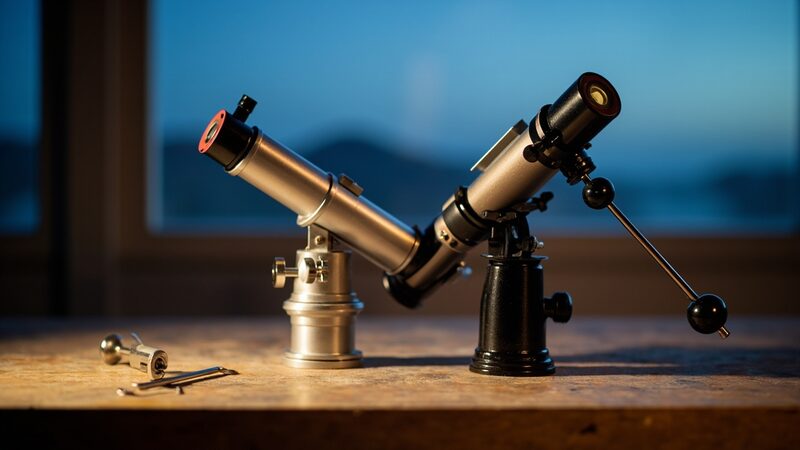
Alt-Az vs Equatorial Mounts
An alt az versus equatorial mount comes down to one question. How long do you want to watch a single target without pushing the tube? The sky moves 15.04° per hour, which is 0.251° per minute. An alt-az mount has to be pushed at exactly that rate.
A 1,000 mm tube with a 10 mm eyepiece is 100x. A 52° eyepiece then shows 0.52° of sky, because 52 ÷ 100 = 0.52. At 0.251° per minute, that field walks across the view in about 2.1 minutes.
An equatorial mount trades that pushing for setup. One axis is tilted to your latitude and points at the pole. The sky then turns under the eyepiece instead of around it. You also carry a counterweight shaft and a heavier tripod. And you align the axis before every session.
So count two things before you pick an axis. The kilograms on your tube. The minutes you stay on one target. The telescope type comes first, and our telescope type comparison starts there.
- Manual alt-az head
- SVBONY SV225 listing: two axes with variable-speed slow motion on both; 10 kg rated payload, and the maker suggests 7 to 8 kg of working load; 2.34 kg head; no polar alignment.
- GoTo alt-az head
- Sky-Watcher AZ-GTi listing: two motorised axes and dual encoders; 5 kg payload (11 lb); 3.9 kg head (8.6 lb); no polar alignment.
- Manual German EQ
- Celestron CG-4 listing: right-ascension axis tilted to your latitude, declination axis, counterweight shaft; 9.07 kg payload (20 lb); 5.66 kg mount (12.5 lb); polar alignment each session.
- GoTo German EQ
- Celestron Advanced VX listing: the same three parts plus motors and a NexStar+ hand control; 13.6 kg payload (30 lb); 21.3 kg kit (47 lb); polar alignment each session.
- Dobsonian rocker base
- Celestron StarSense Explorer 114AZ listing: manual altazimuth tabletop Dobsonian-style base; 114 mm (4.5 in) aperture; 12.6 lb (5.7 kg) unit; no payload printed; no polar alignment.
One maker listing per row, read 2026-11-02; the listings are named in Sources. Weights are what each listing prints: head weight for the two alt-az and two EQ mounts, unit weight for the 114AZ tabletop.
Alt-az and equatorial side by side
An alt-az mount has two axes, and they meet at a right angle. One swings the tube left and right. The other tips it up and down. Both stay square to your own frame, so pointing needs no preparation.
An equatorial mount has three parts instead. A right-ascension axis, tilted up to your latitude. A declination axis across it. And a counterweight shaft on the end.
Three rows in the table below decide most of the argument. The axis row says how the tube moves. The field-rotation row says what happens to the picture while you watch. The payload row says whether the head can carry your tube at all.
The middle one is the row people skip. The daily turn of the sky shows up as a slow rotation of the field. The rate is 15.04° per hour times the cosine of the target's declination.
On the celestial equator that is 15.04° per hour. At +60° it is 7.52°, because the cosine of 60° is 0.5.
An aligned equatorial mount has zero. Its axis already points at the place the sky turns around.
Take a target at +40°. 15.04 × cos 40° = 11.5° per hour, because the cosine of 40° is 0.766. At 0.52° of true field that is 22 field widths of rotation in one hour. The picture turns while you watch, and no eyepiece change will stop it.
That is what the counterweight buys. It does not make the image brighter. It does not add detail. It buys a still field.
Read the payload row as a rating, not a promise. A maker's number is the load the head is built to hold. We add a margin on top of that, and this is our rule rather than a printed one.
Rated payload should be at least 1.2 times the weight of the tube on it.
A 203 mm (8 in) Dobsonian tube weighs 9.07 kg. 9.07 × 1.2 = 10.9 kg of rated payload. A head rated 10 kg does not clear that bar. The SV225 listing says the same in its own words: it recommends a working load of 7 to 8 kg.
A head is not always the whole stand. The SV225 listing is for the head alone, at 340 × 285 × 145 mm. The CG-4 comes with a steel tripod, and the Advanced VX kit is 47 lb with 2 in stainless steel legs.
A payload rating tells you what the head can hold. It says nothing about the walk from the car.
| What to read | Alt-az | Equatorial |
|---|---|---|
| Axes and layout | Two axes at a right angle; both stay vertical and horizontal | Three parts: RA axis tilted to your latitude, declination axis, counterweight shaft |
| Polar alignment | None | Every session: level, set the latitude scale, aim the polar scope, clamp |
| Pushing a moving target | Both axes, at 0.251° per minute | One axis, at 0.251° per minute |
| Field rotation in one hour | 15.04° × cos(declination): 15.04° at 0°, 7.52° at +60°, 0° at the pole | 0° once the polar axis is aligned |
| Counterweight | None | One, on the end of the shaft |
| Rated payload | 5 kg (SV225 Mini), 10 kg (SV225), 5 kg (AZ-GTi) | 9.07 kg (CG-4), 13.6 kg (Advanced VX) |
| Head or kit weight | 1.5 kg (SV225 Mini), 2.34 kg (SV225), 3.9 kg (AZ-GTi) | 5.66 kg (CG-4), 21.3 kg with tripod (Advanced VX) |
| Steps before the first look | 1: set the tripod up | 4: level, latitude, polar scope, clamp |
Two rules come out of that. If you look at the Moon and the planets for minutes at a time, an alt-az head is enough. It is also the easier one to carry.
If you sit on one target for an hour or more, the equatorial mount buys back your time. One axis to push instead of two. A field that does not turn under you.
Before you compare heads, weigh your tube. The payload column tells you which ones can take it. The weight column tells you which ones you will still want to carry at midnight.
What changes when the sky moves
The sky turns against the stars once every sidereal day. That is 15.04° per hour. Divide by 60 and you get 0.251° per minute. Divide once more and you get 15.04 arcseconds per second. That is the rate a hand on the slow-motion knob has to turn at.
Now work it through a telescope. A 1,000 mm tube with a 10 mm eyepiece is 100x, because 1,000 ÷ 10 = 100. A 52° apparent field at 100x gives 0.52° of true field, because 52 ÷ 100 = 0.52.
Divide that field by the drift rate: 0.52 ÷ 0.251 = 2.1 minutes. Two minutes, and the target is at the edge of the frame.
An alt-az mount needs both axes for that job. One hand swings the tube sideways. The other tips it. The two moves have to be coordinated, or the target slides diagonally out of view.
Slow-motion handles on both axes turn it into one job. The SV225 lists variable-speed slow motion on both axes for exactly that reason.
An equatorial mount needs one axis for the same job. The right-ascension axis is already pointed at the pole. Turn it at the drift rate and the target stays in the middle. The declination axis stays where you left it. Your second hand stays off the tube.
The second effect is the field rotation. It is the reason the equatorial mount exists. On an alt-az mount the image turns slowly about the drift axis, at 15.04° per hour times the cosine of the declination.
An aligned equatorial mount does not have that. Its field stays put while the sky turns around it.
Put the two numbers side by side. Two minutes of drift moves the target one field width, 0.52°. One hour of rotation turns the field 15.04°. That is 29 times the width of the same field. The first is a nudge. The second is a quarter turn of the picture.
Nothing about the mount makes the image brighter. A still field is what the extra weight buys.
Pick a mount by what you do with it
Grab and go. The head goes into the car with the tube, and comes out at the field. Nothing to align is the whole point. No latitude scale, no polar scope, no counterweight to hang.
The SV225 Mini is 1.5 kg with a 5 kg payload. Its listing names the tube sizes it pairs with, from 70 mm to 105 mm. A 102 mm refractor tube is 2.27 kg. 2.27 × 1.2 = 2.72 kg of rated payload, so it fits with room to spare.
Chasing a moving target. Here the number is 0.251° per minute, and the mount has to deliver it smoothly. A manual German equatorial mount can: the Celestron CG-4 has slow-motion handles on both axes, 9.07 kg of payload, and 5.66 kg of mount with its tripod.
A dual-slow-motion alt-az does the same job. The difference appears in the second hour. The equatorial mount holds the field still, and your one hand stays on one handle.
A base you can set on a table. The Dobsonian rocker is an alt-az mount with friction knobs instead of clamps. The StarSense Explorer 114AZ is that base with a 114 mm (4.5 in) tube on it. The maker prints no payload for it, so check your own tube first.
Equatorial mounts: the counterweight side
A German equatorial mount is a shape, not a place. The word German describes the geometry, not the country. A right-ascension axis. A declination axis crossing it. A counterweight shaft on the far end.
The right-ascension axis is tilted up until it points at the pole. In the northern hemisphere, the altitude of the pole above the horizon equals your latitude.
The counterweight comes first in the process. Slide the tube along the shaft until it balances. Then clamp the tube. That is why the shaft exists. An unbalanced load makes the axis hard to move, and a head that is hard to move gets handled badly.
Aligning is those four steps, in that order, and it takes about a minute each time you set up.
- 1. Level the tripod, so the latitude scale on the head reads true.
- 2. Set the latitude scale to your latitude. The Advanced VX covers 7° to 77°.
- 3. Aim the polar scope at the pole. The altitude of the pole above the horizon is your latitude.
- 4. Clamp both axes, and check the scope again once the tube is on.
Then there is the cost. The CG-4 is rated 9.07 kg, and the mount is 5.66 kg. 9.07 kg is exactly the weight of a 203 mm (8 in) Dobsonian tube. No margin at all, and our 1.2 rule asks for 10.9 kg.
The Advanced VX carries more, 13.6 kg. Its kit with the tripod is 47 lb, or 21.3 kg. That is a two-piece load, like the 45 lb Dobsonian it is meant to carry.
What you buy with that weight is one axis to push and a field that does not rotate. Nothing in the glass changes.
GoTo mounts: what the catalogue does
A GoTo mount is a catalogue and two motors. You pick a target from a list. The motors turn the tube to it. The list is the product.
The NexStar+ hand control on the Celestron Advanced VX carries a 40,000+ object database. The Sky-Watcher AZ-GTi keeps its catalogue in the SynScan Pro app instead, and raises its own WiFi signal for the phone.
What GoTo does not do is align the sky for you. The AZ-GTi's dual encoders let you move the tube by hand without losing the alignment it already has. The StarSense 114AZ leans on a phone app that recognises star patterns overhead.
Either way, there is an alignment step. On an equatorial mount, that step still starts with the polar axis.
What GoTo does not do is stop the sky. A GoTo alt-az keeps the target in the middle while the field turns under it, at 15.04° per hour times the cosine of the declination.
An equatorial mount with motors turns one axis at 0.251° per minute. Then the field stays still.
Three numbers decide a GoTo purchase. The payload has to cover your tube with the same 1.2 margin. The weight decides whether you carry it: the AZ-GTi is 8.6 lb (3.9 kg) with a 5 kg payload. It runs on AA batteries or a 12 V input.
The catalogue decides how you find things. Where it lives matters as much as how many objects it holds.
Dobsonian bases are alt-az too
The rocker under a Dobsonian is an alt-az mount. Two axes, friction knobs instead of clamps. No polar axis, and nothing to align.
If a Dobsonian already stands in your garage, the question is not whether to buy an equatorial mount. It is whether to buy a different head at all.
The numbers to check are in the table below. The Sky-Watcher Classic 200P splits into a 20 lb tube (9.07 kg) and a 25 lb base, 45 lb assembled.
The 10-inch on our 10-inch page has a 29.2 lb tube (13.25 kg) on a 25.6 lb base.
| Tube | Tube weight | × 1.2 needed | 5 kg head | 9.07 kg EQ | 10 kg head |
|---|---|---|---|---|---|
| 80 mm refractor | 2.45 kg (5.4 lb) | 2.94 kg | Fits | Fits | Fits |
| 102 mm refractor | 2.27 kg (5 lb) | 2.72 kg | Fits | Fits | Fits |
| 203 mm Dobsonian | 9.07 kg (20 lb) | 10.9 kg | No | No margin | No |
| 254 mm Dobsonian | 13.25 kg (29.2 lb) | 15.9 kg | No | No | No |
So read the whole rating, not the first number in it. A 10 kg head does not take a 9.07 kg tube with our margin.
The same listing that says 10 kg also says to keep the load under 8 kg. A 9.07 kg equatorial head carries the tube with no margin at all.
What a Dobsonian buys is aperture for the weight. The 203 mm mirror gathers 841 times a 7 mm pupil, and the 8-inch page works out what that light reaches. What an equatorial mount buys is a still field. Those are different arguments, and a rocker answers the first one.
Common Questions
Do I need an equatorial mount for visual observing?
No, not for the Moon and the planets. An alt-az head does the same job with two hands instead of one, and it needs no alignment. The equatorial mount earns its place in a long session: one axis to push, and a field that does not rotate.
What is the major downside of an alt-az mount?
You push both axes to follow a moving target, and the field slowly rotates while you watch. The sky turns 15.04° per hour, so at 100x a target crosses a 0.52° field in about 2.1 minutes. That rotation is the second thing to correct.
What is a German equatorial mount?
A shape, not a place. A right-ascension axis tilted up to your latitude, a declination axis crossing it, and a counterweight shaft on the end. The shaft lets you balance the tube before you clamp it. Then the sky turns around that axis instead of around your head.
Is polar alignment hard?
Four steps and about a minute: level the tripod, set the latitude scale to your latitude, aim the polar scope at the pole, then clamp the axes. The altitude of the pole above the horizon equals your latitude. Skip the steps and the mount still moves, but the field will not stay still.
Is a Dobsonian an alt-az mount?
Yes. The rocker under a Dobsonian is a two-axis alt-az mount with friction knobs instead of clamps. If you own a Dobsonian, you already own an alt-az mount. An equatorial head is a different platform for the same tube, not a requirement for looking at the sky.
How much payload do I need?
Use our rule: rated payload should be at least 1.2 times the weight of the tube. A 203 mm (8 in) Dobsonian tube is 9.07 kg, so 9.07 × 1.2 = 10.9 kg. A head rated 10 kg does not clear it, and the SV225 listing recommends a working load of 7 to 8 kg.
Read next
- TelescopesTelescope types compared
- ToolsTelescope magnification calculator
- ToolsEyepiece field of view and exit pupil
- What you can seeWhat an 8-inch telescope shows
- What you can seeWhat a 10-inch telescope shows
- What you can seeWhat size telescope you need
- GuidesWhat a smart telescope actually does
Sources
- Sky drift and formulas. The sky turns 15.04° per hour against the stars. True field = apparent field ÷ power. Field rotation = 15.04° per hour × cos(declination). Payload rule (ours, not a printed rule): rated payload ≥ tube weight × 1.2. Method page: How we research, read 2026-11-02.
- Celestron, Advanced VX Computerized German Equatorial Mount listing: 30 lb (13.6 kg) payload, 47 lb (21.3 kg) kit with 2 in stainless steel tripod legs, latitude range 7° to 77°, NexStar+ hand control with a 40,000+ object database. Read 2026-11-02.
- Celestron, CG-4 Manual German Equatorial Mount listing: 20 lb (9.07 kg) payload, 12.5 lb (5.66 kg) mount weight, 33 to 47 in tripod, manual slow motion on both axes, adjustable latitude, accepts a motor drive. Read 2026-11-02.
- Sky-Watcher, AZ-GTi listing: 8.6 lb (3.9 kg) weight, 11 lb (5 kg) payload, dual encoders, own WiFi signal with app control, AA battery compartment and 12 V input, tripod with pier extension from 28 to 53 in. Read 2026-11-02.
- SVBONY, SV225 Alt-Azimuth Mount listing: 10 kg payload with a recommended working load of 7 to 8 kg, 2.34 kg head weight, variable-speed slow motion on both axes, 340 × 285 × 145 mm, one piece. Read 2026-11-02.
- SVBONY, SV225 Mini Alt-Azimuth Mount listing: 5 kg payload, 1.5 kg (3.31 lb) weight, UNC 3/8-16 thread, tilt from -60° to 60° with 360° azimuth, one piece. Read 2026-11-02.
- Celestron, StarSense Explorer 114AZ listing: 114 mm (4.5 in) tabletop alt-az base, phone app alignment, 12.6 lb unit weight, one piece, no payload printed. Read 2026-11-02.
- Sky-Watcher USA product sheet 30-20002-e, Classic 200P: 203 mm, 1,200 mm, tube 20 lb, base 25 lb, 45 lb assembled. Read 2026-10-17, the same sheet used on the telescope types page.
- Sky-Watcher Classic 250P sheet as used on the 10-inch page: tube 29.2 lb, base 25.6 lb, kit 54.8 lb. Read 2026-10-17.
- Celestron StarSense Explorer DX 102AZ sheet: tube 5 lb (2.27 kg). Celestron StarSense Explorer LT 80AZ sheet: tube 5.4 lb (2.45 kg). Read 2026-10-17 and 2026-10-23 as recorded on the telescope types page.
- Listing details read with the site selection tool on 2026-11-02: item titles, feature text, piece count, size and dimensions as printed on each listing.
How we check a number against the formula or the sheet: How we research.