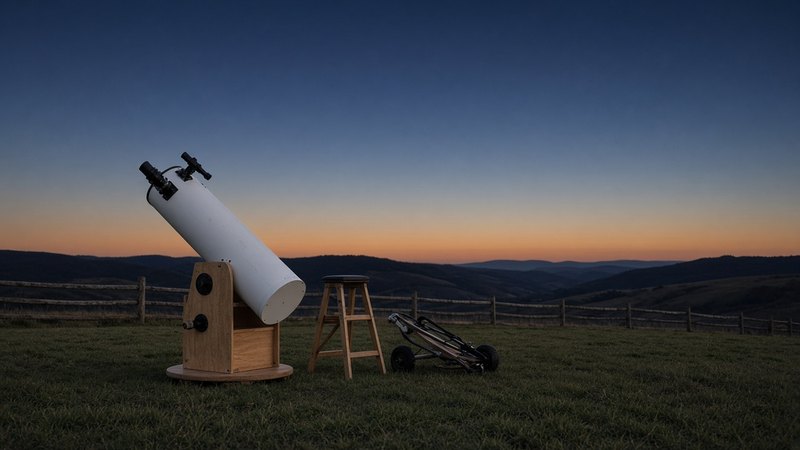
What Can You See With a 10-Inch Telescope?
A 254 mm (10 in) mirror gathers about 1,317 times the light of your eye and splits stars 0.46 arcseconds apart. That covers Saturn's Cassini Division on steady nights, Jupiter's Great Red Spot, and every Messier object.
Galaxy arms need a Bortle 3-4 sky; from a Bortle 6-7 yard they stay hidden.
- Aperture
- 254 mm (10 in)
- Light grasp vs a 7 mm pupil
- 1,317 times
- Dawes limit
- 0.46 arcseconds
- Limiting magnitude, dark-sky estimate
- 14.7
- Max useful magnification
- 508x
- Typical focal length
- 1,200 mm at f/4.7
Light grasp, Dawes, and 508x are formulas in Our assumptions. The 1,200 mm, f/4.7 tube is the Celestron StarSense Explorer 10 Dobsonian spec sheet, checked 2026-10-17. That sheet prints 1,317x, 0.46 arcseconds, 36x, and 600x.
Planets and the Moon
Planets are point-like disks with hard edges. Skyglow hurts them less than it hurts a galaxy. You can do real planet work from a bright suburb.
Resolution and seeing set the view. The 0.46 arcsecond Dawes disk is the mirror's floor. If the air blurs stars to 2 arcseconds, the floor sits idle.
Enlarge a 2 arcsecond blur until it spans 4 arcminutes at your eye. Four arcminutes is 240 arcseconds. Divide 240 by 2 and you are at 120x. More power mostly enlarges the blur.
On a 1 arcsecond night the same sum gives 240x. On a 0.5 arcsecond night it gives 480x, close to the 508x ceiling.
The Moon is about 0.52 degrees across. At 48x that disk spans 25 degrees in the eyepiece. A 52 degree apparent field holds the whole Moon with room around it.
At 120x the Moon spans 62 degrees. A 52 degree eyepiece shows 0.43 degrees of sky. Most of the disk fits. The limb spills past the field stop. Pan along the terminator.
An 80 km (50 mile) crater spans about 43 arcseconds. You see it at 48x. Rilles and craterlets want 150x to 200x and steady air.
Exit pupil at 120x is 254 / 120, or 2.1 mm. The lunar surface is bright at that pupil. If the glare washes the gray tones, raise to 150x-200x (1.7-1.3 mm pupil) before you add glass in front of the eyepiece.
At 200x the exit pupil is 1.3 mm. Shadow relief along the terminator gets sharper. The lit highlands get dimmer.
Jupiter's disk runs about 30 to 50 arcseconds, depending on the date. Take a 40 arcsecond night at 200x. The disk then spans 8,000 arcseconds, or 2.2 degrees, at your eye.
Belts show at 48x to 80x. The Great Red Spot is a contrast mark. It wants about 150x to 200x and air under 2 arcseconds.
Four bright moons sit well outside the disk. You see them at 38x. Their shadows on the cloud tops are about 1 to 2 arcseconds wide. Try 150x when a shadow is scheduled.
At the 2026-10-04 opposition the rings are tipped 7.45 degrees (JPL Horizons) and the globe is about 19.7 arcseconds. Across 2026 the tilt runs from about 1 to 9.2 degrees; by early December it is about 6.1 degrees.
At that tilt the Cassini Division shows mainly at the ansae, the two ends of the rings. Through 2027 the rings open further, and the gap becomes easier along more of the ring.
Dawes' limit here is 0.46 arcseconds. A sub-arcsecond gap is inside the mirror's reach when the air is steady.
At 200x a 0.7 arcsecond gap spans 140 arcseconds, or 2.3 arcminutes, at the eye. Wait for a hard star image. Then try 180x to 250x.
An 8-inch mirror has a Dawes limit near 0.57 arcseconds. Both sizes can resolve a sub-arcsecond gap when the air allows. The 10-inch gives you more light at the same power, so the gap holds contrast better.
Mars is the aperture test people expect.
The disk runs from under 4 arcseconds to about 25 at a close opposition. Near the February 2027 opposition the disk is about 14 arcseconds, close to the 15 arcsecond example below.
At 15 arcseconds and 250x, Mars spans about 1.0 degree. Exit pupil is 254 / 250, or 1.0 mm. That power is 25x per inch, inside the 20x to 30x per inch band used for planets.
At 7 arcseconds the same 250x makes a 0.5 degree disk. Polar caps and the main dark patches are the target near opposition. The old "canals" were never real features. Use 200x to 300x when the star images are tight.
Venus shows phases at 48x. The disk is blank cloud, from a small gibbous to a large crescent.
Mercury is a small phase in twilight, a few arcseconds to a bit over 10. You need a clear horizon and 100x to 150x. The 254 mm mirror keeps that tiny disk bright.
Uranus is about 3.7 arcseconds across. Neptune is about 2.3 arcseconds. At 200x those disks are 0.2 and 0.13 degrees. Triton, near magnitude 13.5 and about 15 arcseconds from Neptune, sits inside the 14.7 magnitude estimate.
Pluto is about magnitude 14.4, just inside the 14.7 estimate, so it is a point of light on a dark, steady night, at high power.
Double stars are where 0.46 arcseconds becomes a split you can plan. Albireo is about 34 arcseconds apart. At 48x the pair is wide and the colors are obvious. A smaller mirror already splits it.
Epsilon Lyrae, the Double Double, has pairs near 2.3 arcseconds. That is 2.3 / 0.46, about five times the Dawes limit. At 120x to 150x a 254 mm mirror splits both pairs on an average night.
A true 0.46 arcsecond pair is another class. At 400x the gap spans 184 arcseconds, or 3.1 arcminutes. Exit pupil is 254 / 400, or 0.64 mm. You still sit under the 508x ceiling.
You need steady air for that pair. Unequal magnitudes make the split harder than the formula. Dawes' limit is for two stars of similar brightness, near magnitude 6.
Color in bright doubles is a light-grasp job. More light keeps the hue in the fainter star. That is one place the jump from 203 mm to 254 mm shows up at modest power.
| Object | Angular size | Bortle 6-7 | Bortle 3-4 | Power to try |
|---|---|---|---|---|
| Moon | 0.52 deg | Craters at 48x, rilles at 150x | Same detail in either sky class | 48x, 120x, 200x |
| Jupiter | 30-50 arcsec | Belts at 80x, spot when air is still | Same detail, darker sky around the disk | 80x to 200x |
| Saturn | globe about 20 arcsec in autumn 2026 | Rings tipped 7.45 deg on 2026-10-04; Cassini at the ansae | Same tilt; seeing sets the gap | 180x to 250x |
| Mars | 4-25 arcsec; about 14 arcsec in Feb 2027 | Caps near opposition at 200x | Same marks | 200x to 300x |
| Uranus | about 3.7 arcsec | Small disk at 200x | Same disk | 200x to 300x |
| Neptune | about 2.3 arcsec; Triton about 15 arcsec off | Disk and Triton on a steady night | Same, with a darker field | 200x to 300x |
| Venus | phase, 10-60 arcsec | Phase at 48x, blank disk | Same | 48x to 120x |
| Albireo | about 34 arcsec | Easy split, colors at 48x | Same | 38x to 80x |
| Tight equal pair | 0.46 arcsec | Only in excellent seeing at high power | Same seeing limit | near 400x |
Read the suburb column before you drive anywhere. The Moon, Jupiter, Saturn, Venus, and wide doubles stay available from a bright yard. Mars near opposition does too.
The 0.46 arcsecond row wants steady air in either sky class. Save the dark-site trip for galaxies.
Three eyepieces cover this table on a 1,200 mm tube. A 32 mm gives 38x and a 6.8 mm exit pupil.
A 10 mm gives 120x and a 2.1 mm pupil. A 6 mm gives 200x and a 1.3 mm pupil. The included 25 mm on the worked sheet is 48x, between the 32 mm and the 10 mm.
Add a 4 mm on the still nights. That is 300x and a 0.85 mm pupil, 30x per inch.
Deep-sky objects
Galaxies and nebulae are extended light. Stars in a cluster are points. A 10-inch treats those two cases differently, and the sky class splits them again.
At the same exit pupil, surface brightness stays put as aperture grows. A 2 mm pupil is 127x on 254 mm and 102x on 203 mm. The galaxy has the same brightness. You get a larger scale on the 10-inch.
At the same power, the 10-inch is brighter. At 120x the pupils are 2.12 mm and 1.69 mm. Brightness follows the square of pupil size, a factor of 1.57. That matches the light-grasp ratio.
Field of view is the other deep-sky limit. A 1.25-inch barrel accepts a field stop near 27 mm. In a 1,200 mm telescope that stop covers 27 / 1,200 × 57.3, or 1.29 degrees.
A 32 mm Plossl at 52 degrees gives a formula field of 52 / 37.5, or 1.39 degrees. The 27 mm barrel stop caps that at 1.29 degrees.
The 2-inch eyepiece on this page is 30 mm with a 70 degree apparent field. Power is 1,200 / 30, or 40x. Celestron lists a 30.4 mm field stop, so true field is 30.4 / 1,200 × 57.3, or 1.45 degrees.
Exit pupil is 254 / 40, or 6.4 mm. That sits under the 7 mm eye and above the 36x floor (254 / 7 = 36.3).
The Pleiades span about 1.8 degrees. A 1.45 degree field clips the outer stars. A 1.29 degree field clips more of them. M31 spans about 3 degrees by 1 degree, so you pan either field to cover the ends.
Open clusters are the easy deep-sky set. M45, the Double Cluster, and M44 want the wide field. You are framing degrees.
A 1,200 mm focal length is a middling field even with a 2-inch eyepiece. A shorter tube would show more sky at the same eyepiece. You trade that width for the planet scale this focal length gives at 6 mm.
Globulars are the opposite. M13 is about 20 arcminutes across and near magnitude 5.8 integrated. At 48x it is a round glow. At 120x the outer stars start to grain apart.
The core stays tight. Push to 150x or 180x on a steady night. Exit pupil at 180x is 1.4 mm. You are resolving points, so the dark-sky gain is real but smaller than it is for a faint galaxy.
From Bortle 6-7 you still resolve the halo of M13, M5, and M3. The faintest outliers drop into the sky. From Bortle 3-4 the same 120x frame fills in, with the same eyepiece.
Bright nebulae survive a suburb. M42, the Orion Nebula, is about a degree long. It fits in the 1.29 degree field.
You see the bright core from Bortle 7. The wings want Bortle 3-4 at 40x with the 70° eyepiece (1.45°), a 6.4 mm pupil.
The Trapezium's bright members sit about 9 to 13 arcseconds apart. Try 120x. The E and F stars, magnitude 10 to 11, sit in that same glow. The extra light of 254 mm is what pulls them out.
M57, the Ring Nebula, is about 1.4 by 1.0 arcminutes. At 48x it is a tiny smoke ring. At 120x the hole is obvious in both sky classes. A darker sky makes the ring edge cleaner. The shape stays a ring.
M27, the Dumbbell, is about 8 by 6 arcminutes. It shows from a suburb at 48x to 80x. The faint outer shell is a dark-sky target at a 3 to 4 mm pupil, around 60x to 85x on this mirror.
M8 spans about 90 by 40 arcminutes and sits low for northern observers. M17 is about 11 arcminutes, a smaller target in the same part of the sky. If they culminate in the murk, sky brightness sets the contrast you get.
M31's core is visible from Bortle 6-7. Dust lanes and the full 3 degree disk want a darker sky and the 1.45 degree field, and you still pan to see the ends.
M32 and M110 sit beside M31. They are small and higher in surface brightness than the outer disk. You can pick them up from a suburb at 48x to 80x when transparency is decent.
M51 is about 11 by 7 arcminutes. From Bortle 6-7, plan on two cores and a faint halo. The arms are low surface brightness. They want Bortle 3-4, a 2 mm pupil, and a night that is both dark and steady.
M81 and M82 fit in one 1.3 degree field. M81 is a smooth oval. M82 is a thin streak with mottling that takes 120x. Both cores show from a bright suburb. The mottling wants the darker site.
The Virgo cluster is a list of separate targets. Dozens of galaxies sit between magnitude 9 and 11, a few arcminutes each. From Bortle 6-7 you get the brightest, such as M87 and the M84-M86 pair, as dim patches at 80x to 120x.
From Bortle 3-4 the same 254 mm mirror lengthens that list. Most of them show as cores. Arm detail is a handful of targets, M51 among them.
NGC 891, the Leo triplet, and NGC 7331 are the step past the bright Messier cores. NGC 891 is often invisible from Bortle 6-7. From Bortle 3-4 the dust lane shows.
The Leo triplet spans about 0.8 degrees. At 40x to 60x the three can share a field. NGC 3628 shows as the faint third streak.
NGC 7331 is a small glow from Bortle 6-7 at 80x to 120x. From Bortle 3-4 the core looks elongated.
A common miss is to crank power because the galaxy looks faint. Stay near a 2 to 4 mm pupil, or the extended object dims.
For a faint galaxy, try 80x to 120x first. That is a 15 mm to a 10 mm eyepiece on the 1,200 mm tube.
Point sources work the other way. A faint star gets a real gain from 1,317 times the light of your eye. The dark-sky limiting magnitude from the simple formula is about 14.7. Skyglow steals the faint end of that number long before the mirror does.
| Object | Size | Bortle 6-7 | Bortle 3-4 | Power |
|---|---|---|---|---|
| M45 | about 1.8 deg | Core in a 1.29 deg field | Same stars, darker background | 38x to 40x |
| M13 | 20 arcmin | Grainy halo at 120x | Fuller halo, tighter core | 120x to 180x |
| M42 | about 1 deg | Bright core, Trapezium at 120x | Outer wings at a 4-6 mm pupil | 40x to 60x, and 120x |
| M57 | 1.4 x 1.0 arcmin | Small ring, hole at 120x | Cleaner edge | 120x to 180x |
| M27 | 8 x 6 arcmin | Dumbbell shape at 48x | Faint shell at 60x to 85x | 48x to 85x |
| M31 | about 3 x 1 deg | Core; pan the inner disk | Dust lane, still pan the ends | 40x to 80x |
| M51 | 11 x 7 arcmin | Two cores, faint halo | Arms on a steady dark night | 100x to 127x |
| M81 / M82 | pair in 1 field | Both cores | M82 mottling at 120x | 48x and 120x |
| NGC 891 | about 13 arcmin | Often invisible | Dust lane on a dark night | 80x to 150x |
| Leo triplet | about 0.8 deg | Brightest glow only | NGC 3628 is the faint third streak | 40x to 60x |
| NGC 7331 | about 10 arcmin | Small glow at 120x | Elongated core | 100x to 150x |
Our assumptions
Every power on this page uses one tube unless we say otherwise. Aperture 254 mm. Focal length 1,200 mm. Focal ratio 1,200 / 254 = 4.72, listed as f/4.7.
Those three figures match the Celestron StarSense Explorer 10 Dobsonian spec sheet, checked 2026-10-17. The included 25 mm eyepiece is listed at 48x. Our division gives 1,200 / 25 = 48 exactly.
The sheet also lists a 2-inch focuser and a 2-inch to 1.25-inch adapter. A 2-inch eyepiece fits this class of tube. A 1.25-inch eyepiece fits with the adapter.
Pupil for light grasp and minimum power is 7 mm. Light grasp is (254 / 7) squared = 1,316.7, rounded to 1,317. The sheet prints 1,317x. Minimum power is 254 / 7 = 36.3x. The sheet prints 36x.
Dawes' limit is 116 / D in millimeters, the same rule as 4.56 / D in inches. 116 / 254 = 0.457, rounded to 0.46 arcseconds. The sheet prints 0.46. Rayleigh's limit is about 5.5 / D inches, or 0.55 arcseconds here. The sheet prints 0.55.
Maximum useful power is twice the aperture in millimeters, or 508x (about 50x per inch). The sheet prints 600x.
508x leaves a 0.5 mm exit pupil; 600x drops to 0.42 mm, so we do not treat 600x as a working power.
Exit pupil is aperture divided by power, or eyepiece focal length divided by focal ratio. True field is apparent field divided by power. With a known field stop, true field in degrees is stop mm / 1,200 × 57.3.
Three checks you can redo: 1,200 / 25 = 48x and 254 / 48 = 5.3 mm. 116 / 254 = 0.46 arcseconds. (254 / 7) squared = 1,317. A fourth check for the 2-inch eyepiece: 1,200 / 30 = 40x, 30.4 / 1,200 × 57.3 = 1.45 degrees, and 254 / 40 = 6.4 mm.
Limiting magnitude here is the aperture-only estimate 2.7 + 5 log10(D in mm). log10(254) is 2.405. Five times that is 12.02. Add 2.7 and you get 14.7.
That matches the 14.7 on the sheet. It assumes a dark sky and a dark-adapted eye. Schaefer's 1990 treatment adds sky brightness, age, and power. This page keeps the aperture-only estimate and states the sky class beside it.
Bortle class is the sky variable, from the 2001 scale. We use class 6-7 for a bright suburb and class 3-4 for a dark site. Naked-eye limits are about magnitude 5 to 5.5 in class 6, and about 6.6 to 7.0 in class 3.
A class 7 sky is brighter still, near magnitude 5. M31's core can remain a telescopic target there. The outer disk and M51's arms want a darker sky.
The Moon's working diameter on this page is 0.52 degrees. The real disk swings by a few arcminutes through the month.
We take a 1.25-inch field stop ceiling of 27 mm, and a 2-inch ceiling of 46 mm. At 1,200 mm those stops cover 1.29 degrees and 2.20 degrees.
The 1.45 degree example from the 30.4 mm field stop sits under the 2-inch cap.
The Plossl examples use a 52 degree apparent field. Your eyepiece may differ. Recompute true field as apparent field divided by power.
Planet and nebula angular sizes are typical spans, not an ephemeris for one date. Jupiter at 30 arcseconds and Jupiter at 50 arcseconds are different nights. Redo the apparent-size product when you have the day's figure.
The secondary mirror on the worked sheet has a 64 mm minor axis. Area ratio is (64 / 254) squared, or 6.3 percent. You lose a little light. You also lose a little contrast. The 1,317x figure is for the full 254 mm, before that obstruction.
Primary thickness on that sheet is 30 mm, about a 1:8 thickness ratio. A 30 mm glass mirror needs time to match the night air.
Until the glass matches the air, star images stay larger than the 0.46 arcsecond disk. High power before cooldown spends the Dawes limit on a soft disk.
The sheet lists slew as manual. The phone dock plate-solves. A motorized GoTo 10-inch is a separate machine, with its own power draw and its own alignment.
Tube length on the sheet is 1,118 mm, or 44 inches. Tube weight is 29.2 lb. Base weight is 25.6 lb. Kit weight is 54.8 lb. Those are one solid-tube 10-inch, not every 10-inch.
Compared with the next size up or down
The next size down is 8 inches, 203 mm. The next size up is 12 inches, 305 mm. A 6-inch, 152 mm, is the step below that. Formulas stay the same. Only D changes.
Light versus the 8-inch is (254 / 203) squared = 1.57. In magnitudes that is 2.5 log10(1.57) = 0.49. Half a magnitude.
Dawes moves from 0.57 to 0.46 arcseconds. On doubles near the limit you will notice. On the Moon at 150x you might. M31's core is arcminutes wide, so the extra resolution barely changes it.
At a matched 2 mm pupil you run 127x instead of 102x. Surface brightness matches. Scale is 254 / 203 = 1.25 times larger.
Versus a 6-inch, light is (254 / 152) squared = 2.79, or about 1.1 magnitudes. Dawes moves from 0.76 to 0.46. Globular halos and faint galaxy cores are where you notice a 6-to-10 jump. A 6-inch already shows Saturn's rings.
A 12-inch gathers (305 / 254) squared = 1.44 times this mirror, about 0.40 magnitudes. Dawes goes to 0.38 arcseconds. You pay that gain in bulk. The step is the same shape as 8-to-10, a bit smaller in magnitude.
Read the 8-inch calculation beside this one. The 6-inch page and the 4-inch page use the same formulas with a smaller D. The aperture chart lines the four sizes up.
Finding targets is one case. The StarSense Explorer 10 sheet uses a phone dock. The camera matches star patterns and tells you where to push the 254 mm, 1,200 mm tube. Slew on that sheet is manual.
Moving the tube is the other case. The Sky-Watcher USA Flextube 250P specifications list a 254 mm mirror at 1,200 mm.
The tube retracts to 31.5 inches and extends to 44 inches. Optical tube weight is 33 lb with accessories. The base is 26.5 lb. Checked 2026-10-17.
That tube is 33 lb with accessories, against 29.2 lb for the solid tube alone. What you save is packed length, not weight.
The solid-tube sheet used for the worked powers is 44 inches long and 29.2 lb, on a 25.6 lb base, 54.8 lb as a kit. The Flextube stores 12.5 inches shorter.
8-inch Dobsonian models are the lighter step if 54.8 lb is the wrong carry. Expect the 0.49 magnitude gap above.
| Aperture | mm | Light vs 7 mm | Dawes | Max power | Min power | Light vs 10 in |
|---|---|---|---|---|---|---|
| 6 in | 152 | 472x | 0.76″ | 304x | 22x | 0.36x |
| 8 in | 203 | 841x | 0.57″ | 406x | 29x | 0.64x |
| 10 in | 254 | 1,317x | 0.46″ | 508x | 36x | 1 |
| 12 in | 305 | 1,899x | 0.38″ | 610x | 44x | 1.44x |
Common Questions
What can you see with a 10-inch telescope from a suburban yard?
From a Bortle 6-7 yard the Moon, Jupiter's belts, and Saturn's rings are the easy targets. On a 1,200 mm tube, 48x to 200x covers them.
Galaxy arms fade into skyglow. M13 still shows a grainy edge at 120x. The 0.46 arcsecond Dawes limit shows up only when the air is steady. A bright sky does not promise that air.
What magnification should you use on a 10-inch Dobsonian?
On a 1,200 mm tube, 32 mm gives 38x, 10 mm gives 120x, and 6 mm gives 200x. The working ceiling is 508x, twice 254 mm.
A spec sheet may print 600x. That is a 2 mm eyepiece and a 0.42 mm exit pupil. Stop near 508x unless the star images are unusually hard.
Can you see galaxies with a 10-inch telescope?
Yes, as faint light, not as a photo. M31's core shows from a suburb in a field near 1.3 degrees. The full 3 degree disk needs a darker sky, and you still pan.
M51's two cores are a Bortle 6 target. The arms want Bortle 3-4 and an exit pupil near 2 mm. That is about 127x on a 254 mm mirror.
How does a 10-inch compare with an 8-inch?
A 254 mm mirror gathers 1.57 times the light of a 203 mm mirror. That is 0.49 magnitudes. Dawes' limit moves from 0.57 to 0.46 arcseconds.
At a 2 mm exit pupil the 10-inch runs at 127x and the 8-inch at 102x. Surface brightness matches. You gain scale on galaxies and light on stars.
Does a 2-inch eyepiece show more sky on a 10-inch?
A 1.25-inch barrel tops out near a 27 mm field stop. At 1,200 mm that stop covers 1.29 degrees. The 30 mm eyepiece has a 30.4 mm field stop, so at 40x the true field is 1.45 degrees.
That 1.45 degree frame clips the outer stars of the Pleiades. M31 is about 3 degrees, so you still pan. The exit pupil is 6.4 mm. The focuser has to be a 2-inch model.
Read next
- Hub What size telescope do you need
- Data What an 8-inch telescope shows
- Compare 8-inch Dobsonian models by spec
Sources
- Sky & Telescope, Bob King, "Pushing Limits: A Spring Sky Double Star Romp" (Dawes R = 4.56/D inches and R = 116/D mm): skyandtelescope.org, checked 2026-10-17.
- Sky & Telescope, "How to Choose Your Telescope Magnification" (planets often 20x to 30x per inch; doubles up to 50x per inch; Rayleigh about 5.5/D inches): skyandtelescope.org, checked 2026-10-17.
- BBC Sky at Night Magazine, "Understanding the limits of your telescope" (about 2x aperture in mm, or 50x per inch): skyatnightmagazine.com, checked 2026-10-17.
- Telescope-optics.net, magnification (about 50x per inch from a 4 arcminute eye limit and Dawes): telescope-optics.net, checked 2026-10-17.
- Aperture-only limiting magnitude 2.7 + 5 log10(D mm), as on the Celestron sheet, which prints 14.7. Sky brightness is outside that formula. See Schaefer, B. E., Publications of the Astronomical Society of the Pacific, 1990, doi.org/10.1086/132629.
- Bortle, J. E., the Bortle dark-sky scale, Sky & Telescope, February 2001: skyandtelescope.org, checked 2026-10-17.
- Celestron, StarSense Explorer 10" Dobsonian spec sheet, checked 2026-10-17: 254 mm, 1,200 mm, f/4.7, 25 mm at 48x, 2-inch focuser. celestron.com
- Same sheet: printed 600x ceiling, 36x, magnitude 14.7, light grasp 1,317x, Dawes 0.46, Rayleigh 0.55, secondary 64 mm, primary 30 mm.
- Same sheet, size and mass: tube 1,117.6 mm and 29.2 lb, base 25.6 lb, kit 54.8 lb, slew listed as manual.
- Field angles use apparent field / magnification, and field stop mm / focal length mm × 57.3. The 27 mm and 46 mm stops are the usual 1.25-inch and 2-inch barrel caps used in the assumptions above.
- Sky & Telescope, Saturn at opposition the night of October 3-4 (rings 7.6 degrees on October 1, 6.6 degrees on October 31, globe 19.7 arcseconds): skyandtelescope.org, checked 2026-10-17.
- NASA JPL Horizons, Saturn from Earth's center, checked 2026-10-23. Ring opening is the planetocentric sub-Earth latitude: 7.45 degrees south at the 2026-10-04 opposition, about 1 to 9.2 degrees across 2026, and about 6.1 degrees on 2026-12-01. The globe is 19.7 arcseconds on 2026-10-04. ssd.jpl.nasa.gov/horizons.
- Sky-Watcher USA, Flextube 250P, SKU S11720, specifications (OTA length 31.5 in retracted and 44 in extended, OTA weight 33 lb with accessories, base 26.5 lb): skywatcherusa.com and the S11720 specifications file, checked 2026-10-17.
- Celestron Ultima Edge 30 mm eyepiece, 70 degree apparent field, 2 in barrel, field stop 30.4 mm: celestron.com, checked 2026-10-17.
- On a 1,200 mm tube that eyepiece is 1,200 / 30 = 40x. True field uses the Celestron field stop: 30.4 / 1,200 × 57.3 = 1.45 degrees. Exit pupil is 254 / 40 = 6.4 mm.
- How the formulas are kept: How we research.