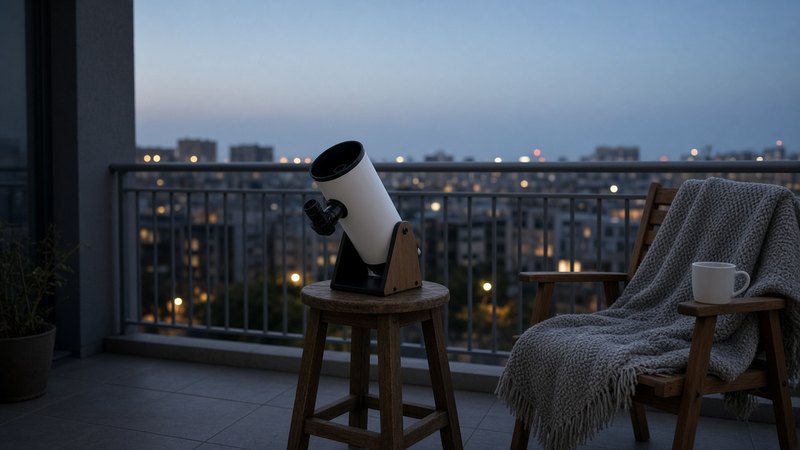
What Can You See With a 6-Inch Telescope?
A 150 mm mirror gathers 459 times the light of a 7 mm pupil. Dawes limit for that aperture is 0.77 arcsec. From a Bortle 6-7 yard that is enough for lunar craters down to about 4 km, Jupiter's belts and four moons, and Saturn's rings. The same yard reaches M13 and the core of M42.
Under a Bortle 6-7 sky the faint-star estimate drops to about 11.7. The dark-sky figure is 13.6. Your sky class moves the faint-star number.
A tube sold as 6-inch often prints 150 mm. Exact 6 inches is 152.4 mm, since 6 times 25.4 is 152.4. We keep 150 mm in every formula here. At 152 mm, Dawes only shifts from 0.77 to 0.76 arcsec.
The worked tube is 150 mm at f/8. Focal length is 1200 mm. That is 150 times 8. A faster or slower 6-inch keeps the same aperture and changes only the eyepiece that hits a given power.
Maximum useful power is about 2 times aperture in millimeters. For 150 mm the ceiling is 300x. The inch form of that rule is 50x per inch. At 5.9 inches that is 295x. We use 300x as the working cap, and only when the star image is tight.
Minimum useful power is aperture divided by 7. You get 21.4x. Below that the exit pupil is wider than 7 mm, and the extra glass is wasted on a typical dark-adapted pupil.
The 675x you see on boxes comes from a 60 mm refractor: 900 mm times a 3x Barlow, divided by a 4 mm eyepiece. That lens tops out near 120x, so 675x is not usable. On this 150 mm tube the same arithmetic caps out at 300x.
We split the sky into two bands. Bortle 6-7 is the bright suburb, and we use an unaided limit of 5.0. Bortle 3-4 is a dark site, and we use 6.5. Both values sit inside the bands John Bortle published in 2001.
Seeing gets two working values too. A common suburban night is 2 arcsec. A good night is 1 arcsec. You cannot use a 0.77 arcsec limit while the air is smearing stars at 2 arcsec.
- Aperture
- 150 mm (5.9 in)
- Light grasp vs 7 mm pupil
- 459 times
- Dawes limit
- 0.77 arcsec
- Limiting magnitude (est.)
- 13.6 dark sky; about 11.7 at Bortle 6-7
- Max useful magnification
- 300x (2 times 150 mm)
- Min useful magnification
- 21.4x
- Typical focal lengths
- 750 mm at f/5; 1200 mm at f/8; 1500 mm at f/10; 1800 mm at f/12
Planets and the Moon
The Moon
The Moon averages 0.52 degrees, about 31 arcmin. NASA's 1896 arcsec is the figure at 378,000 km. You will not miss it at any power a 6-inch can use.
You start at 40x. You move to 150x when you want a crater.
Mean lunar diameter is 3475 km. Spread across 1872 arcsec, one arcsec on the Moon is 1.86 km. The 0.77 arcsec Dawes limit is a 1.4 km feature. At 2 arcsec of seeing the floor is about 3.7 km.
So a perfect night could show a crater a bit over 1 km across. A normal suburban night stops near 4 km. You still get the great named forms.
Sky class barely matters. The Moon is bright from a city lot and from a dark field. Use 40x for the whole disk and 80x to 200x for craters. Both Bortle bands can do that.
On the 1200 mm tube, a 25 mm eyepiece gives 48x. With a 52 degree apparent field the true field is 1.08 degrees. That holds about 2 Moon widths, since 1.08 divided by 0.52 is 2.1.
A 6 mm eyepiece at the same 1200 mm gives 200x and a 0.26 degree field. The Moon is 0.52 degrees wide, so you see about half the disk. That is the right frame for a crater chain, not for a full-Moon postcard.
Jupiter
NASA puts Jupiter between 30.5 and 50.1 arcsec. Mean opposition is 46.9 arcsec at magnitude minus 2.7. The planet is an easy find from Bortle 7 and from Bortle 3.
Cloud belts show at 80x to 150x in both sky classes. The disk is magnitude minus 2.7, so a Bortle 7 sky still shows the belts. On a 2 arcsec night, fine belt edges stay soft.
The four large moons sit off the disk and show at 30x. A 32 mm eyepiece on the 1200 mm tube is 37.5x, which is enough.
You do not need a dark site for that. You can find them from a bright yard.
The Great Red Spot is a low-contrast mark. Plan on 150x to 177x and seeing near 1 arcsec. A Bortle 6 yard can do it when the air steadies. A Bortle 3 sky shows the same spot when the seeing is also near 1 arcsec.
At 150x the 46.9 arcsec disk covers 117 arcmin in the eyepiece. That is 3.8 times the 31 arcmin Moon you see with no telescope. The planet looks large. The field is still mostly black.
Saturn
NASA lists the globe from 14.5 to 19.9 arcsec. Mean opposition is 18.8 arcsec. Magnitude at that opposition is about 0.7. Rings make the system brighter still.
The A ring outer edge is 136,780 km from Saturn's center. The ring diameter is 273,560 km. At the mean opposition distance of 1,277.13 million km, that diameter is 44 arcsec. The rings are wider than the globe.
You can see the rings at 50x from a suburb and from a dark site. On the 1200 mm tube, 50x is a 24 mm eyepiece. A 25 mm eyepiece at 48x is close enough to start.
The Cassini Division is 4,800 km wide. NASA states that width. At 1,277.13 million km the gap is 0.78 arcsec. At Saturn's minimum distance, 1,205.5 million km, it is 0.82 arcsec. At maximum distance, 1,658.6 million km, it is 0.60 arcsec.
The gap is a dark line in a bright ring, not two star disks. Dawes limit is a test for equal double stars. It does not set a cutoff for this high-contrast line. Sky & Telescope says the Dawes limit tells us nothing about contrast on planetary detail. Scopes of 80 to 100 mm often show the division at the ansae. The radial width there does not shrink as the rings tilt.
Seeing of about 1 to 2 arcsec, and the ring tilt, decide a given night. A shallow tilt shortens the line at the ansae. It leaves the 0.60 to 0.82 arcsec radial width alone.
Planetary detail likes about 20x to 30x per inch of aperture. For 5.9 inches that band is 118x to 177x, with seeing near 1 arcsec. 200x is a stretch past that band, still under the 300x cap.
Saturn reached opposition on 2026-10-04. The globe was 19.7 arcsec at about 1.26 billion km. At the 2026-10-04 opposition the tilt was 7.45 degrees (JPL), so the short axis was 44 arcsec times the sine of 7.45 degrees, about 5.7 arcsec.
On 2026-10-31 the tilt is 6.6 degrees and the short axis is about 5.1 arcsec. The tilt falls toward 6.1 degrees in early December, then opens again. This year the division shows mainly at the two ansae.
Bortle 7 and Bortle 3 both show the rings. Only seeing, distance, and tilt change the division.
Mars
NASA puts Mars between 3.5 and 25.6 arcsec. A mean opposition is 17.8 arcsec at about magnitude minus 2.0. The planet swings by a factor of 7 in apparent size.
At 3.5 arcsec the disk is only 1.8 times the 2 arcsec seeing blob. Surface detail is not a realistic target. Near conjunction that disk is in the daytime glare and is not a real target. The phase is nearly full then. A clearer phase, about 85 percent lit, comes near quadrature, when the disk is larger.
At 17.8 arcsec and 200x the disk spans 59 arcmin in the eyepiece. That is just under 1 degree, or about 1.9 Moon widths with no telescope. A polar cap is then a high-power mark, not a low-power one.
At a close 25.6 arcsec the same 200x view spans 85 arcmin. The next opposition is 2027-02-19, an aphelion opposition, with a peak disk near 13.8 arcsec. At 200x that disk spans about 46 arcmin. The next large disk, near 24.5 arcsec, is the opposition of 2035-09-15. Halfway between oppositions, skip the cap and use the time on Saturn or the Moon.
Both sky classes can show Mars. The date and the seeing dominate.
You time the look for a big disk. A 4 arcsec disk stays 4 arcsec at Bortle 3 and at Bortle 7.
Venus, Uranus, and Neptune
Venus runs from 9.7 to 66.1 arcsec. NASA's 60.0 arcsec is the mean disk at inferior conjunction. Inferior conjunction fell on 2026-10-24 (UTC). For about a week either side, the elongation stays about 7 to 10 degrees, so Venus is not a target.
From early November it is a large morning crescent. Sky Calc puts it at about 6 percent lit and 56 arcsec on November 7, and about 14 percent lit and 50 arcsec on November 16. It is brightest in the morning sky on November 29, and it thickens to a half by 2027-01-03.
Maximum magnitude is minus 4.8. A suburb shows the crescent at 50x to 100x once it is back in the morning sky.
Uranus is 3.3 to 4.1 arcsec, and 3.8 arcsec at mean opposition, near magnitude 5.6. At 150x the disk is a small circle, not a star point. Both sky classes can show it once you have the field.
Neptune is 2.2 to 2.4 arcsec, and 2.3 arcsec at mean opposition, near magnitude 7.7. At 177x the disk spans about 7 arcmin in the eyepiece, since 2.3 times 177 divided by 60 is 6.8. You need a chart. A darker sky helps the find.
| Object | Angular size | Bortle 6-7 | Bortle 3-4 | Power |
|---|---|---|---|---|
| Moon | 0.52 deg mean; NASA 1896 arcsec at 378,000 km | Craters from about 4 km up | Same, down toward 1.4 km if seeing is 1 arcsec | 40x to 200x |
| Jupiter | 30.5 to 50.1 arcsec; 46.9 at mean opposition | Belts at 80x to 150x | Same belts; spot still needs steady air | 80x to 177x |
| Jupiter's moons | Points beside the disk | Yes at 30x | Yes at 30x | 30x to 80x |
| Saturn globe | 14.5 to 19.9 arcsec; 18.8 mean | Disk at 50x | Disk at 50x | 50x to 150x |
| Saturn rings | 44 arcsec across; short axis about 5.7 arcsec at 7.45° on 2026-10-04; 5.1 at 6.6° on 2026-10-31 | Rings at 50x | Rings at 50x | 50x to 150x |
| Cassini Division | 0.78 arcsec near mean opposition; 0.60 to 0.82 with distance | Line at the ansae in 1 to 2 arcsec seeing | Same; sky class does not help | 118x to 177x |
| Mars | 3.5 to 25.6 arcsec; 13.8 at the 2027-02-19 opposition | Small disk in 2027; cap needs a larger year | Same disk; sky class is secondary | 118x to 177x |
| Venus | 9.7 to 66.1 arcsec; about 50 arcsec and 14 percent lit on 2026-11-16 | Morning crescent from early November, 50x to 100x | Same crescent | 50x to 150x |
| Uranus | 3.3 to 4.1 arcsec; 3.8 mean opposition | Small disk at high power | Same disk, easier to find | 118x to 177x |
| Neptune | 2.2 to 2.4 arcsec; 2.3 mean opposition | Tiny disk if you can locate it | Easier find, same disk | 118x to 177x |
A 6 mm eyepiece at 1200 mm
Divide 1200 by 6. You get 200x. Exit pupil is 6 divided by 8, because the tube is f/8. That is 0.75 mm. That is above the 0.5 mm empty-power line and below the 7 mm waste line.
200x on a 5.9 inch aperture is 34x per inch. The planetary band cited above is 20x to 30x per inch. The hard cap is 50x per inch. A 6 mm eyepiece sits just above that planet band, and under the cap.
Focal ratio moves that result. A 150 mm f/5 tube has a 750 mm focal length. The same 6 mm eyepiece gives 125x. That sits inside the 118x to 177x planet band.
A 150 mm f/12 tube has an 1800 mm focal length. Now 6 mm gives 300x, the ceiling. Exit pupil is 0.50 mm. Fine on a rare 1 arcsec night. Soft on a 2 arcsec night.
A 150 mm f/10 tube, focal length 1500 mm, puts 6 mm at 250x. Exit pupil is 0.60 mm.
That is a planetary setup. It is a poor low-power setup, because a 32 mm eyepiece is only 47x and the true field stays tight.
Eyepiece choice for other focal lengths is worked on the eyepiece guide. The 200x figure above is only the 1200 mm case.
Three focal lengths cover the 1200 mm tube. A 25 mm eyepiece gives 48x for the Moon and open clusters. A 10 mm gives 120x for Jupiter's belts. A 6 mm gives 200x, past the 118x to 177x planet band, for a steady night.
A 4 mm eyepiece hits 300x. Exit pupil is 0.50 mm. True field with a 52 degree apparent field is 0.17 degrees. Use it when the star image is tight. Leave it in the case on a 2 arcsec night.
Here is the failure mode. Seeing of 2 arcsec, times 300x, is 600 arcsec at the eye. That is 10 arcmin of blur. The view spreads the 2 arcsec smear. Lunar detail still stops at the 3.7 km floor.
The table uses one assumption. Apparent field is 52 degrees, a plain Plossl. True field is 52 divided by power. A wider apparent field scales the true field up in proportion. A 68 degree eyepiece at 48x would need a 29.7 mm field stop. A 1.25 inch barrel still caps it near 1.29 degrees. The full 1.42 degrees needs a 2 inch eyepiece and focuser.
| Eyepiece | Power | Exit pupil | True field | Moon widths |
|---|---|---|---|---|
| 32 mm | 37.5x | 4.00 mm | 1.29 deg | 2.5 |
| 25 mm | 48x | 3.13 mm | 1.08 deg | 2.1 |
| 15 mm | 80x | 1.88 mm | 0.65 deg | 1.3 |
| 10 mm | 120x | 1.25 mm | 0.43 deg | 0.8 |
| 6 mm | 200x | 0.75 mm | 0.26 deg | 0.5 |
| 4 mm | 300x | 0.50 mm | 0.17 deg | 0.3 |
Deep-sky objects
Stars use the full light grasp. A 459 times gain is why the stellar limit moves from magnitude 5.0 to about 11.7 in a suburb. Galaxies do not get that gift. Their light is spread over an area.
Most deep-sky objects look gray at 150 mm. Color shows on bright planets and a few double stars, not on galaxies and nebulae.
Surface brightness in the eyepiece follows exit pupil. A bigger pupil, up to about 7 mm, makes the sky patch brighter. The same exit pupil on a larger aperture does not brighten each square arcsec. It raises the power instead, if the f-ratio matches.
On this f/8 tube, a 4 mm exit pupil is a 32 mm eyepiece. Power is 37.5x. That is the bright, wide setup for nebulae.
Drop to a 2 mm pupil, a 16 mm eyepiece, 75x, and the sky background dims. Faint stars in a cluster pop. The nebula surface dims with them.
Clusters and nebulae
M45, the Pleiades, is magnitude 1.6. Wikipedia lists the cluster at 2 degrees. A 1.25 inch focuser has a field stop near 27 mm. On a 1200 mm tube the widest true field is 27 divided by 1200, times 57.3. That is 1.29 degrees.
The bright dipper is smaller than that catalog size. Electra to Atlas is about 60 arcmin east to west. Taygeta to Merope is about 31 arcmin north to south. The asterism is about 1.1 degrees.
That 1.1 degree shape fits a 1.29 degree field, with the edges tight. Outer members spill past the stop. The formula field of a 32 mm, 52 degree eyepiece is 1.39 degrees, and the barrel still clips it near 1.29.
Shorten the tube and the field grows. A 150 mm f/5 scope is 750 mm. The same 27 mm stop covers 2.06 degrees, which frames the 2 degree catalog size.
M42 is magnitude 4.0 and 65 by 60 arcmin. 65 arcmin is 1.08 degrees, inside the 1.29 degree cap.
From Bortle 6-7 you get the bright core at 40x to 80x. From Bortle 3-4 the faint outer glow has room in that same field.
M8, the Lagoon, is magnitude 4.6 and 90 by 40 arcmin. It sits low for mid-northern latitudes. A suburb shows the bright region when it is up. A dark site shows more of the 90 arcmin length. Haze near the horizon can erase both.
M13 is magnitude 5.8 and 20 arcmin. Both sky classes show the ball at 80x to 120x.
A 10 mm eyepiece is 120x, true field 0.43 degrees, and 20 arcmin is 0.33 degrees. The cluster fits with a little black around it. Darker sky resolves more of the edge stars.
M22 is magnitude 5.1 and 32 arcmin. Same story, if your latitude lifts it. M27, the Dumbbell, is magnitude 7.4 and 8.0 by 5.6 arcmin.
A Bortle 6 yard can show the dumbbell shape at 80x. It is brighter per area than a large galaxy of the same magnitude.
M57, the Ring, is magnitude 8.8. SEDS lists the bright ring at 1.4 by 1.0 arcmin. The 230 arcsec Wikipedia figure includes the faint outer halo, about three times the ring a 6-inch shows.
At 120x that bright ring is a small oval in a 0.43 degree field. 1.4 arcmin is 0.023 degrees, about one eighteenth of the field. You can find it from Bortle 6-7. The dark center is easier when the sky is Bortle 3-4 and the power is 100x to 150x.
Galaxies
M31 is magnitude 3.4 and 3.17 by 1 degree. The long axis is 2.5 times the 1.29 degree field. You frame the core, not the catalog ellipse.
From Bortle 6-7 the core is a soft glow at 40x. The dust lane wants Bortle 3-4 and that same low power.
M33 is magnitude 5.7 and 70.8 by 41.7 arcmin. The light is spread thin. Bortle's own notes treat it as a hard object once the sky brightens.
Treat a 6-inch view of M33 from Bortle 6-7 as a miss, not a failure of the mirror. From Bortle 3-4, sweep at 30x to 50x.
M51 is magnitude 8.4 and 11.2 by 6.9 arcmin. From a suburb you may catch two cores at 100x.
The arms are a Bortle 3-4 target. Even there, 150 mm is the edge. An 8-inch gathers 1.83 times the light and makes that edge easier.
M81 is magnitude 6.9 and 26.9 by 14.1 arcmin. M82 is magnitude 8.4 and 11.2 by 4.3 arcmin. The centers are about 37 arcmin apart.
A 0.65 degree field is only 39 arcmin, so both cores sit on the edge and the galaxies spill out. A 25 mm eyepiece gives 48x and a 1.08 degree field, which holds both. Cores show from Bortle 6-7. The dark lane in M82 and the oval of M81 gain texture at Bortle 3-4.
M104, the Sombrero, is magnitude 8.0 and 9 by 4 arcmin. The dust lane is a dark-sky mark at 120x to 160x. From Bortle 7 expect a small elongated glow, if transparency is good. Do not expect the lane every night.
M1, the Crab, is magnitude 8.4 and 420 by 290 arcsec. That is 7.0 by 4.8 arcmin. It is easy to overlook from Bortle 7 because the surface is low.
A dark site at 80x to 120x makes it a plain oval. It will not look like a photograph at any power this aperture has.
| Object | Mag | Size | Bortle 6-7 | Bortle 3-4 | Power at 1200 mm |
|---|---|---|---|---|---|
| M45 | 1.6 | 2 deg catalog; bright dipper about 1.1 deg | Dipper just fits; outer stars spill | Same fit at f/8; f/5 frames the catalog size | 37x to 48x |
| M42 | 4.0 | 65 by 60 arcmin | Bright core | Core plus faint outer glow | 40x to 80x |
| M8 | 4.6 | 90 by 40 arcmin | Bright part if it is high enough | More of the length | 40x to 80x |
| M13 | 5.8 | 20 arcmin | Ball, some edge stars | More resolved edges | 80x to 120x |
| M27 | 7.4 | 8.0 by 5.6 arcmin | Shape visible | Easier contrast | 60x to 120x |
| M57 | 8.8 | 1.4 by 1.0 arcmin | Small ring if you know the field | Dark center clearer | 100x to 150x |
| M31 | 3.4 | 3.17 by 1 deg | Core only | Core plus dust lane | 37x to 60x |
| M33 | 5.7 | 71 by 42 arcmin | Usually a miss | Large dim glow at low power | 30x to 50x |
| M51 | 8.4 | 11.2 by 6.9 arcmin | Two cores | Arms only on a clean night | 80x to 150x |
| M81 / M82 | 6.9 / 8.4 | 27 by 14 and 11 by 4 arcmin; centers 37 arcmin apart | Cores in a 1.08 deg field | More texture | 48x |
| M104 | 8.0 | 9 by 4 arcmin | Small elongated glow | Dust lane at high power | 120x to 160x |
| M1 | 8.4 | 7.0 by 4.8 arcmin | Easy to miss | Plain oval | 80x to 120x |
Double stars
Dawes limit is a double-star test, not a planet test. It was framed for equal stars near magnitude 6, with the disks touching. Brighter pairs are easier. A faint companion in a bright glare is harder, even when the gap is wide.
Albireo is 34.3 arcsec, magnitudes 3.1 and 5.1. That split is 45 times the 0.77 arcsec limit. You can separate it at 40x from Bortle 7. Color contrast is the show, not resolution.
Mizar is 14.5 arcsec, magnitudes 2.3 and 4.0. Still a low-power pair. Almach is 9.5 arcsec, magnitudes 2.3 and 5.1. About 80x makes the gap comfortable. All three work in both sky classes.
Polaris is 18.2 arcsec, magnitudes 2.0 and 8.7. The gap in brightness is 6.7 magnitudes. The 18.2 arcsec split is wide. The faint star sits in the glare of the bright one.
A Bortle 3-4 sky helps this one more than it helps Albireo. Use about 100x and keep the bright star just outside the center.
Delta Cygni is 2.7 arcsec, magnitudes 2.9 and 6.3. That gap is 3.5 times Dawes. You still need seeing under 2 arcsec.
Sky class is secondary because both stars are fairly bright. This is a fair 6-inch test on a calm night and a miss on a boiling one.
Epsilon Lyrae is a wide pair 209 arcsec apart, so 40x shows two stars. Each of those is itself a pair, near 2.3 and 2.4 arcsec.
Splitting both tight pairs wants 120x to 180x and seeing near 1 arcsec. The wide split and the tight splits are different jobs.
| Pair | Sep | Mags | Versus 0.77 arcsec | Power | Sky note |
|---|---|---|---|---|---|
| Albireo | 34.3 arcsec | 3.1 and 5.1 | 45 times the limit | 40x | Both classes |
| Mizar AB | 14.5 arcsec | 2.3 and 4.0 | 19 times | 40x to 60x | Both classes |
| Almach | 9.5 arcsec | 2.3 and 5.1 | 12 times | 80x | Both classes |
| Polaris AB | 18.2 arcsec | 2.0 and 8.7 | 24 times, but a 6.7 mag gap | 100x | Darker sky helps the faint star |
| Delta Cygni | 2.7 arcsec | 2.9 and 6.3 | 3.5 times | 150x to 200x | Needs seeing under 2 arcsec |
| Epsilon Lyrae, wide | 209 arcsec | 4.7 and 4.6 | Easy | 40x | Both classes |
| Epsilon Lyrae, tight pairs | 2.3 and 2.4 arcsec | near 5 and 6 | about 3 times | 120x to 180x | Needs seeing near 1 arcsec |
Wide pairs such as Albireo move slowly. Castor moves fast, so it stays off this list.
The 209 arcsec figure is the Astronomical League WDS list from January 2024. The 2.3 and 2.4 arcsec tight pairs are the Havering club page, read 2026-10-17.
Our assumptions
Every power, field, and limit above uses the same sheet. If your tube is not 1200 mm, keep the aperture math and rerun the eyepiece math. The eyepiece calculator does that for true field and exit pupil.
Light grasp equals (aperture divided by 7) squared. 150 divided by 7 is 21.43. The square is 459.
We use a 7 mm pupil because minimum power is defined as aperture over 7. Pupils shrink with age, which lowers the grasp ratio and raises the minimum power. Sky & Telescope notes a downward trend after young adulthood, with wide scatter at any one age.
Dawes limit is 116 divided by aperture in millimeters. 116 divided by 150 is 0.773, which we round to 0.77 arcsec.
Sky & Telescope prints the same 150 mm case as 0.8 arcsec. Both are the one formula, rounded differently. We keep 0.77.
Maximum power is 2 times the millimeters, so 300x. The parallel rule, 50 times the inches, is 50 times 5.9, or 295x. The 5x gap is rounding, not two laws. Past either cap, Sky & Telescope calls further power empty for planets.
Minimum power is 150 divided by 7, or 21.4x. On a 1200 mm tube that is a 56 mm eyepiece.
A 1.25 inch barrel will not pass that eyepiece. Your wide limit is the 27 mm stop. The widest field a 1.25 inch eyepiece can give on this tube is a 32 mm at 37.5x.
Exit pupil is aperture divided by power. It is also eyepiece focal length divided by f-ratio.
At f/8, 25 mm gives 25 divided by 8, or 3.13 mm. Power is 48x, and 150 divided by 48 is 3.13 mm. You should see the same pupil both ways.
True field in degrees is apparent field divided by power. We lock apparent field at 52 degrees unless a sentence says otherwise.
A 68 degree eyepiece at the same power is a 1.31 times wider field, up to the field-stop cap. 1.31 is the ratio of the diameters. The area ratio, if the stop allowed it, would be 1.71. The hardware cap remains field stop over focal length, times 57.3.
The dark-sky stellar estimate is 2.7 plus 5 times log10 of the aperture in millimeters.
Log10 of 150 is 2.176. Times 5 is 10.88. Plus 2.7 is 13.58, listed as 13.6. That number is for stars. It is a dark-site ceiling.
The sky-class version adds a magnitude gain to the unaided limit. The gain is 5 times log10 of 150 divided by 7. Log10 of 21.43 is 1.331.
Times 5 is 6.65 magnitudes. A suburb at unaided 5.0 reaches about 11.7. A dark site at unaided 6.5 reaches about 13.2.
Why is 13.6 not 13.2? Subtract 6.65 from 13.58 and you get 6.93. The formula behaves like an unaided limit near 6.9, inside Bortle class 3.
We keep 13.6 on the card as that formula's output. We keep 11.7 and 13.2 for the two sky bands we actually use.
We do not subtract a coating loss. Two mirrors and a few glass surfaces can dim the view by a few tenths of a magnitude.
Expect a real limit a few tenths of a magnitude short of 13.6. Treat 13.6 as a ceiling, not a promise.
Seeing is assumed at 2.0 arcsec for Bortle 6-7 nights and 1.0 arcsec for a good dark-site night. Those are planning numbers, not a forecast.
If your star image is a 3 arcsec boil, every high-power row in the planet table moves out of reach. The low-power cluster rows do not.
Planet sizes use NASA fact sheets read on 2026-10-17. Where NASA prints the angle, we copy it. The ring span and the Cassini angle are computed.
Arcseconds equal kilometers divided by distance in kilometers, times 206265. For the gap, 4800 divided by 1,277,130,000 times 206265 is 0.78.
Messier magnitudes and sizes come from the Wikipedia list of Messier objects, read the same day. Double-star gaps are the RASC handbook values in Jeffery's table, plus the two Epsilon Lyrae sources named above. None of these rows is a log from a single night.
Check the date if you reuse a number next year. Mars and Saturn change apparent size every opposition. Double-star gaps for fast pairs change. The 459 times light grasp stays fixed for a 150 mm aperture.
Compared with the next size up or down
A 4-inch class tube is 102 mm. An 8-inch is 203 mm. A 10-inch is 254 mm. The 6-inch between them is 150 mm. Light grasp against a 7 mm pupil is 212, 459, 841, and 1317 times.
Against the 6-inch, the 4-inch gathers 0.46 times the light, because (102 divided by 150) squared is 0.46.
The 8-inch gathers 1.83 times as much, from (203 divided by 150) squared. The 10-inch gathers 2.87 times as much.
Dawes limits are 1.14, 0.77, 0.57, and 0.46 arcsec. On a 2 arcsec night you gain light, but the finest Saturn detail stays at the 2 arcsec seeing limit in every one of these tubes.
On a 1 arcsec night the 8-inch and the 10-inch pull ahead. The 4-inch is still near its own 1.14 arcsec floor.
Ceilings at 2 times millimeters are 204x, 300x, 406x, and 508x. You will rarely use the 10-inch cap. A 2 arcsec sky limits detail before 508x. The practical planet range for the 6-inch stays 118x to 177x.
The 6-inch is enough for the Moon, Jupiter's belts, Saturn's rings, Albireo, Mizar, M13, and the core of M42. You can do those from Bortle 6-7.
Moving to 203 mm does not change that list. It makes the same targets brighter and a bit more detailed when seeing allows.
You want the next size up for thin galaxy arms, M33, the dust lane in M104, and doubles under 1 arcsec on a calm night. A 10-inch at 254 mm is 2.87 times the light of 150 mm.
That is a real step for faint stars. Bortle 7 still hides M51's arms.
Keep the 25 mm eyepiece and change only the tube.
On the 150 mm f/8 you get 48x and a 3.13 mm pupil. A 203 mm f/8 tube is 1624 mm, so the same eyepiece gives 65x. The pupil is still 3.13 mm. The image scale grows by 65/48, or 1.35 times, while surface brightness per square arcsec stays the same.
Force the 8-inch down to 48x and the pupil grows. 203 divided by 48 is 4.2 mm.
The galaxy surface gets brighter than in the 6-inch at 48x. Against the 8-inch's own 65x, dropping to 48x widens the field from 0.80 to 1.08 degrees, but only in a 2 inch focuser. In a 1.25 inch barrel the 27 mm stop caps it at 0.95 degrees.
The neighbor pages use the same formulas at their own apertures. The 4-inch page, the 8-inch page, and the 10-inch page sit next to this one. The hub is the aperture chooser. The 8-inch Dobsonian specs are on the 8-inch comparison.
| Aperture | Light vs 7 mm | Light vs 150 mm | Dawes | Max power | Dark-sky mag est. |
|---|---|---|---|---|---|
| 102 mm (4 in) | 212x | 0.46 times | 1.14 arcsec | 204x | 12.7 |
| 150 mm (6 in) | 459x | 1 | 0.77 arcsec | 300x | 13.6 |
| 203 mm (8 in) | 841x | 1.83 times | 0.57 arcsec | 406x | 14.2 |
| 254 mm (10 in) | 1317x | 2.87 times | 0.46 arcsec | 508x | 14.7 |
Three setups share 150 mm and still do different jobs.
A long focal ratio, f/10 to f/12, means 1500 to 1800 mm. A 6 mm eyepiece then gives 250x to 300x.
A manual Dobsonian at f/8 keeps 1200 mm and the full 150 mm for clusters. An app or a GoTo handset finds the faint targets. You read the listed weight before you plan the carry.
Read four lines before you trust a carton. Aperture in millimeters. Focal length in millimeters. Focal ratio. Weight. A fifth line matters if you hate hunting: the finder, whether it is a red-dot, an optical finder, or a GoTo handset.
Ignore the largest power printed on the box. Divide focal length by the eyepiece you will actually use. Then compare that power with 2 times the millimeters. If a 60 mm box says 675x, it is advertising more than five times its 120x ceiling.
At 150 mm the Moon, Jupiter's belts, and Saturn's rings are already in reach.
M51's arms want 203 mm and a sky darker than Bortle 7. Going from 150 mm to 203 mm adds 1.83 times the light. A 2 arcsec sky still caps the detail.
Common Questions
What can you see with a 6 inch telescope from a bright suburb?
From Bortle 6-7, 150 mm still shows the Moon, Jupiter's belts, Saturn's rings, and Albireo at 34 arcsec. If your unaided limit is 5.0, stars reach about 11.7. M42 and M13 work at 40x to 120x.
M51's arms and M31's dust lane want Bortle 3-4. You still need seeing near 1 arcsec for planet detail. Use 118x to 177x on a steady night.
Can a 6-inch show the Cassini Division?
Yes. The division is a dark line in the bright rings, 0.78 arcsec wide at mean opposition. Contrast carries it, so the 0.77 arcsec Dawes limit does not decide it. Use seeing near 1 to 2 arcsec and 118x to 177x.
The rings were tipped 7.45 degrees at the 2026-10-04 opposition, and about 6.1 degrees in early December. At maximum distance the width is 0.60 arcsec. Sky class does not settle it.
What magnification should you use with a 6-inch?
On a 1200 mm tube, 25 mm gives 48x, 10 mm gives 120x, and 6 mm gives 200x. The ceiling is 300x, which is 2 times 150 mm.
A 2 arcsec night turns 300x into 10 arcmin of blur. Everyday planet power stays in the 118x to 177x band, about 20x to 30x per inch.
What can you see with a 6 inch Dobsonian?
A manual 6-inch Dobsonian is usually 150 mm at f/8, so the tube is 1200 mm. You get the planets above, plus M13, M42, and M31's core from a suburb.
The bright Pleiades dipper is about 1.1 degrees and just fits a 1.29 degree field. Outer members spill past the stop. An f/5 tube at 750 mm frames the 2 degree catalog size. Dawes stays 0.77 arcsec either way.
How does a 6-inch compare with an 8-inch?
203 mm gathers 1.83 times the light of 150 mm. Dawes drops from 0.77 to 0.57 arcsec. On a 2 arcsec night you see the extra light. Sharper detail waits for 1 arcsec air.
At f/8, one 25 mm eyepiece gives 48x on the 6-inch and 65x on the 8-inch. Exit pupil stays 3.13 mm. Step up for faint galaxies.
What does a 6 mm eyepiece do in a 1200 mm tube?
It gives 200x. Exit pupil is 0.75 mm. A 52 degree field becomes 0.26 degrees, about half a Moon. That sits inside the 300x cap.
On a 750 mm tube the same eyepiece is 125x. On an 1800 mm tube it is 300x. The eyepiece guide covers the other steps.
Read next
- HubWhat size telescope do you need?
- CalculatorEyepiece field and exit pupil
- Comparison8-inch Dobsonian telescopes
- DataWhat an 8-inch shows
Sources
- Sky & Telescope, astronomy terms: maximum useful power is 50 times aperture in inches, or 2 times aperture in millimeters. Magnification is telescope focal length divided by eyepiece focal length. Read 2026-10-17. skyandtelescope.org/astronomy-terms
- Sky & Telescope, A Pupil Primer: after young adulthood the dark-adapted pupil trends downward with age, and people of the same age can differ by about 3 mm. Read 2026-10-17. skyandtelescope.org
- Sky & Telescope, How to Choose Your Telescope Magnification: Dawes limit, 20x to 30x per inch for planets, 50x per inch as a high end, empty power beyond a small exit pupil. Read 2026-10-17. skyandtelescope.org
- Sky & Telescope, Pushing Limits: R equals 116 divided by D in millimeters, with 150 mm listed near 0.8 arcsec. Read 2026-10-17. skyandtelescope.org
- Bortle, J. E., Sky & Telescope, February 2001. Class 3 unaided limit 6.6 to 7.0. Class 4 is 6.1 to 6.5. Class 6 is 5.1 to 5.5. Class 7 is about 4.6 to 5.0. We use 5.0, at the bright edge of class 7, and 6.5, at the dark edge of class 4.
- Limiting magnitude used on this site and on the method page: 2.7 plus 5 log10 of aperture in millimeters, a visual estimate for an average observer under a dark sky. For 150 mm that is 13.6.
- JPL Horizons, DE421: Saturn ring tilt 7.45 degrees at the 2026-10-04 opposition, 6.60 degrees on 2026-10-31, and 6.10 degrees on 2026-12-01. The south face of the rings is toward Earth. Read 2026-10-23. ssd.jpl.nasa.gov/horizons
- NASA Jupiter fact sheet, David R. Williams: apparent diameter 30.5 to 50.1 arcsec, mean opposition 46.9 arcsec, magnitude minus 2.7. Read 2026-10-17. nasa.gov jupiter fact sheet
- NASA Saturn fact sheet: globe 14.5 to 19.9 arcsec, mean opposition 18.8 arcsec, distance 1,277.13 times 10 to the 6 km. Read 2026-10-17. nasa.gov saturn fact sheet
- NASA rings fact sheet: A ring outer edge 136,780 km. Read 2026-10-17. nasa.gov saturn rings
- NASA, Cassini Division width 4,800 km, PIA08901. Read 2026-10-17. science.nasa.gov
- NASA Mars fact sheet: 3.5 to 25.6 arcsec, mean opposition 17.8 arcsec. Read 2026-10-17. nasa.gov mars fact sheet
- NASA Venus fact sheet: apparent diameter 9.7 to 66.1 arcsec, 60.0 arcsec at inferior conjunction, maximum visual magnitude minus 4.8. Read 2026-10-17. nasa.gov venus fact sheet
- Sky Calc, Venus physical ephemeris at 00:00 UTC: 2026-11-07 disk 56.3 arcsec and 6.44 percent illuminated; 2026-11-16 disk 49.7 arcsec and 14.32 percent illuminated. Read 2026-10-17. sky-calc.com
- EarthSky, Venus at greatest morning brilliancy: inferior conjunction on 2026-10-23/24, greatest morning brilliancy on 2026-11-29. Read 2026-10-17. earthsky.org
- NASA Uranus fact sheet: 3.3 to 4.1 arcsec, mean opposition 3.8 arcsec, apparent visual magnitude 5.57. Read 2026-10-17. nasa.gov uranus fact sheet
- NASA Neptune fact sheet: 2.2 to 2.4 arcsec, mean opposition 2.3 arcsec, apparent visual magnitude 7.7. Read 2026-10-17. nasa.gov neptune fact sheet
- Sky & Telescope, Saturn Flaunts its Rings at Opposition: opposition on the night of 2026-10-04, globe 19.7 arcsec, distance about 1.26 billion km. Ring tilt 7.6 degrees on October 1 and 6.6 degrees on October 31, minimum about 6.1 degrees in early December. Read 2026-10-17. skyandtelescope.org
- SEDS, Mars 2027: opposition on 2027-02-19, an aphelion apparition, apparent diameter 13.81 arcsec. Read 2026-10-17. seds.org mars 2027
- Beish, J. D., A.L.P.O., The 2035-2036 Perihelic Apparition of Mars: opposition at 1933 UT on 2035-09-15, apparent diameter 24.5 arcsec. Read 2026-10-17. alpo-astronomy.org
- SEDS Messier 57: bright ring 1.4 by 1.0 arcmin, magnitude 8.8. The faint halo is a separate, larger measure. Read 2026-10-17. messier.seds.org m57
- NASA Moon fact sheet: apparent diameter 1896 arcsec at 378,000 km. Read 2026-10-17. nasa.gov moon fact sheet
- Wikipedia, List of Messier objects, magnitudes and angular sizes cited in the deep-sky table. Read 2026-10-17. wikipedia.org
- Jeffery, UNLV double-star table, citing the RASC Observer's Handbook for 2012 and 2013: Albireo 34.3 arcsec, Mizar 14.5, Almach 9.5, Polaris 18.2, Delta Cygni 2.7. The page warns that fast binaries move. Read 2026-10-17. physics.unlv.edu
- Astronomical League binocular double-star list, WDS measures, updated January 2024: Epsilon Lyrae wide pair 209 arcsec. astroleague.org
- Havering Astronomical Society, Epsilon Lyrae: tight pairs 2.3 and 2.4 arcsec. Read 2026-10-17. havastro.co.uk
How we check numbers: How we research.