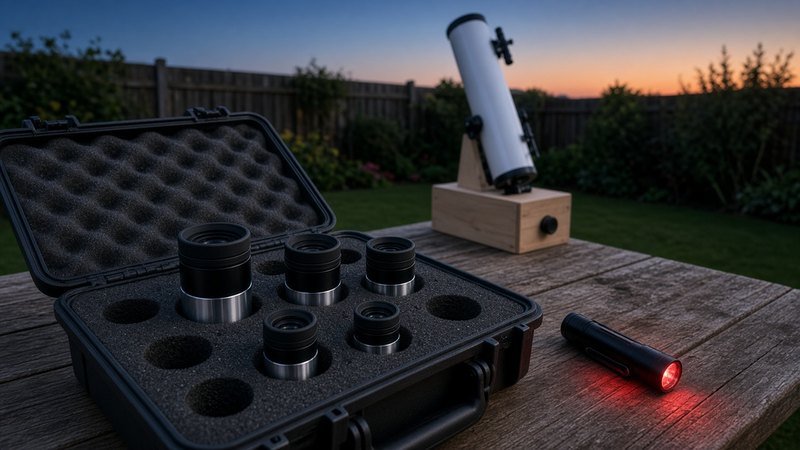
Telescope Eyepiece Kits Compared
Sort eyepiece kits by what you already own. If you have only the box eyepiece, a 5 Plössl kit with a 2x Barlow covers 30x to 200x on a 1,200 mm Dobsonian. If you want wider views, a 4 piece 68° set does the job. If you want one barrel, a zoom covers 50x to 150x.
We compared 6 kits. They range from a 2 eyepiece add on to a 2 in set. Every number below comes from the maker page and one division.
Power is telescope focal length ÷ eyepiece focal length. The ceiling is 2 times the aperture in mm. So the same kit gives different powers on each scope.
The kits side by side
| Kit | Eyepieces | Field | Barlow | Barrel | Filters |
|---|---|---|---|---|---|
| CelticBird 13-piece | 40, 20, 12.5, 8, 6 mm Plössl | not listed | 2x | 1.25 in | 7, incl. Moon and polarizing |
| Celestron 94303 | 32, 17, 13, 8, 6 mm Plössl | 44° (32 mm), 52° | 2x | 1.25 in | 6 color plus Moon |
| SVBONY 68° set | 20, 15, 9, 6 mm | 68° | none | 1.25 in | none |
| Celestron 8 to 24 mm zoom | 8 to 24 mm zoom | 40° to 60° | none | 1.25 in | none |
| Celestron 94306 | 15, 9 mm Kellner | not listed | none | 1.25 in | 2 color plus Moon |
| Celestron 94305 | 40, 32, 26 mm E-Lux | not listed | 2x, 2 in | 2 in | 5 color |
Read the eyepiece column first. Then divide your focal length by each number. Any result past your ceiling is a step you will rarely use.
The two 5 Plössl kits look similar. One runs from 40 mm to 6 mm. The other runs from 32 mm to 6 mm. Both add a 2x Barlow and filters.
The 68° set has no Barlow and no filters. It spends the budget on wider fields. The zoom replaces several eyepieces with one barrel.
The 2 in kit is a different tool. It needs a 2 in focuser. It covers the low power end with large field stops.
Power from each kit
| Kit | 1,200 mm Dobsonian | 660 mm refractor |
|---|---|---|
| CelticBird | 30x, 60x, 96x, 150x, 200x | 16x, 33x, 53x, 82x, 110x |
| Celestron 94303 | 38x, 71x, 92x, 150x, 200x | 21x, 39x, 51x, 82x, 110x |
| SVBONY 68° | 60x, 80x, 133x, 200x | 33x, 44x, 73x, 110x |
| 8 to 24 mm zoom | 50x, 150x | 28x, 82x |
| Celestron 94306 | 80x, 133x | 44x, 73x |
| Celestron 94305 | 30x, 38x, 46x | 16x, 21x, 25x |
On 1,200 mm, most kits reach 200x with a 6 mm. That is half the 406x ceiling, a good top step from a suburb. On 660 mm the same 6 mm gives 110x.
The 40 mm Plössl gives 30x on 1,200 mm. That is just above the 29x floor, which is aperture in mm ÷ 7. On a 660 mm refractor it gives 17x, below the 102 mm floor of 15x by a small margin.
Gaps matter as much as range. A good set steps about 1.5 to 2.5 times each time. Close steps waste a slot. Wide gaps leave you without a middle power.
If you own only the box eyepiece
Most scopes ship with 1 or 2 eyepieces. A 25 mm and a 10 mm are common. A 5 Plössl kit fills the gaps on both sides at once.
The CelticBird kit has 40, 20, 12.5, 8 and 6 mm. On 1,200 mm that is 30x, 60x, 96x, 150x and 200x. The steps sit 1.25 to 2 times apart.
Its 2x Barlow doubles each one. The 20 mm becomes a 10 mm at 120x. The 12.5 mm becomes 6.25 mm at 192x. So you get about 8 distinct powers.
The 7 filters include a Moon filter and a polarizer. Those two see the most use. The color filters suit bright planets at 150x and up.
The Celestron 94303 kit has 32, 17, 13, 8 and 6 mm. On 1,200 mm that is 38x, 71x, 92x, 150x and 200x. The 17 mm and 13 mm sit close together.
The maker lists 52° for the four short ones and 44° for the 32 mm. At 38x the 32 mm shows 1.17°. That fits the whole Moon at 0.52° twice over.
Its filters are 6 color glasses and a neutral Moon filter. The aluminum case has foam cutouts for every piece. The 2x Barlow takes the 13 mm to 185x.
The two kits differ most at the low end. The 40 mm in the CelticBird kit gives 30x. The 32 mm in the Celestron kit gives 38x. In a 1.25 in barrel, both hit the same field stop limit near 27 mm.
So the 40 mm does not show more sky than the 32 mm. It shows the same patch at lower power, with a narrower apparent field. The image is a bit brighter per area, with a 6.8 mm exit pupil instead of 5.3 mm.
For most eyes over 40, a 5.3 mm exit pupil uses the full beam. A 6.8 mm pupil may lose some light at the edge of the eye. On 1,200 mm, the 32 mm is the more useful low step for many owners.
Short Plössls have tight eye relief. It runs near 0.7 times the focal length. A 6 mm gives about 4 mm. With glasses, plan to replace that one first.
Both kits suit an f/5 to f/10 telescope. A Plössl uses 4 lenses in 2 pairs. It stays sharp to the edge at f/6 and slower. At f/4.5 the outer third of the field softens.
The exit pupil tells you how bright the view will look. Divide the eyepiece focal length by the focal ratio. On an f/5.9 Dobsonian, 32 mm gives 5.4 mm and 6 mm gives 1.0 mm. Both ends sit in the useful band.
If you want wider fields
A 68° field shows about 30% more sky than 52° at the same power. On a manual Dobsonian that buys time before a target drifts out.
The SVBONY set has 20, 15, 9 and 6 mm, all at 68°. On 1,200 mm that is 60x, 80x, 133x and 200x. The true fields are 1.13°, 0.85°, 0.51° and 0.34°.
There is no Barlow in this set. Add one later if you want 400x on rare nights. Most people use the 4 steps as they are.
At f/5.9 a 68° design keeps most of the field sharp. At f/4.5 and faster, expect softer stars near the edge. The center stays sharp either way.
On a 660 mm refractor the same set gives 33x, 44x, 73x and 110x. That is a full range for a 102 mm tube, short of the 204x ceiling.
Wide eyepieces weigh more than Plössls. A 68° 20 mm can weigh twice a 52° 20 mm. On a small tabletop scope, that can tip the tube. Check balance after each swap.
A 68° set also suits a tracking mount. A wider field means fewer nudges per target. On a 1,200 mm Dobsonian, a star crosses a 1.13° field in about 4.5 minutes near the celestial equator.
If you want one eyepiece
A zoom covers several steps in one barrel. You twist to change power. The target stays centered, so you do not lose it in a swap.
The Celestron 8 to 24 mm zoom gives 50x to 150x on 1,200 mm. The field runs from 40° at 24 mm to 60° at 8 mm. At 24 mm the true field is 0.80°.
| Eyepiece | Power | Field | True field |
|---|---|---|---|
| 32 mm Plössl (94303) | 38x | 44° | 1.17° |
| 20 mm 68° (SVBONY) | 60x | 68° | 1.13° |
| 17 mm Plössl (94303) | 71x | 52° | 0.73° |
| 24 mm zoom end | 50x | 40° | 0.80° |
| 8 mm zoom end | 150x | 60° | 0.40° |
| 6 mm 68° (SVBONY) | 200x | 68° | 0.34° |
| 6 mm Plössl (94303) | 200x | 52° | 0.26° |
The narrow 40° at the low end feels like a tube. That is the trade. You give up width for speed at the eyepiece.
A zoom pairs well with a 2x Barlow. On 1,200 mm that gives 100x to 300x. Two pieces then cover almost the whole useful range.
Zooms suit a first night with a group. You change power without handing over a new eyepiece. They also suit a phone adapter, since the phone stays clamped.
Zoom eyepieces have one known weak spot. The field stop shifts as you twist, so the image may drift slightly off center. Refocus after large changes. Most zooms need a small touch at each end.
On a 660 mm refractor the zoom gives 28x to 83x. That leaves the top of the range empty. A 2x Barlow fills it at 55x to 165x, under the 204x ceiling.
Add-on for the stock eyepieces
Some scopes ship with a single 20 mm or 25 mm. A small add on kit fills the middle and high steps for little cost.
The Celestron 94306 kit adds a 15 mm and a 9 mm Kellner. On 1,200 mm that is 80x and 133x. On 660 mm it is 44x and 73x.
It also includes a Moon filter and 2 color filters, a #80A blue and a #25 red. The case is foam lined plastic.
With a stock 25 mm on 1,200 mm, the set reads 48x, 80x and 133x. Each step is about 1.7 times the last. That is a tidy ladder for a first year at the eyepiece.
A Kellner uses 3 lenses. It is sharp in the center at f/8 and slower. On f/5 scopes the edge softens. For a first step up from one box eyepiece, that is fine.
If your focuser takes 2 in
A 2 in focuser takes larger field stops. That widens the low power view. A 2 in kit only makes sense if your focuser accepts 2 in barrels.
The Celestron 94305 kit has 2 in E-Lux eyepieces at 40, 32 and 26 mm. On 1,200 mm that is 30x, 38x and 46x. It adds a 2 in 2x Barlow, 5 color filters and a 2 in mirror diagonal.
The Barlow doubles each eyepiece. The 26 mm becomes 92x. The 32 mm becomes 75x. The 40 mm becomes 60x. So the kit covers 30x to 92x with 2 in glass.
There is no high power step here. Pair it with a 1.25 in 6 mm or 8 mm for 150x to 200x. The diagonal suits refractors and SCTs, not Newtonians.
A 2 in eyepiece can weigh 2 or 3 times a 1.25 in one. Tighten altitude tension on a Dobsonian. Check balance on a refractor mount.
The included diagonal suits a refractor or an SCT that has a 2 in visual back. Newtonian and Dobsonian focusers take the eyepiece directly. Leave the diagonal in the case there.
The kit also includes an adapter so a refractor can take the 2 in diagonal. Check the thread type on your tube before the night. Some tubes need a separate visual back.
Overlap with what you own
Before you buy, list your box eyepieces. Then cross out any kit eyepiece within 15% of one you have. Those slots add little.
A 25 mm and a 10 mm are common box pieces. Against the CelticBird kit, nothing overlaps closely. Against the 94303 kit, nothing overlaps either. Against the SVBONY set, the 9 mm sits close to the 10 mm.
The Barlow changes the count. With 2x, a 5 piece kit gives about 8 distinct powers under 300x on 1,200 mm. Without it, a 4 piece set gives 4.
Filters in kits
Kit filters screw into the barrel of a 1.25 in or 2 in eyepiece. They stack, but each layer adds glare. Use one at a time.
Filters do not work on every target. A color filter dims the whole view. On faint targets, that hurts more than it helps. Keep them for the Moon and bright planets.
Most kit filters are colored glass. A neutral Moon filter is the one most people keep using. It cuts glare at 30x to 60x near full Moon.
A polarizing filter does a similar job with less color shift. Some can be rotated to change density. The CelticBird kit includes one.
Color filters such as #80A blue and #25 red raise contrast on bright planets. The effect is small on scopes under 150 mm. Many owners leave them in the case.
Kits or single eyepieces
A kit wins when you own only the box eyepieces. It fills every gap at once. The case keeps pieces clean and in order.
Single eyepieces win when you own 2 or 3 good ones. Then one 6 mm or one wide 20 mm adds more than a full kit. You also avoid duplicates.
Spend on the high power step either way. That is where eye relief and sharpness matter most. A low power step at 38x looks bright and clean in almost any design.
Plössl, Kellner and wide designs
The kits here use three designs. Each trades field, eye relief and cost in a different way. Knowing the design tells you what the view will feel like.
A Kellner has 3 lenses. Its field is near 40° to 45°. It works well at f/8 and slower. The 94306 kit uses Kellners.
A Plössl has 4 lenses. Its field is near 50° to 52°. It stays sharp at f/6 and slower. Both 5 piece kits use Plössls.
A 68° design uses 5 or 6 lenses. It shows more sky at each power. It costs more per eyepiece and weighs more. The SVBONY set uses this type.
Eye relief follows the design. Plössls and Kellners scale it with focal length, near 0.7 times. Wide designs often hold it steadier across the range. Glasses wearers should check each focal length.
Building a set over time
Many owners start with a kit and replace pieces one by one. That keeps the case and filters while the glass improves. The low power step usually stays the longest.
The 6 mm step goes first for most people. Its short eye relief makes it the hardest to use. A 6 mm with 15 mm of eye relief fixes that.
The middle step goes next. A wide 9 mm to 12 mm suits planets and the Moon on 1,200 mm. It sees the most use after the low step.
A 2x Barlow from a kit is often good enough to keep. Its job is simple. Check that it gives a clean star at 200x before you replace it.
Kits by telescope
On a 450 mm reflector, a 6 mm gives only 75x. Kits with a 2x Barlow reach 150x. The 114 mm ceiling is 228x, so a Barlow kit suits it.
On a 660 mm refractor, a 6 mm gives 110x. Kits with 2x reach 220x, a touch past the 204x ceiling. Use the 8 mm with 2x for 165x instead.
On a 1,200 mm Dobsonian, every kit here fits well. The 6 mm gives 200x. The Barlow adds steps up to 400x for rare steady nights.
On a 2,032 mm SCT, short eyepieces push past the ceiling. A 6 mm gives 339x. A 40 mm gives 51x. The 2 in kit suits it at 51x to 78x.
If you wear glasses
Eye relief is the distance from the eye lens to where your eye sees the full field. Glasses sit about 10 mm to 15 mm from the eye. So glasses wearers need 15 mm or more.
In a Plössl kit, the long eyepieces pass that test. A 32 mm Plössl has more than 20 mm. A 17 mm sits near 12 mm. A 6 mm sits near 4 mm.
So in a 5 Plössl kit, glasses wearers can use 2 or 3 pieces comfortably. The short ones work only with glasses off. That is fine for nearsighted eyes, since focus can make up for it.
Astigmatism is the exception. It cannot be focused out. If you have strong astigmatism, keep your glasses on and choose long eye relief for every step.
A Barlow helps here. A 2x Barlow on a 12.5 mm gives the power of a 6.25 mm with the eye relief of the 12.5 mm. Kits that include one give glasses wearers a way around the short pieces.
How we compared the kits
We read each maker page and listing for the contents of every kit. We noted focal lengths, apparent fields, barrel size, Barlow factor and filters. Where a maker did not list a field, we wrote not listed.
Then we divided two common focal lengths by each eyepiece. We used 1,200 mm for an 8 in Dobsonian and 660 mm for a 102 mm refractor. We checked every result against the 2 × aperture ceiling.
We counted distinct powers under 300x. We treated two powers within 15% as one step. Kits with a Barlow got credit for each doubled step that did not duplicate another.
Weight also matters on small mounts. We noted barrel size as a rough guide, since 2 in eyepieces weigh far more than 1.25 in ones. A light tabletop scope works best with the 1.25 in kits here.
We also noted what each kit leaves out. The 68° set and the zoom have no filters. The 2 in kit has no high power step. The 94306 kit has no low power step. Each gap tells you what to add next.
We did not score optical quality. We did not compare prices. Prices and stock change, so check the retailer page for the current details.
Kits for a group night
A shared night favors simple gear. One low power eyepiece finds targets fast. A zoom lets each guest pick a comfortable power without a swap.
Keep the Barlow in the case on a group night. Each extra piece in the light path means more refocusing. Stay with the 25 mm to 32 mm range for the first targets.
A kit case also helps with order. Each piece goes back to its own cutout. That keeps fingerprints and dropped caps to a minimum.
What to check on the spec sheet
- Focal lengths: divide your focal length by each one, then cross out duplicates.
- Apparent field in degrees: 52° Plössl, 68° wide, 40° to 60° zoom.
- Barrel size: 1.25 in fits almost every focuser; 2 in needs a 2 in focuser.
- Barlow factor: 2x doubles each eyepiece in the kit.
- Filters: a Moon or polarizing filter sees the most use.
Also check thread sizes. Most 1.25 in eyepieces take standard filter threads. Kit filters screw into the bottom of the barrel.
Check the case. Foam cutouts keep pieces from knocking together. A latch that opens one handed helps in the dark.
Caring for a kit
Keep caps on both ends of each eyepiece. Dust on the eye lens shows up as soft glare. Dust on the field lens can show in focus as specks.
Bring a cold case inside and leave it closed for an hour. That lets the glass warm slowly. Opening it early can fog the lenses.
Clean lenses only when needed. Blow off loose dust first. Then use a lens tissue and a drop of lens fluid in small circles.
Label the case cutouts with focal lengths. In the dark, a small strip of tape helps. A red flashlight keeps your eyes adapted while you swap.
Common Questions
Are eyepiece kits worth it for beginners?
Often, if you own only the box eyepiece. A 5 Plössl kit with a 2x Barlow gives about 8 powers from 30x to 200x on 1,200 mm. If you already own 2 or 3 good eyepieces, one single eyepiece usually adds more. Check overlap before you buy.
Which eyepiece in a kit gets used most?
The low and middle steps, near 40x to 60x and 100x to 130x. Those find targets and show most planets. The 6 mm step at 200x sees use on steady nights. The color filters see the least use in most cases.
Do kit eyepieces fit my telescope?
Most kits use 1.25 in barrels, which fit almost every focuser. A 2 in kit needs a 2 in focuser. Smart telescopes have no eyepiece focuser, so kits do not apply to them. Check the focuser size on your spec sheet first.
Is a zoom eyepiece a good replacement for a kit?
A zoom covers 50x to 150x on 1,200 mm in one barrel. It is quick and keeps the target centered. The trade is a 40° field at the low end, against 52° to 68° in fixed eyepieces. Add a 2x Barlow to reach 300x.
Read next
- EyepiecesHow to choose telescope eyepieces
- EyepiecesBarlow lens: 2x vs 3x
- EyepiecesEyepiece field of view calculator
- ToolsTelescope magnification calculator
Sources
- Celestron Eyepiece and Filter Kit 1.25 in (94303): Plössls 6, 8, 13, 17, 32 mm; 52°, 32 mm at 44°; 2x Barlow; 6 color filters and a Moon filter; aluminum case. celestron.com, checked 2026-10-23.
- Celestron Eyepiece and Filter Kit 2 in (94305): E-Lux 40, 32, 26 mm; 2 in 2x Barlow; 5 filters; 2 in mirror diagonal. celestron.com, checked 2026-10-23.
- Celestron PowerSeeker Accessory Kit 1.25 in (94306): 15 mm and 9 mm Kellners, #80A and #25 filters, Moon filter, case. celestron.com, checked 2026-10-23.
- Celestron 8 to 24 mm zoom: apparent field 40° to 60°. celestron.com, checked 2026-10-23.
- SVBONY 68° eyepieces, 6, 9, 15 and 20 mm, 1.25 in. svbony.com, checked 2026-10-23.
- CelticBird 13 piece kit: Plössls 40, 20, 12.5, 8, 6 mm; 2x Barlow; 7 filters; metal case. Maker listing, checked 2026-10-23.
- Sky and Telescope, choosing magnification: power, exit pupil and the 2 × aperture ceiling. skyandtelescope.org
How we check numbers: How we research.