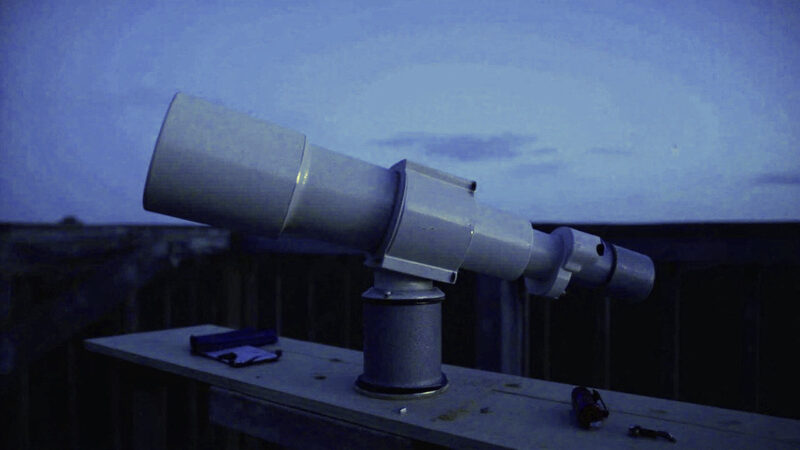
Dobsonian Telescopes for Beginners
A 150 mm Dobsonian with a 1,200 mm focal length gives 48x with a 25 mm eyepiece and 120x with a 10 mm. That mirror collects 459 times the light of a 7 mm pupil. The first decision is which tube you can carry up the stairs.
The hard part is not the optics. A Dobsonian arrives in two heavy pieces. One is a 49 in tube. The other is the base. The number on the box needs checking before you trust it.
A 203 mm mirror lifts the light figure to 841 times. The useful ceiling moves to 406x. A carton that claims 600x on a 1,200 mm tube wants a 2 mm eyepiece. That is below the practical floor, and well past the ceiling.
Start with the aperture. Then let the focal length set the powers. Everything below is arithmetic you can redo on a scrap of paper.
- Aperture
- 150 mm (5.9 in)
- Focal length
- 1,200 mm
- Focal ratio
- f/8
- Light grasp vs a 7 mm pupil
- 459 times
- Dawes limit
- 0.77 arcsec
- Max useful magnification
- 300x
- Exit pupil with a 25 mm eyepiece
- 3.1 mm
- Kit weight
- 40 lb (18 kg): 15 lb tube, 25 lb base
- Focuser
- 2 in rack-and-pinion with a 1.25 in adapter
- Overall length
- 49 in
Reference machine: Sky-Watcher Classic 150 Dobsonian, 150 mm on a 1,200 mm focal length. Weight, focuser and length from the maker listing, checked 2026-11-02. Light grasp, Dawes limit, ceiling and exit pupil are our arithmetic: (aperture ÷ 7 mm)², 116 ÷ aperture, 2 × aperture, and eyepiece ÷ focal ratio.
What a Dobsonian telescope actually is
Three parts do the work. A parabolic primary mirror sits at the bottom of the tube. A flat secondary near the top turns the light 45°. A focuser on the side of the tube holds the eyepiece.
The light turns 90° on the way out. The eyepiece ends up at waist height. It is comfortable to use. It is awkward to point at a small target.
Focal length is measured from the primary mirror to the focus, so a 1,200 mm Dobsonian focuses 1,200 mm behind its mirror. A longer focal length means a longer tube. It also means a narrower field.
The base has two axes. Azimuth turns the whole tube left and right. Altitude tips it up and down. Both are moved by hand: you push the base and you lift the tube. No motor, no tracking, no GoTo in a plain Dobsonian.
The price gap against a refractor is mostly about optical parts. A 150 mm Dobsonian and a 150 mm refractor collect the same light. That is 459 times a 7 mm pupil. The Dobsonian uses one curved mirror and one flat. A refractor uses a lens ground on both sides.
Three costs come with that saving. The mirrors have to stay aligned, so a Dobsonian needs collimation. The tube is long. The 1,200 mm version measures 49 in end to end. The weight arrives in two pieces. On the 150 mm model that is 15 lb of tube. The base adds 25 lb.
The maker listings name Teflon bearings. They also name tension handles. That is how the base holds the balance point of a long tube.
Which size to start with
Five sizes cover the beginner market in the table below. They differ in two ways. One is how much light the mirror collects. The other is how far you have to carry it. Here is what we assume for every number on this page.
Our assumptions: the reference machine is a 150 mm mirror at 1,200 mm. That is f/8. Light grasp is measured against a 7 mm dark-adapted pupil.
The Dawes limit is 116 divided by the aperture in millimetres. The useful ceiling is about 2 times the aperture in millimetres. Magnification is focal length divided by eyepiece focal length. The exit pupil is the eyepiece focal length divided by the focal ratio.
| Model | Aperture | Focal length · f/N | Light grasp | Dawes | Ceiling | Powers · 25 / 10 / 6 mm | Exit pupil, 25 mm | Weight | Fits |
|---|---|---|---|---|---|---|---|---|---|
| Celestron StarSense Explorer 114AZ | 114 mm (4.5 in) | 400 mm · f/3.5 | 265x | 1.02 arcsec | 228x | 16 / 40 / 67x | 7.1 mm | 12.6 lb, 15 x 15 in base | A balcony or a desk |
| Sky-Watcher Heritage 130 | 130 mm (5.1 in) | 650 mm · f/5 | 345x | 0.89 arcsec | 260x | 26 / 65 / 108x | 5.0 mm | 19.2 lb | One hand on the tube |
| Sky-Watcher Virtuoso GTI 150P | 150 mm (5.9 in) | 750 mm · f/5 | 459x | 0.77 arcsec | 300x | 30 / 75 / 125x | 5.0 mm | 25.8 lb, 20 x 20 in | A table, with a phone pointing |
| Sky-Watcher Classic 150P | 150 mm (5.9 in) | 1,200 mm · f/8 | 459x | 0.77 arcsec | 300x | 48 / 120 / 200x | 3.1 mm | 40 lb, 15 lb tube plus 25 lb base | The entry-level solid tube |
| Sky-Watcher Classic 200P | 203 mm (8 in) | 1,200 mm · f/5.9 | 841x | 0.57 arcsec | 406x | 48 / 120 / 200x | 4.2 mm | 45 lb, 20 lb tube plus 25 lb base | A car boot and a dark site |
Read the light column first. Going from 114 mm to 203 mm multiplies the light by 3.2. That is 841 ÷ 265. Going from 150 mm to 203 mm multiplies it by 1.8. That is 841 ÷ 459. That is the ladder from the smallest model to the largest one in the table.
Resolution moves the other way. The Dawes limit falls with the aperture. From 1.02 arcsec at 114 mm to 0.57 arcsec at 203 mm. Resolution is what splits a close pair of stars. Brightness is what makes a faint patch visible at all. A target that is dim but sharp is a light problem. A bright target that is mushy is a seeing problem.
Focal length changes the powers, not the light. A 750 mm tabletop tube and a 1,200 mm solid tube with the same 150 mm mirror collect the same 459 times. The short tube gives a wider exit pupil too. 25 ÷ 5 = 5.0 mm. On f/8 it is 25 ÷ 8 = 3.1 mm.
The exit pupil is the beam that leaves the eyepiece. It should not be much wider than your own pupil. That is why f/5 gives a brighter view than f/8 with the same eyepiece. It is also why the 6 mm step on a 1,200 mm f/8 tube is dim: 6 ÷ 8 = 0.75 mm.
Aperture does not fix everything. A 203 mm mirror and a 150 mm mirror show the same object at the same power. The bigger one shows it brighter. That helps on a faint patch. It helps much less on a bright planet.
Now take the box apart. A 600x claim means a 2 mm eyepiece. Check it: 1,200 ÷ 600 = 2. Two problems. 2 mm is below the 4 mm practical floor for an eyepiece. And 600x is above the 406x ceiling of a 203 mm mirror. Both numbers disqualify the claim. Do the division before you trust a label.
The same test works on any box. Divide the stated focal length by the stated power. That gives the eyepiece they used. If the result is under 4 mm, the claim is not one you can use. If the power is over twice the aperture in millimetres, the number cannot be reached.
Weight comes last in the specs and first in the decision. The 1,200 mm 8-inch Dobsonian weighs 45 lb in two pieces. 20 lb of tube, 25 lb of base. It measures 49 in long. Three flights of stairs change the answer. Take the 6-inch class.
Pick a Dobsonian for where you observe
The same aperture behaves differently depending on where you set it up. Three setups cover most cases.
A balcony or a desk suits a tabletop Dobsonian. The 114 mm Celestron sits on a 15 x 15 in base. It weighs 12.6 lb. At a 400 mm focal length it gives 16x with a 25 mm eyepiece. That is enough for the Moon and for a few bright clusters. Nothing about it needs a car.
A drive to a dark site rewards aperture. The 203 mm Classic 200P collects 841 times the light of a 7 mm pupil. It is the size where a 6 mm eyepiece at 200x is worth the weight. It is 45 lb in two pieces. 20 lb of tube, 25 lb of base.
Staying at home puts a suburban sky against you. At Bortle 6 to 7, the sky is the limit. Not the mirror. A 150 mm at 1,200 mm gives 459 times the light. That is against a 7 mm pupil. A 10 mm eyepiece gives 120x. That is where most faint objects start to fade in a bright sky.
The Bortle scale runs from 1 to 9. It measures how dark the sky is. Our seeing pages work in two bands. Bortle 6 to 7 for a suburban yard. Bortle 3 to 4 for a dark site.
One exception runs through all three. Aperture sets the brightness ceiling. Seeing decides whether you can use the whole aperture, because unsteady air blurs the detail a bigger mirror would otherwise resolve. On a bad night, 120x on a 203 mm beats 300x on the same tube.
The object lists for each aperture sit on our seeing pages: 4 in, 6 in and 8 in. A GoTo or tracking mount is a different class of machine. It changes the size rule. Less glass to carry. More cables and batteries to manage.
How to move, aim and collimate a Dob
Once the tube is out of the box, the base is the part you touch every time. Two axes, both moved by hand, and one rule about where to push.
Push the base, not the focuser. The focuser sticks out at an angle. Pulling on it twists the tube. To turn, push the base around its vertical axis. To raise the tube, hold the tube itself and rock it up.
Finding a target takes three steps. Get the rough direction first, from a coordinate or a chart. Line the finder up with the target. Then look in the main tube and adjust.
Collimation is the part beginners skip, and it decides whether the mirror is sharp. Three checks, in this order.
- Centre the secondary. Look down the open end of the tube. The secondary outline should sit in the middle of the opening.
- Centre the primary. Look at the secondary's reflection in the primary mirror. The circles should look concentric.
- Check the flat. Use a Cheshire, the cap with a hole and a light behind it; the reflection of the primary should be concentric with the secondary outline.
How often depends on two things. Move the scope and the alignment shifts. A temperature change of 5 °C or more shifts it as well. Check after every move. Once a month if the tube lives in a garage or a car.
If the view is soft, check the focus before you blame the mirrors. A 2x Barlow moves the focus point. A 1.25 in eyepiece in a 2 in focuser also sits a little further out. Turn the knob until the image sharpens, then look again.
First accessories
Once the mirrors are aligned, you need three things to find anything: eyepieces, a finder, and a chart.
On a 1,200 mm tube, three eyepieces cover most of the useful range. 25 mm, 10 mm, and 6 mm. Add a finder and a chart. Then you can find things on your own. Everything else can wait for the second season.
The 150 mm and 203 mm listings include a 25 mm and a 10 mm eyepiece. They also include a finder. That covers the 48x and 120x steps from the first night. You still need a 6 mm for the 200x step.
Check the barrel size before you buy. A 1.25 in eyepiece drops into most focusers. A 2 in eyepiece needs a 2 in focuser. The 1.25 in adapter in the box does the opposite.
| Accessory | Why the first night needs it | Key spec | Power band |
|---|---|---|---|
| 25 mm 1.25 in eyepiece | The lowest step that still shows detail | 52° apparent field, 1.25 in barrel | 48x on 1,200 mm, a 1.08° field |
| 10 mm 1.25 in eyepiece | The step you spend most time on | 52° apparent field, 1.25 in barrel | 120x on 1,200 mm, a 0.43° field |
| 6 mm 1.25 in eyepiece | The high-power step for a steady night | 52° apparent field, 0.75 mm exit pupil at f/8 | 200x on 1,200 mm, a 0.26° field |
| Zero-power finder | Points at the sky without magnifying it | Illuminated circles at 4°, 2° and 0.5° | Covers half a 1.08° field at 48x |
| Planisphere star chart | Tells you what is above the horizon | 40° north plate, stars to magnitude 5.5, 7 x 5 in | Sets the target before you move |
The order matters less than the pair. Start with the 25 mm at 48x. The field is 1.08° wide. A target is easy to lose at higher power. That 1.08° comes from the eyepiece: 52° ÷ 48 = 1.08°. The 10 mm at 120x halves it to 0.43°, and the 6 mm at 200x takes it down to 0.26°.
The finder saves the most time on the list. It shows the sky at 1x. Unmagnified and upright. What you see in the window is where the tube points. The Telrad draws three circles: 4°, 2° and 0.5°. The 0.5° circle covers 46% of the height of a 1.08° field at 48x, which makes it a fine aiming mark for a wide field.
Using the finder takes a little practice. Put the 0.5° circle on the target. Use the 2° circle if it is faint. Then swap to the main tube. Look for the same spot near the centre of the field. If the object is not there, the finder is off by the width of the circle you aimed with. That is the whole calibration, and it takes two attempts to learn.
The circles are a measuring tool, not decoration. A 4° circle covers a region eight times wider than the 0.5° circle, so the area inside it is 64 times larger. Count the stars inside the 4° circle. That is a brightness estimate you can check against any chart.
The chart makes the finder usable. A planisphere for 40° north prints stars to magnitude 5.5. The card is 7 x 5 in. You set it to the date and the hour, hold it over your head, and turn it until the horizon on the card matches the horizon in front of you. Everything in the finder window is then a point you can name on the card, and the circles tell you which way to move the tube.
Magnitude 5.5 is the limit of what the printed card shows you. The 1.08° field at 48x covers about 17 times the area of the 0.26° field at 200x. The low-power step is the one that finds things.
Learn the chart before you chase planets. A planet is a moving point with no pattern around it, so the chart gives you nothing to match it against. The stars around it stay put. Know the neighbours and the planet is easy to pick out.
After those three, the rest is optional. A 2x Barlow doubles every power. It turns the 25 mm into a 96x step. Add it once you know which eyepieces you use. Our Barlow guide works through the ratios. Filters and kits come later. A filter or a kit does not repair a misaligned mirror.
Common Questions
Is a Dobsonian a good first telescope?
Conditionally, yes. A Dobsonian gives a lot of aperture for the weight it carries, and no electronics at all. The two costs are real. You carry the tube and the base separately. You align the mirrors. If you can move the pieces and will spend ten minutes on collimation, the aperture is worth more than the convenience. A refractor usually needs neither step, and our telescope types guide compares the two.
What is the difference between a 6-inch and an 8-inch Dobsonian?
Light and resolution. The 150 mm collects 459 times a 7 mm pupil, the 203 mm collects 841 times. That is 1.8 times the light. The Dawes limit drops from 0.77 to 0.57 arcsec. The cost is weight: 40 lb against 45 lb, and 49 in of tube either way.
Is a short focal length better than a long one?
It depends on where you use it. A 750 mm f/5 tabletop is short to carry and gives a 5.0 mm exit pupil with a 25 mm eyepiece. A 1,200 mm f/8 tube gives 48x instead of 30x for the same eyepiece and a 3.1 mm exit pupil. Short means easy to move, long means more power per eyepiece.
How long does collimation take, and how often is it needed?
About five minutes for the three checks: centre the secondary, centre the primary, then check the flat with a Cheshire. Check after every move, and once a month if the tube lives in a temperature swing. A change of 5 °C is enough to move the alignment.
Can a Dobsonian show planets?
Yes, and that is what a 6 mm eyepiece is for. On a 1,200 mm tube the 6 mm gives 200x, which is the working range for belt detail and ring structure on a steady night. The 150 mm and 203 mm pages list what each aperture resolves, and the 8-inch page lists the power steps that reach them.
Should a beginner buy a Dobsonian or a refractor?
A Dobsonian if you want the most light for the weight and will move it in two pieces. A refractor if you want one box, no collimation and a sharp image on any night. The full comparison is in our telescope types guide; the short version is weight and collimation on one side, convenience on the other.
Read next
- Telescope typesDobsonian vs refractor vs Maksutov vs smart
- What you can seePick the page for your aperture
- 8 inWhat an 8-inch telescope shows
- 6 inWhat a 6-inch telescope shows
- 4 inWhat a 4-inch telescope shows
- EyepiecesHow to choose telescope eyepieces
- EyepiecesBarlow lens: 2x vs 3x
- ToolsTelescope magnification calculator
- ToolsEyepiece field of view calculator
Sources
- Formulas used on this page: magnification = focal length ÷ eyepiece, exit pupil = eyepiece ÷ focal ratio, true field = apparent field ÷ magnification, light grasp = (aperture ÷ 7 mm)², Dawes limit = 116 ÷ aperture in mm, useful ceiling = 2 × aperture in mm. How we research.
- Sky-Watcher Classic 150 Dobsonian: 150 mm, 1,200 mm, f/8, 40 lb in two pieces, 2 in focuser, 49 in long. Maker listing and Classic 150P spec page, checked 2026-11-02.
- Sky-Watcher Classic 200 Dobsonian: 203 mm, 1,200 mm, f/5.9, 45 lb in two pieces, 2 in Crayford focuser, 49 in long. Maker listing, checked 2026-11-02.
- Celestron StarSense Explorer 114AZ: 114 mm, 400 mm, f/3.5, 15 x 15 in tabletop base, 12.6 lb. Maker listing and spec page, checked 2026-11-02.
- Sky-Watcher Virtuoso GTI 150P: 150 mm, 750 mm, f/5, 25.8 lb, 20 x 20 in. Maker listing, checked 2026-11-02.
- Sky-Watcher Heritage 130: 130 mm, 650 mm, f/5, 19.2 lb. Maker listing and spec page, checked 2026-11-02.
- Telrad finder: 4°, 2° and 0.5° illuminated circles, 1x view, 9.9 x 6 in. Maker listing, checked 2026-11-02.
- Miller Planisphere 40N/5.5: 40° north plate, stars to magnitude 5.5, 7 x 5 in, one size. Maker listing, checked 2026-11-02.
- Apparent field of a 1.25 in Plössl at about 52°, and the true field that follows from it: How to choose telescope eyepieces.
How we check numbers: How we research.